
Remembering the Ronettes, the Consummate ’60s Girl Group
by Jeff Tamarkin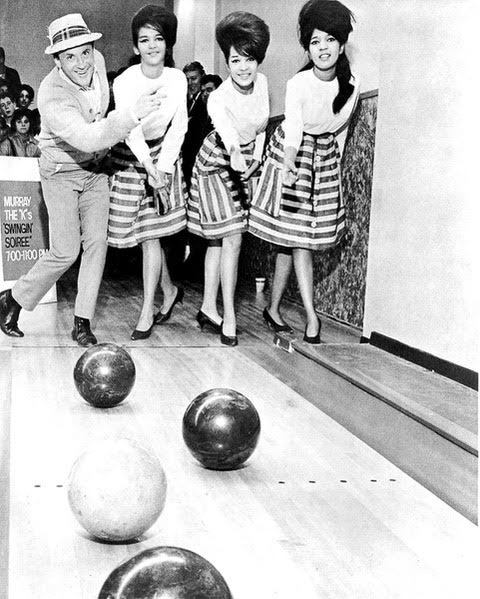
The Ronettes with New York disc jockey Murray the K (Murray Kaufman). From left: Nedra Talley, Ronnie (Bennett) Spector, Estelle Bennett
With the death, on April 26, 2026, of Nedra Talley Ross, the story of the Ronettes—the consummate 1960s “girl group”—comes to a close. Ross, who went by her maiden name of Talley during her time with the trio, was a core member of the group along with her cousins Veronica “Ronnie” Bennett (later Spector) and Estelle Bennett. The Ronettes were best known for their #2 Billboard smash “Be My Baby,” one of several hits produced for the group by Phil Spector, on whose label Philles Records the trio’s recordings were released.
“Be My Baby,” which the late Beach Boys founder Brian Wilson often cited as his all-time favorite single (and an influence on his own group’s sound), was the first hit, arriving in the summer of 1963. It was followed later that year by “Baby, I Love You” (#24) and 1964’s “(The Best Part of) Breakin’ Up” (#39), “Do I Love You” (#34) and “Walking in the Rain” (#23). There were other releases on Philles later, including 1966’s “I Can Hear Music,” later covered by the Beach Boys, but it’s those first several Philles sides that truly defined the group.
The trio were all born in New York City and grew up in the Washington Heights section of Manhattan, where they took in the sounds of rock and roll and R&B music and, in the late 1950s, decided to form their own singing group. Estelle Bennett, the oldest (born July 22, 1941) and her sister Veronica Yvette (born Aug. 10, 1943), were of African American, Cherokee and Irish descent. Joined by Nedra Yvonne Talley (born January 27, 1946), who added Puerto Rican to those ethnic roots, at first they called themselves the Darling Sisters and Ronnie and the Relatives, before changing their name to the Ronettes. The three performed at George Washington High School, which they all attended, and later at the popular Manhattan dance club the Peppermint Lounge, where they had a regular residency.
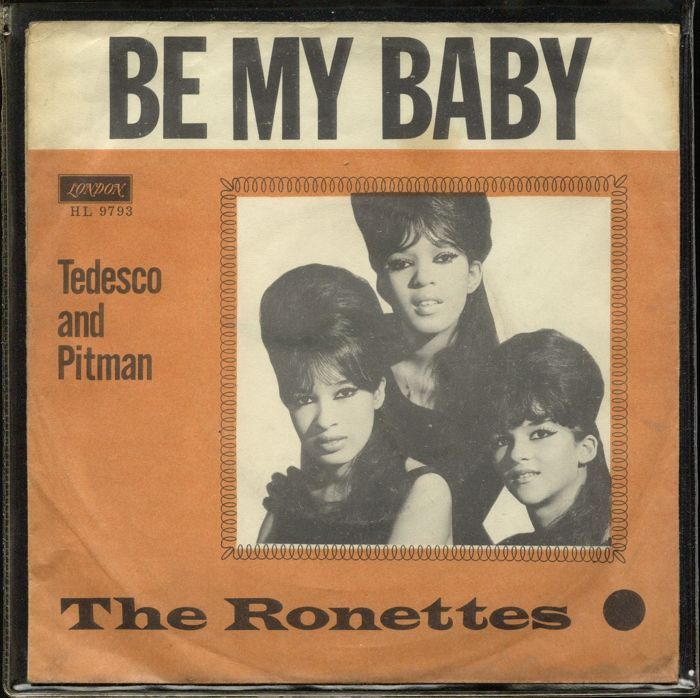
With their mile-high bouffant hairdos and heavy eye makeup (Estelle had a job at Macy’s in the cosmetics department), they stood out, and by the early ’60s they’d cultivated a sizable following. Among those who championed the group early on was the influential New York disc jockey Murray “The K” Kaufman, who featured them regularly on the semi-annual multi-artist concerts he hosted at the Brooklyn Fox Theatre, often referring to them as “Murray the K’s dancing girls.”
After a few failed recordings for the Colpix label, the Ronettes sought a new recording deal, and on a whim Estelle Bennett contacted Phil Spector, already riding high on the charts with hit singles by the Crystals, another all-female group. When Spector auditioned the group and heard Ronnie Bennett’s voice (on a cover of her hero Frankie Lymon’s “Why Do Fools Fall in Love”), he proclaimed it “the sound I’ve been looking for” and signed the trio to his label. “Be My Baby,” featuring Spector’s “Wall of Sound” production, was co-written by Jeff Barry, Ellie Greenwich and Spector, and featured the Los Angeles studio group later known as the Wrecking Crew, with Hal Blaine supplying the pounding opening drums. (Trivia note: Only Ronnie from the group appears on the recording.)
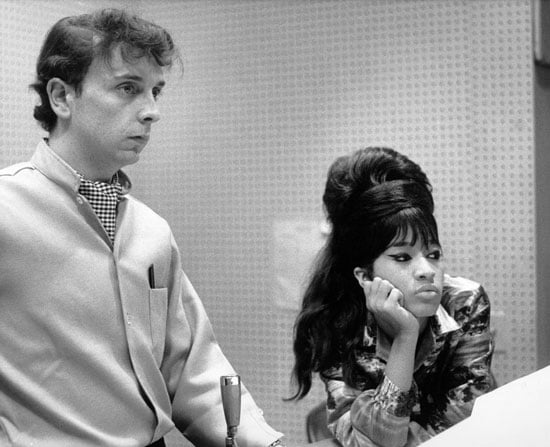
Phil Spector and the former Ronnie Bennett in 1963 (Photo via Ronnie Spector’s Facebook page)
The Ronettes quickly became a national sensation and unlike many American groups, did not initially suffer a downfall when the British Invasion arrived in early 1964: They opened shows for the Beatles and the lesser-known Rolling Stones opened for them, and the Ronettes appeared in the Spector-produced concert film The Big TNT Show. Gradually, their prominence slipped, and in the meantime, Ronnie Bennett and Spector became romantically involved. The domineering producer insisted that she leave the group, and Ronnie was replaced on the road by another cousin, named Elaine (who had sung in the pre-fame years with the others). The Ronettes toured without their lead singer, with audiences often unaware that they were watching someone else. (Photos of the period show Nedra singing lead.)
By 1967 the group had begun to fall apart and with Ronnie’s 1968 marriage to Phil Spector, it was all over. What fans did not know was that Ronnie Spector—as she became known—was treated from the start as a virtual prisoner by her abusive husband, the harrowing story of which she later told in her memoir, Be My Baby: How I Survived Mascara, Miniskirts, and Madness, Or, My Life as a Fabulous Ronette. Ronnie left Phil in 1972, fleeing their home without any of her possessions, and their divorce was granted in 1974. She re-formed the Ronettes for a time, but success evaded them this time and Ronnie went off on a solo career that lasted until her 2022 death at age 78. Her influence, on rockers including Bruce Springsteen, Billy Joel and the Ramones (who covered the Ronettes’ “Baby, I Love You” on their 1980 Phil Spector-produced End of the Century album), kept her in the public eye long after the dissolution of the Ronettes and her marriage to Spector.
Related: Tributes poured in following the death of Ronnie Spector
As for the others, Estelle Bennett carried on as a singer for a while, recording under her own name and forming a group, the Love Chain, in the late ’60s, but she was unable to find success and left the music business. She experienced mental health issues and homelessness and died in 2009 at age 67. Talley Ross, meanwhile, became a born-again Christian after leaving the Ronettes, and began recording Christian music in the late ’70s.
The Ronettes—all three of whom were in attendance to accept the award—were inducted into the Rock & Roll Hall of Fame in 2007, with superfan Keith Richards giving their induction speech. “They touched my heart right then and there,” he said, “and they touch it still.”
Watch the Ronettes accept at their Rock & Roll Hall of Fame induction
Their recordings are available in the U.S. here, in Canada here and in the U.K. here.




3 Comments so far
Jump into a conversationThe Ladies were great.
Another sad loss of an iconic group member. The 60s are quickly receding into the history books as another generation departs.
Excellent article, Jeff. And let’s not forget her great performance on Eddie Money’s 1986 hit Take Me Home Tonight (Be My Baby). Still love that song. Cheers.