
A New Book Ponders ‘How Bob Dylan and the Beatles Changed Each Other—And the World’
by Brad Auerbach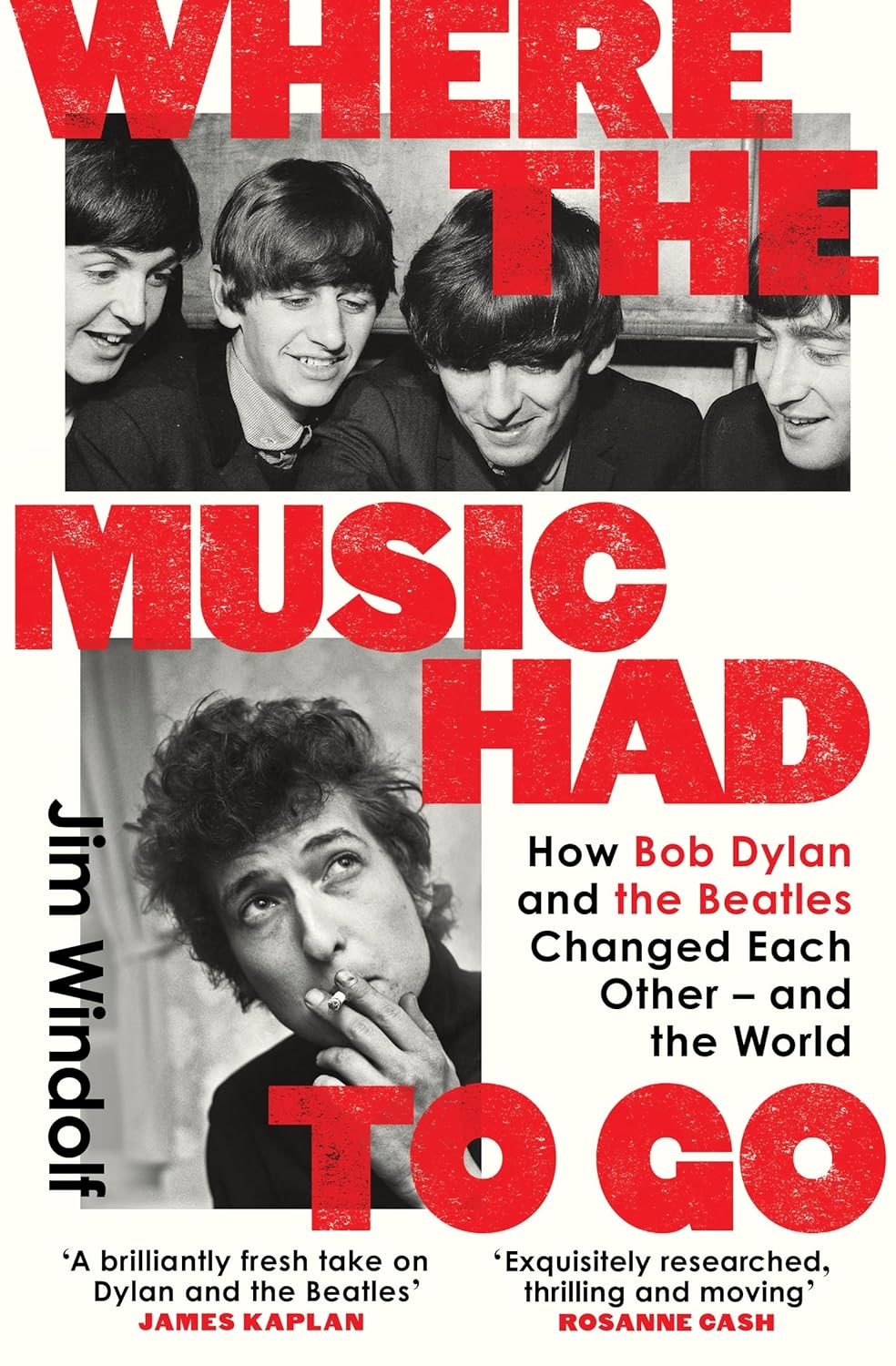
The cover art for the U.K. edition of Where the Music Had to Go: How Bob Dylan Changed Each Other—And the World.
Bookshelves groan happily from the weight of books about (and by) the two most influential artists of the last half century. Bob Dylan and the Beatles are on everyone’s Mt. Rushmore. Arguing about who else should be there is for another time.
Jim Windolf told me that the inspiration for his book, Where the Music Had to Go: How Bob Dylan Changed Each Other—And the World, was the discrepancies he came across in prior reports about the interactions and interconnections between the Beatles and Dylan. “I noticed holes,” is how the author described it. He did not realize it would become a book. He set out to settle the basic facts, and Windolf accomplishes that task with style. The references go on for pages; the author clearly explored almost every rabbit hole. In a strategy befitting the New York Times reporter he is, Windolf delivers a synthesis of the available literature, buttressed by first-person conversations. Indeed, the transcript of a recent conversation with Paul McCartney reveals surprises, even for Sir Paul.
[The hardcover edition of the book arrived on April 14, 2026, by Scribner. It’s available to order in the U.S. here, in Canada here and in the U.K. here.]
As the chapters unfold, we discover what Windolf calls “a reciprocal influence.” Windolf does a deft job tracing the post-WWII influences of two seen-many-better days cities and their most famous sons. The dusty streets of Hibbing, Minnesota, and Liverpool at the right time left five boys who changed pretty much everything about modern music. Initially coy about each other, Dylan and the Beatles soon evolved into fans and members of mutual appreciation societies.
On the eve of their first trip to perform in the U.S., the Beatles dissected Dylan’s first two albums in Paris during a series of shows there. Oddly not discussed more deeply by Windolf was the aftermath of JFK’s assassination in November 1963; by the time of the Beatles’ February 1964 appearance on TV’s Ed Sullivan Show, much of America was ready to end their mourning of the fallen President.
Given the voluminous research available on the day-to-day movements of Dylan and the Beatles, the author is able to describe how their paths almost intersect (occasionally playing gigs a hundred miles apart in their early days). Especially effective are the descriptions of February 1964 with the Beatles moving from New York City to Washington, D.C., and back while Dylan is on a cross-country road trip. By the time Dylan reaches Santa Monica for a critical show at the Civic Auditorium, he is pushing coins into a jukebox to hear the Liverpudlians’ latest singles repeatedly.
We all know by now that Dylan introduced marijuana to the Beatles. Here Windolf parses the before, during and after with aplomb.
A particularly great observation: By the end of 1964, the Beatles no longer had to stomp their feet to command the attention of the crowd. The context had changed. With screaming girls serving as their shock troops, and journalists taking the role of their communications operation, they had achieved real cultural power. The question now was, what would they do with it?
Another great comparison: The Beatles’ “Nowhere Man” and Dylan’s “Ballad of a Thin Man” have the same subject: a conventional man who’s ill-equipped to understand the changing world around him. Dylan sings, “Something is happening here, but you don’t know what it is, do you, Mr. Jones?” John Lennon hits on the same thing with the line, “Nowhere Man, you don’t know what you’re missing.”
Windolf dissects the doomed encounter between Dylan and Lennon in the backseat of the former’s limo at 7 a.m., tooling through the streets of London in 1966. Dylan is overseeing the production of a documentary about him. Dylan clearly wants to get Lennon to admit his “Norwegian Wood” was inspired by Dylan. Lennon had referred to Dylan’s “Fourth Time Around” as seeming to belong to the Beatles’ publishing company. The sequence was cut from Eat the Document, directed by D.A. Pennebaker (and partially edited by Dylan himself). Windolf has seen the full car sequence, and it is a fascinating account. As the two lyrical architects jab each other, Dylan feels the ill effects of an unknown drug and longs for home. The description seems more accurate than the Woodstock motorcycle accident in terms of Dylan’s brush with death.
Windolf points out that the motorcycle accident happened on the same day DJs in Alabama took offense to Lennon’s misinterpreted remark about the Beatles being bigger than Jesus Christ. Bonfires burning their records followed, with the KKK torching records along with a burning cross. A day later a lightning bolt struck the radio station that sponsored the bonfire.
In August 1966 in San Francisco, the Beatles’ last American show ended as it had the day Lennon and McCartney met—with a Little Richard song.
By 1967, Dylan was woodshedding with The Band, making music about a seemingly lost America, and the Beatles were doing likewise about lost days in Liverpool. The latter resulted in “Strawberry Fields Forever” and “Penny Lane,” perhaps the strongest single ever released. Dylan’s woodshedding over time would forever change the course of music. Americana would not be a label for decades, but endless musicians (including Eric Clapton and George Harrison) would point to the basement tapes recorded by Dylan and The Band in that pink house as seminal. Without realizing what the other was doing, Dylan and the Beatles were making music unlike anyone else, which “seemed to exist out of time.” In 2025, the author also notes, McCartney called The Band’s Music from Big Pink one of his three favorite albums of all time.
The interconnections continued. During the seemingly endless Get Back sessions, the Beatles jammed on myriad cover versions; the book lists the artists covered, with Dylan on top.
My favorite discovery in the book? When Elliott Landy shot the timeless album cover of Dylan’s marvelous Nashville Skyline, it was Dylan tipping his hat to Harrison, holding the guitar Harrison gave Dylan.
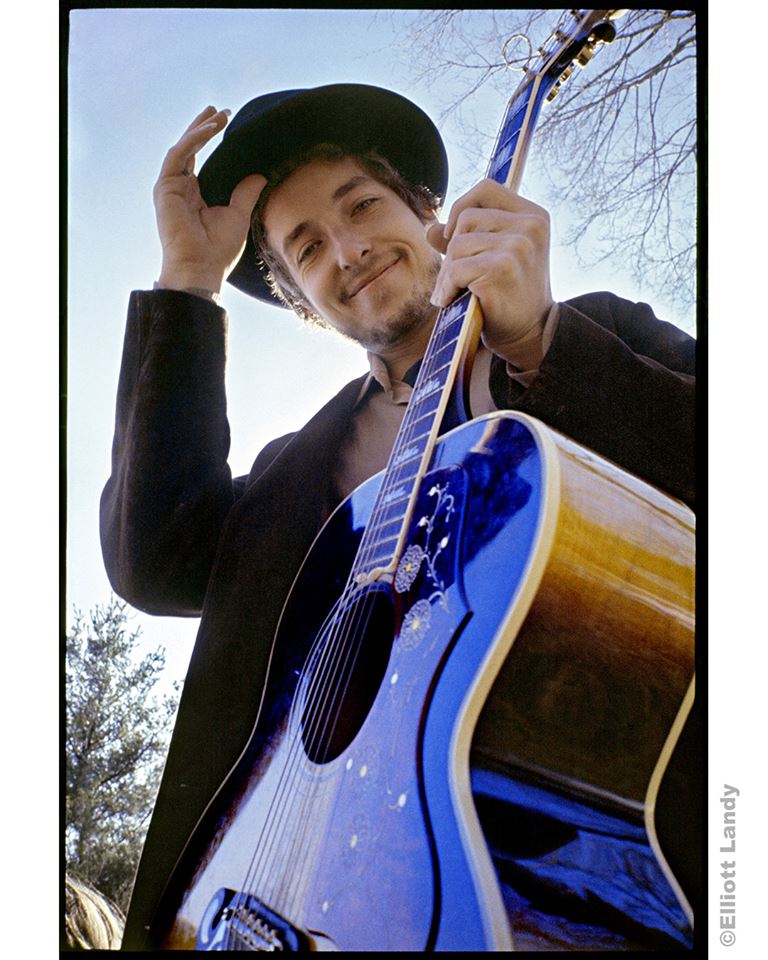
(Photo © Elliott Landy; LandyVision, Inc.; used with permission)
The book wraps up nicely, referencing the Traveling Wilburys and the several songs the surviving Beatles wrote about John. The most poignant reference to John is the song Dylan has only performed twice, “Roll on John.”
Even the casual fan will find much to like in this excellent book. Longtime fans will marvel at the interconnections, many we’ve hardly ever heard of.




1 Comment so far
Jump into a conversationI’ve read many books separately about the Beatles and Dylan but found this one to be so unique and interesting particularly as it relates to them essentially competing against each other while still maintaining a close connection.
I have to admit I thought I knew all there was to know about them. I was wrong.
A terrific read.