
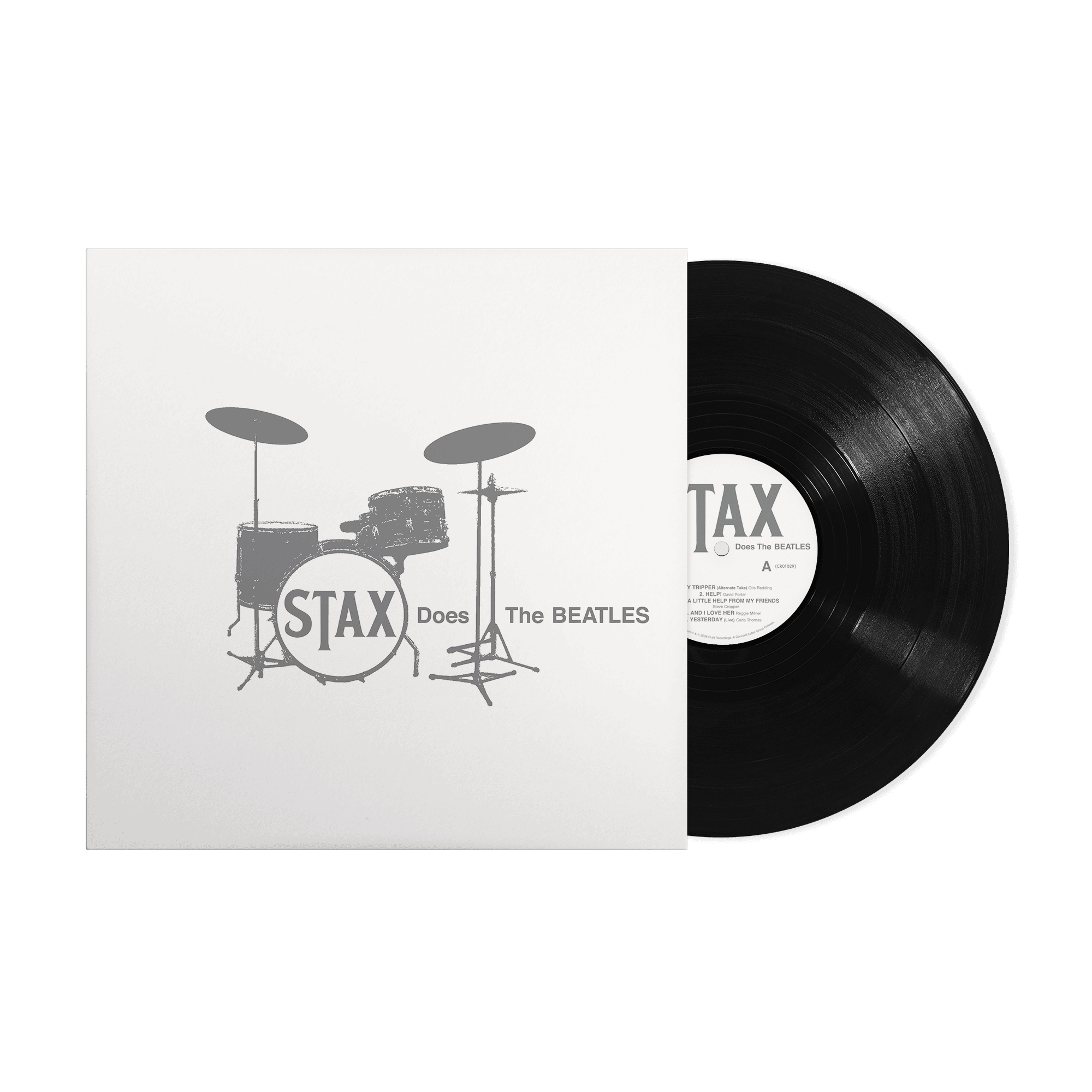
 Stax Records and Craft Recordings have announced a long-awaited vinyl reissue of the compilation album Stax Does the Beatles. Released in 2007 on the influential Memphis soul label, Stax Does the Beatles, due June 26, 2026, boasts members of the iconic label’s roster putting their indelible touch on Beatles classics. Among the highlights: Otis Redding’s exhilarating take on “Day Tripper,” Isaac Hayes’ epic (at 11-plus minutes), heart-tugging version of “Something,” Carla Thomas’ live, velvety interpretation of “Yesterday” and Steve Cropper’s upbeat, brass-laden adaptation of “With a Little Help from My Friends.”
Now available for pre-order in the U.S. here, in Canada here and in the U.K. here, Stax Does the Beatles returns to vinyl for the first time since its limited Record Store Day 2019 exclusive pressing. This newly curated edition distills highlights from the original CD release by Stax luminaries into a streamlined single LP, offering a focused listening experience. The standard pressing of Stax Does the Beatles is pressed on black vinyl, while fans can also find exclusive variant drops: a rich Translucent Ruby (Barnes & Noble exclusive), sunny Eggdrop Yellow (indie retail exclusive) and Silver Smoke (Stax Records/Craft Recordings exclusive).
From the mid-1960s onward, Stax artists had begun covering Beatles tracks for the label, with their output peaking toward the late 1960s and early 1970s. This eight-track LP includes vocal and instrumental performances alike from legendary Stax Records artists, who imbue the Beatles’ catalog with a rousing mix of soul, funk, and R&B.
The album also contains a funk-soul rebirth of “Eleanor Rigby” from Booker T. and the M.G.’s. “I was moved by the Beatles,” Booker T. Jones said in the book Stax: Soulsville, U.S.A. “I thought they were doing really great things. Their records didn’t sound alike ever.”
The feeling was mutual. The Beatles’ appreciation of Stax, which was founded nearly 70 years ago, is storied. In particular, an unearthed 1966 letter from the late George Harrison revealed that the Beatles once hoped to recruit Stax co-founder and producer Jim Stewart to help them record Revolver at Stax Studios. During 1965, Paul McCartney also suggested to Brian Epstein, manager of the Beatles, that he also wanted the band to record at Stax. Epstein had legitimate concerns about security issues and protecting his popular group away from the confines of Abbey Road in England.
McCartney enthused years later about Stax, “The only reason you want to record in those kinds of studios is because you love the records that come out of the studios.”
Stax Records, now owned by Concord, was founded by Jim Stewart in 1957 in Memphis, Tenn. It rose from a small, family-operated company to become one of the most influential record labels in the world, helping to create “The Memphis Sound” and launching the careers of such great artists as Otis Redding, Isaac Hayes, Booker T. and the M.G.’s, the Staple Singers, Sam and Dave, Rufus and Carla Thomas, the Bar-Kays, and dozens of others. In all, Stax placed 167 hit songs in the Top 100 in pop and 243 hits in the Top 100 in R&B.
Related: Our feature on Isaac Hayes
In my recently published Screen Gems: Pop Music Documentaries & Rock and Roll TV Scenes, I devote a chapter to Stax. The following quotes appear in the book.
Wayne Jackson was an R&B musician who played trumpet in the Mar-Keys and in the studio house band at Stax Records. Later, he was a member of the Memphis Horns. In 2007, I asked him about the label and some of the recording artists he knew and was in the studio with.
“You can tell the horn sound,” said Jackson. “Me, Andrew Love and Floyd Newman sound a certain way. All those records had that in common. All those records had Steve Cropper’s guitar, Al Jackson’s drums, Duck Dunn’s bass and Booker’s organ. Those things are very distinctive and that made up Stax sounds. And that’s where Otis came from.
“I loved Otis and he loved me,” Jackson continued. “We were big friends, ’cause we all liked to laugh, and we were all young and the testosterone levels were out of this world. That’s what you heard in that music. Al Jackson was a joy to watch. He was the most fun drummer I ever was around. He was just the best drummer you ever heard and the best drummer you ever saw. He was a great musician.
“Musicians are not in competition. No one in that band was in competition. We were one thing. We were there to support and glorify Otis Redding. And we did that. Whether it be Otis, Eddie Floyd or Sam and Dave, we did that. That was our job and we loved it and did it good. Everybody in that band had his position. Like Duck Dunn. Have you ever seen anybody work that hard on bass? It makes my hands cramp up.
“When I was with Otis, he was on another energy track. Otis was like a 16-year-old boy with a hard on all the time.
“Otis always brought a great contribution to all the sessions he was on. He was educated. Steve Cropper invented a style of guitar where the little guitar parts were singular. He played licks that became part of the song. The horns were part of the song. Without us they would not have been the same.”
During 2007, I also spoke with Stax mainstay, guitarist/songwriter and producer Steve Cropper.
“I don’t think there ever was or ever will be a band that had the magnetism that Booker T. and the MG’s had,” he said, “whether they backed somebody or played on their own. In our high school days and upbringing, we had that band mentality thing ’cause we worked as a unit. Because if some guy wants to go out there and ego on stage, he’s gonna blow it for everybody else. We learned to play as a unit in the studio. We were there not for ourselves but for the artist we were playing behind. In the studio when I was writing songs and starting to record them, I always saw it in my head as a finished product. I knew where to go with it.
“Al Jackson, Booker, Duck and I grew up playing nightclubs in Memphis. Wayne Jackson grew up that way. You have to play as a unit. Playing live, like at Monterey Pop, if a vocalist is not there, I’m playing vocal parts. when a vocalist is there, I back off and play rhythm and fills.”
Oscar-winning documentarian Morgan Neville, in 2007, directed and produced a terrific deep-dive exploration of the Stax world in his Respect Yourself: The Stax Records Story, which I discuss in my 2021 book, Docs That Rock, Music That Matters.
“It has a link to my Brill Building documentary in the sense that Stax Records was about opening a studio in South Memphis and letting the kids in the neighborhood like David Porter, Isaac Hayes and Booker T. Jones come in and make music. Young people could come and do the best creative work they were capable of. They were challenged and they rose to that challenge.
“I really think Stax is one of the rare stories where the music is as amazing as the story. Everything about Stax is a big story with big characters, and, it’s about race in America in the ’60s and ’70s. But the music is freaking good! If I’m picking music, I’ll pick Stax over Motown any day!”
Author and music journalist Harvey Kubernik’s books are available in the U.S. here, in Canada here and in the U.K. here.
Stax Does the Beatles Track List
Side A
1. Day Tripper (Alternative)—Otis Redding
2. Help—David Porter
3. With a Little Help from My Friends—Steve Cropper
4. And I Love Her—Reggie Milner
5. Yesterday (Live)—Carla Thomas
Side B
1. Something—Isaac Hayes
2. Eleanor Rigby—Booker T. and the M.G.’s
3. Hey Jude—The Bar-Kays




No Comments so far
Jump into a conversationNo Comments Yet!
You can be the one to start a conversation.