
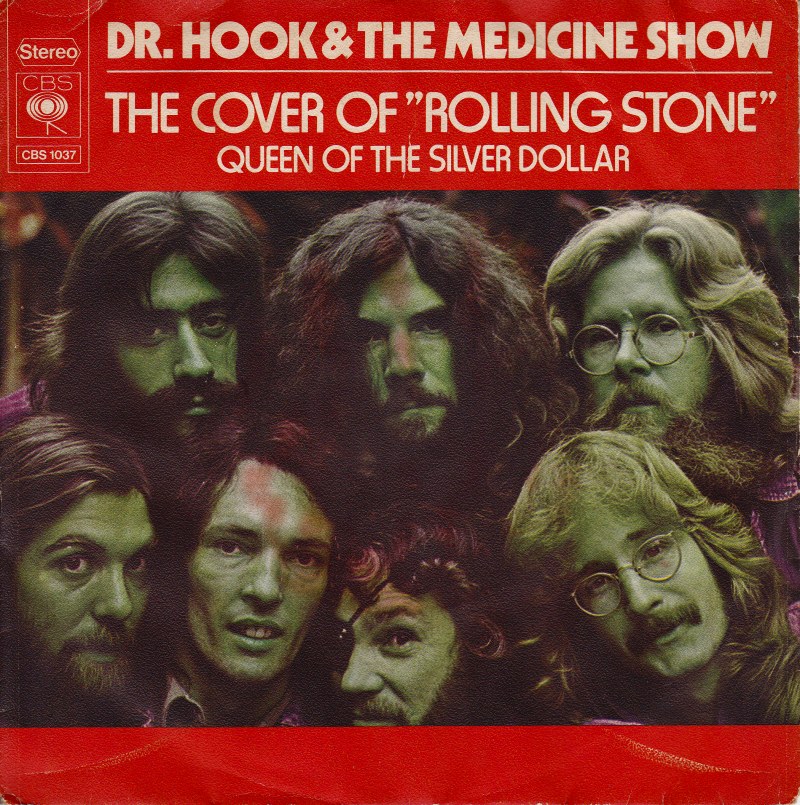
 Dennis Locorriere, a co-founder and frontman of the 1970s band Dr. Hook, died yesterday (May 16, 2026). The cause, confirmed by his management, was kidney disease. No location was cited, although Locorriere had been living in the U.K. for more than two decades at the time of his death. Locorriere—who shared lead vocal duties in the band during its heyday with Ray Sawyer, who died in 2019—was 76.
Although best known for their 1972-73 hit “The Cover of ‘Rolling Stone,’” which reached #6 on the Billboard Hot 100, Dr. Hook—originally called Dr. Hook and the Medicine Show from its 1969 founding until 1975—actually placed six singles in the Top 10, beginning with 1972’s “Sylvia’s Mother” and ending with 1980’s “Sexy Eyes.” Both of those songs peaked at #5, while “Only Sixteen,” “Sharing the Night Together” and “When You’re in Love With a Beautiful Woman” all reached #6. The group also placed 11 albums on the Billboard LPs chart.
Dr. Hook’s roots stretched back to a Southern band formed in 1967 called the Chocolate Papers, which had some success touring but not on disc. After that act fizzled, two of its members, George Cummings and Sawyer, relocated to Union City, N.J., just 15 minutes outside of Manhattan, and recruited bassist and singer Locorriere, who was born in that city on June 13, 1949. Billy Francis, another ex-Chocolate Paper, rejoined the group, a couple of other musicians were added and they were soon on their way.
Not much happened with the band—which took on the Dr. Hook and the Medicine Show moniker due to Sawyer’s eye patch—until 1970, when it was tapped to cut the soundtrack music for a new Dustin Hoffman flick called Who Is Harry Kellerman and Why Is He Saying Those Terrible Things About Me?, which featured songs written by poet/cartoonist Shel Silverstein. The film, which included Dr. Hook performing the song “Bunky and Lucille” onscreen, was a bust, but it brought Dr. Hook to the attention of Columbia Records, which signed them to a contract.
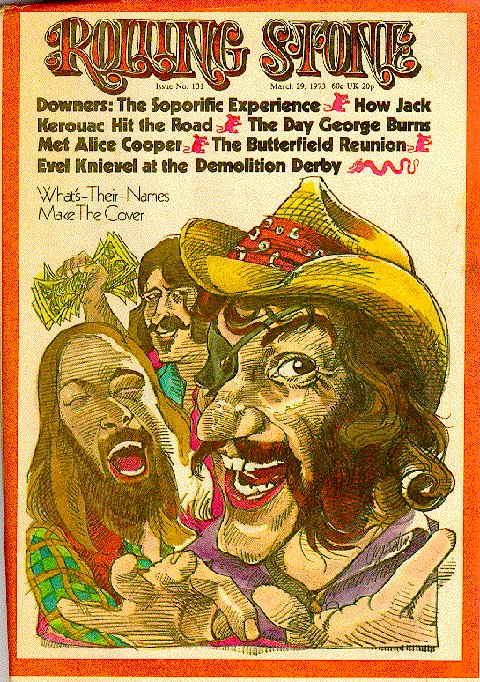
Dr. Hook on “the cover of the Rolling Stone“
They hit pay dirt pretty quickly with “Sylvia’s Mother,” a song penned by Silverstein, who wrote all of the songs on the group’s self-titled 1971 debut album. The album stalled at #45 and the band knew that if it had any hope of continuing its run, and being taken seriously in the post-AM radio rock world, it had to do something to get the attention of record buyers. As Dr. Hook prepared its second album—also written entirely by Silverstein—it became obvious which song was the standout: “The Cover of ‘Rolling Stone.’”
Rolling Stone magazine was only five years old in 1972, but it had already become a very big deal in the counterculture. Coverage by the magazine could boost a band’s career while being ignored or shunned would paint a rock band as too unhip for consideration. “The Cover of ‘Rolling Stone,’” with lead vocals by Sawyer, wasn’t quite serious but neither was it parody. Columbia Records had argued with the band about some of the lyrical content—“We take all kinds of pills that give us all kind of thrills” and “I got a freaky ole lady name a cocaine Katy”—but the song was released as a single nonetheless, and on December 2, 1972, it had begun its climb, peaking at #6 in Billboard on March 17, 1973, 15 weeks later. The gamble had paid off: Dr. Hook had staying power.
Watch them perform the song in 1973 on The Midnight Special
While the song was ascending the singles chart, the group’s manager, Ron Haffkine, met with Rolling Stone’s editor and publisher, Jann Wenner, convincing him that the band was basically providing a radio commercial for his magazine. Wenner was persuaded, and sent young reporter Cameron Crowe to interview Dr. Hook and the Medicine Show. Issue #131 of Rolling Stone, published March 29, 1973, featured the “Cover of ‘Rolling Stone’” band on the cover of Rolling Stone. If you look carefully at the image, you’ll note that although Wenner put them on the cover, he avoided mentioning them by name.

Dennis Locorriere (Photo from the Dr. Hook website)
Following the band’s chart run, which ended in 1982, Locorriere retained the Dr. Hook name and continued to tour well into the current century. He also concentrated on his songwriting. According to his Wikipedia entry, his songs have been recorded by Bob Dylan, Crystal Gayle, B.J. Thomas, Helen Reddy, Willie Nelson, Southside Johnny, Olivia Newton-John and Jerry Lee Lewis. He also contributed vocals to recordings by others, including country singer Randy Travis.
Locorriere released three studio solo albums—Out of the Dark (2000), One of the Lucky Ones (2005) and Post Cool (2010)—as well as live albums and compilations. Various Dr. Hook hits collections are available here.
Related: Musician deaths of 2026






5 Comments so far
Jump into a conversationRoland the roadie loves Gertrude the Groupie, But Gertrude groupie loves Groups.
Rest in Peace Dennis.
We love you❤️
Thanks for this article.
I hadn’t thought of or heard the memorable Sylvia’s Mother since it was in rotation on the radio! Will now have to go back and take a listen.
Saw Dr Hook in Australia some years ago. He was very gracious in signing the album and with having a photo taken. A gentleman to those who chatted with him.
He was amazing, I absolutely adored Dennis Locorriere, saw Dr Hook twice in london and twice in Glasgow, also met him. An absolute gentleman, and will be so missed
Yes, sad about this. They did something unusual which worked. They changed their sound to more soft rock and they were really good at it Dennis was a good singer and songwriter.