
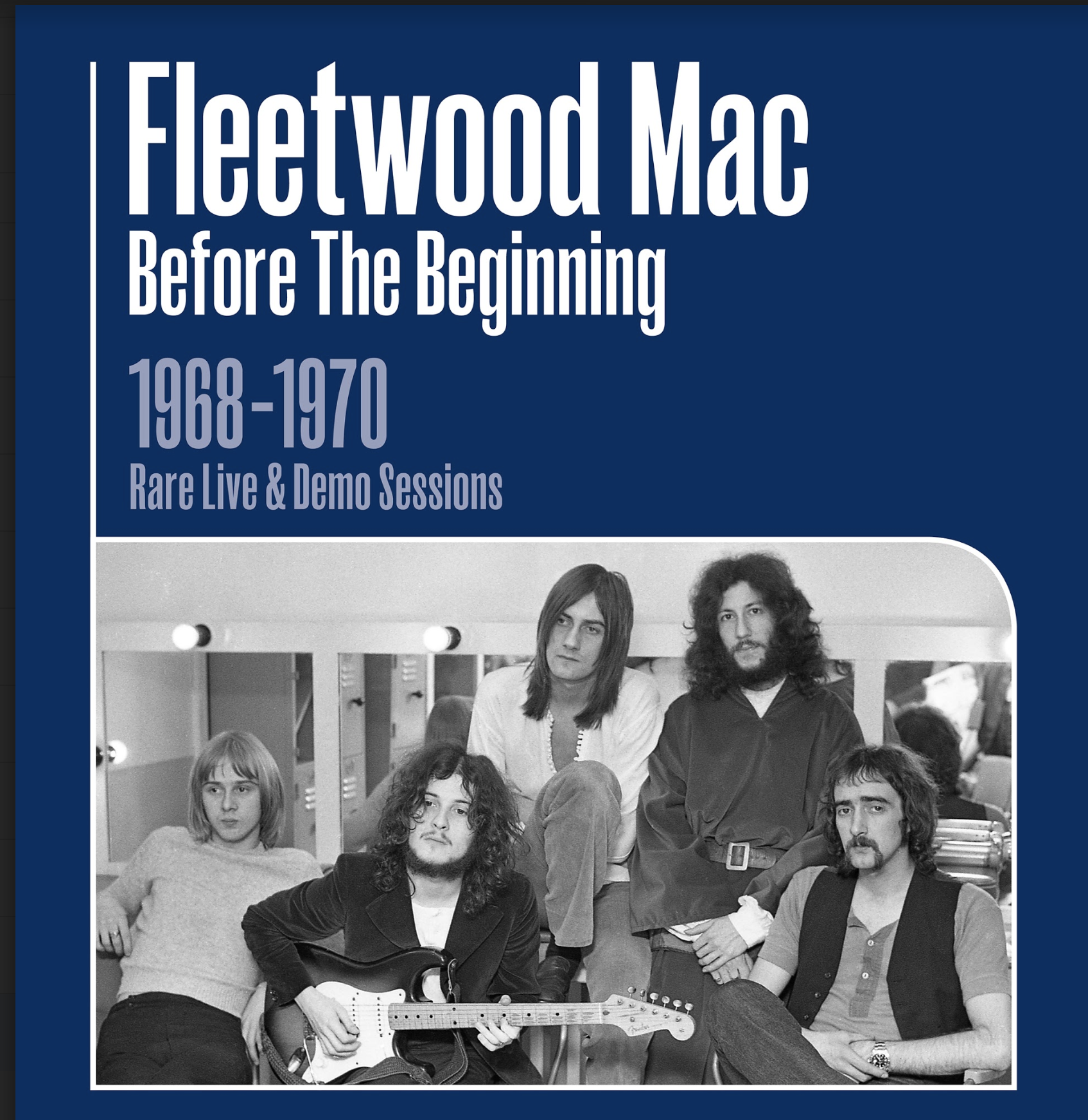
This collection of early Fleetwood Mac recordings was released in 2019.
Prior to becoming the dynamic, Southern California pop-rock juggernaut of the mid-’70s, Fleetwood Mac was a completely different beast—far more raw, unpredictable, and deeply rooted in the blues. The band was conceptualized and founded in 1967 by guitar deity Peter Green, who named the group in honor of the powerhouse rhythm section he brought with him from John Mayall’s Bluesbreakers: drummer Mick Fleetwood and bassist John McVie. In this brilliant early incarnation, the band’s identity was entirely anchored by Green’s stunning, soulful, and self-critical guitar work.
The first edition of the band was not (just) about the blues. Green made his case with fluid, delicate, raw emotion on classics such as “Albatross” and “Man of the World,” while…next to him, slide guitarist Jeremy Spencer lent it all a dirtier, more traditional sound. Then along came Danny Kirwan and the songs opened up to new melodic possibilities.
It was a brief stability. By 1970, Green had left, and Fleetwood Mac was changing members and styles, slowly progressing from blues toward what was surprisingly commercial music with pop sensibilities. But long before the arrival of Lindsey Buckingham and Stevie Nicks—and the significant shift of the band‘s persona as the calendar turned to 1975—Fleetwood Mac defined late ’60s British blues.
New musicians came and went. Among them were keyboardist/vocalist Christine McVie (John’s wife, original name Christine Perfect), who would become a fixture of the band during its most successful period, and Bob Welch, an American singer-songwriter, who stayed with the band from 1971-74 before moving on to a successful solo career.
“Albatross” (1968)
This delicate instrumental, built of epic guitar lines and very slow, tide-like rhythm, captures Green at his most restrained. The track, the band‘s only #1 single in the U.K., subtly changed their impact and influenced a whole generation of British guitarists.
“Black Magic Woman” (1968)
Two years before Santana made it big worldwide, Green, McVie and Fleetwood earned a modest U.K. hit with this early single. Green‘s vocal and stinging guitar led the mysterious, seductive song, woven over an elusive rhythm. It’s a fine example of his superb style at just 21 years of age.
“Shake Your Moneymaker” (1968)
This lively version (is there any other kind?) of the 1961 Elmore James song was buried as the fifth track (of six) on side one of the group’s debut album. From the sound of things, it appears that a good time was had by all during the recording process.
“Need Your Love So Bad” (1968)
This blues cover of the 1955 Little Willie John song features a member of the band Chicken Shack—John McVie’s wife, Christine—who appeared as a session keyboardist on several Mac tracks before joining the band full-time in 1970. The non-album track was released as a single, reaching #31 in the U.K. and later appeared on several compilation albums.
“Stop Messin’ Round” (1968)
A lean, high-velocity shuffle and a perfect showcase for the band in its rawest early form. The tidy and percussive guitar leads the way into a glorious, full-tilt blues stomp, heralding Green as one of the tightest and most economical blues guitarists out there. A perfect sonic shot of adrenalized energy.
“Man of the World” (1969)
Green’s fragile vocals are complemented by sparse instrumentation that leaves each word exposed, and it stands as one of the most affecting of his career. It is profoundly personal, conveying his lonely state-of-mind. Decades later, Fleetwood told Rolling Stone, “We had no idea that he was suffering internally as much as he was.” It all added up to becoming a popular hit in the U.K., reaching #2 there.
“Oh Well (Part 1)” (1969)
Another big U.K. single (#2) was also the band’s first to chart on the Billboard Hot 100, reaching a modest #55. (They wouldn’t return to the U.S. singles chart until 1975 with the beginning of the band’s significant run with Lindsey Buckingham and Stevie Nicks.) The classic track—it’s been a frequent cover—begins strongly and maintains a relentless intensity. The delivery of pure acoustic blues breaks down to meet jagged electric riffs and Green sets off on one of his most assertive and straightforward efforts.
“The Green Manalishi (With the Two Prong Crown)” (1970)
Green‘s last masterpiece with the band was written in time of severe mental anguish. “The Green Manalishi” is said to symbolize his freaky visions of “money dog” and his fight against the increasing riches (greed and control) of the band’s other members. A #10 success in the U.K., it is often regarded as a heavy metal blueprint. Judas Priest recorded a cover version of it in the late 1970s, which helped the “grinding riff” reach a far larger American audience.
“Rattlesnake Shake” (1969)
Kirwan‘s presence added a greater depth as a guitar duo. The serious/aggressive sound became a staple of their shows, usually running from 15–20 minutes. Fleetwood has acknowledged that he’s the subject of the Green composition as an homage to male masturbation. In fact, he’s named in the lyrics: “I know this guy, his name is Mick, now he don’t care when he ain’t got no chick. He do the shake and jerks away the blues.”
“Love That Burns” (1968)
This song is proof that sometimes the less you play, the more you can convey. It never gained much traction in America. The vocals have a mournful quality, elevated by an atmospheric, almost cinematic, horns and piano-filled production that makes up much of the instrumentation.
“Coming Your Way” (1969)
This track, the leadoff number from their third album, Then Play On, is a reflection of the complex, double percussion groove that would become typical of the Kirwan years. It displays his “brighter, more melodic sensibility” by combining his vibrato with a new, folk-rock-oriented sound. The song is of a time when the band was still rooted in blues, but starting to surround itself with the experimental blues-rock of the early ’70s.
Green departed the band in 1970. It took years—he was diagnosed with schizophrenia and underwent shock therapy—but he eventually emerged and found his musical footing and was still performing in 2018.
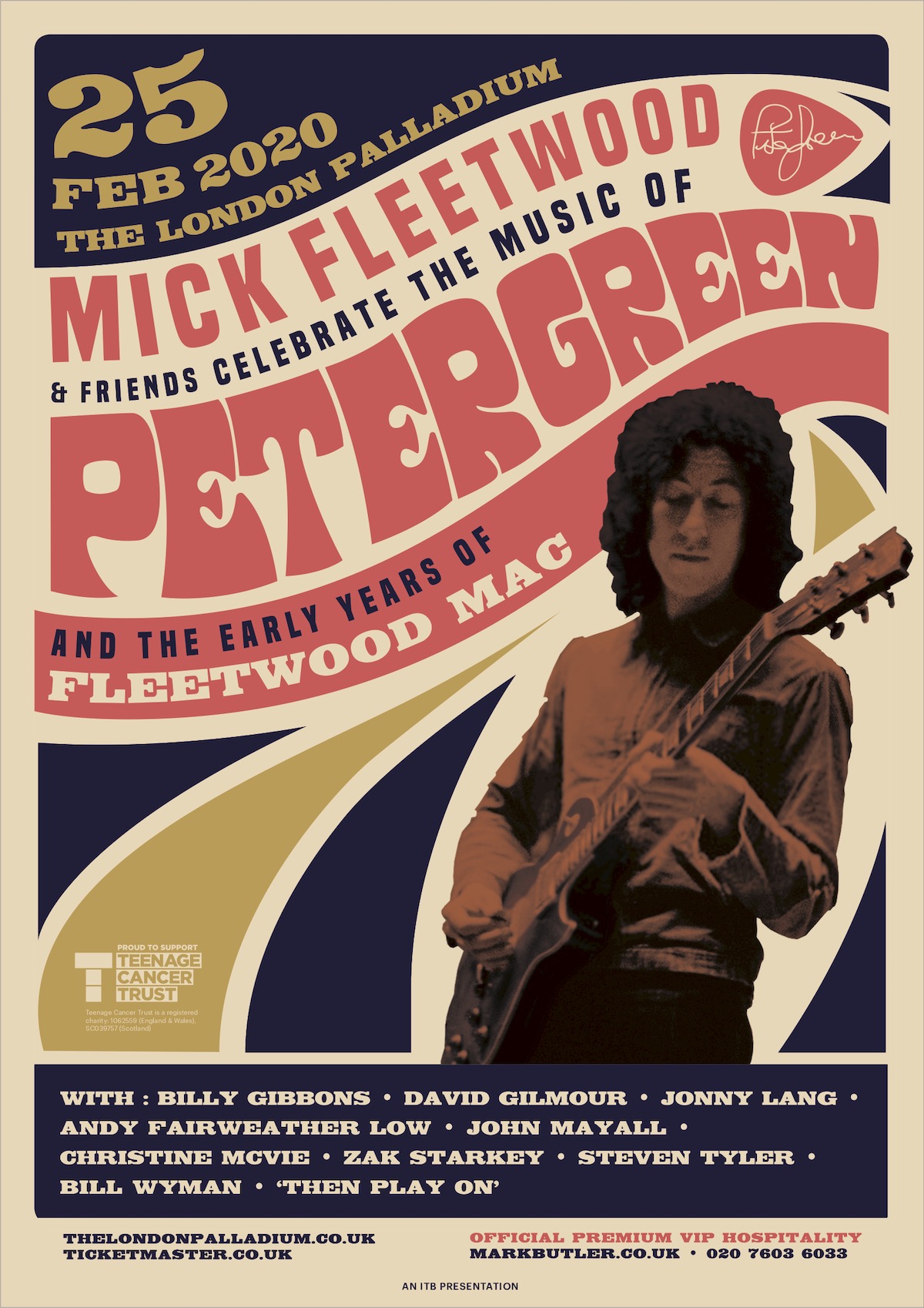
Green was celebrated at an all-star event on Feb. 25, 2020.
On Feb. 25, 2020, Green was celebrated in London with an all-star event billed as “Mick Fleetwood and Friends Celebrate the Music of Peter Green and the Early Years of Fleetwood Mac.” The performance featured such acolytes as Christine McVie, David Gilmour, Pete Townshend, Billy Gibbons, former Rolling Stones bassist Bill Wyman, Steven Tyler, and others. Original Fleetwood Mac member Jeremy Spencer made a surprise appearance. Green was not present.
Five months later, on July 25, he died at age 73. His recordings with Fleetwood Mac are available in the U.S. here and in the U.K. here.



6 Comments so far
Jump into a conversationThis band was far more interesting than the 1970s FM pop group and far superior musically. They were the finest RnB RnR Blues band to come out of the UK! The Original Fleetwood Mac Accept No Imitations! Peter Alan Green (Greenbaum) founded this band and was the leader from day one. Greeny was a very humble man and played with Mick and John in John Mayall’s Bluebreakers. Mayall gave Green free recording time as a gift, which Fleetwood, McVie and Green used to record five songs. The fifth song was an instrumental that Green named after the rhythm section, “Fleetwood Mac”.When he left in 1967 he took Mick Fleetwood with him, though John McVie was still with Mayall. Greeny had the feeling John would come soon, thus he named the band FM. The original bassist was Bob Brunning. Jeremy Spencer was with a group called The Levi Set and was already an accomplished pianist and slide guitar player. Greeny recruited him to have a second guitarist onstage. First gig was billed as Peter Green’s Fleetwood Mac featuring Jeremy Spencer. Shortly afterward McVie came on board tired of Mayall leaning towards horns. Jeremy did not always play on certain songs; he was a bit lazy. Danny Kirwan (Langran) was in a trio called Boilerhouse. Mike Vernon, FM producer, booked Boilerhouse to play in his blues club. Danny met the Mac, was a Green disciple and Boilerhouse had opened for FM a time or two. Danny became enamored with Greenys playing and often showed up during the day of gigs to help carry equipment and get a chance to jam with Peter. Peter was still looking for an additional player as Jeremy was a bit lazy and often sat out studio songs and some live ones. Fall of 68 they kicked the idea around the idea of Danny joining, but it was Mick who asked him to do so, and he accepted. Danny was a perfect foil for Peter and was a good songwriter on his own. His addition gave them the ability to stretch out so to speak, to expand to areas beyond RnB and Blues. Danny wrote half the songs on Then Play On. Green left the band he formed in May of 70 and things changed after that, but it was incredible while it lasted. Sadly as close as Peter and Danny were as players, they wrote one song together World In Harmony; Danny wrote a part of Albatross but never got a credit. RIP Greeny and Danny!
Is there anything more relaxing than listening to Albatross? For me, the Peter Green era is Fleetwood Mac. We all like what we like.
I was lucky enough to see Fleetwood Mac at the Shine in 1969. Frank Zappa and the Sir Douglas Quintet were also on the bill. I was into the blues but had never heard of Fleetwood Mac before the show. They stole the show and the next morning I was purchasing their album English Rose.
You forgot Bare Trees and Sentimental Lady
I love original Fleetwood Mac blues band, from beginning w/ John Mayall thru Bob Welch albums [‘the other later FM band’, not so much, most just Mick as drummer, song Big Love, maybe 1 or 2 others and that’s it!] I listen to the aforementioned FM albums, live concerts and studio, cds, videos, and even the studio recordings of many tracks as they were being recorded! [I want to name them all, but won’t!] Then Play On I 1st heard on headphones listening to the record and it was spectacular!…I recommend it if you have never done so…the great artistry of FM blues band, to me is a major collection of musical treasures and pleasures, and many of Peter Green’s solo records are worth finding and listening to as well…to quote that great line: ‘splendid time is guaranteed 4 all”!
Sorry to say but Mick Fleetwood and John McVie did not form FM you need to check your facts. Being wrong is one thing, not knowing the facts due to lack of research or laziness is poor journalism. Peter Green had the vision and was the leader from the start. He was the driving force behind John Mayall’s Bluesbreakers after EC left and in mid 67 he decided to go his own way. He took Mick Fleetwood with him, he had Bob Brunning on bass (who later played with Savoy Brown and then went into teaching) and he discovered Jeremy Spencer with his band The Levi Set and took him on. The original name was Peter Greens Fleetwood Mac featuring Jeremy Spencer. Greeny quickly shortened it to FM. John followed Green and Fleetwood about a month or so after they left John Mayall. The fact is Greeny was the founder and leader and creator of FM until he left in May of 1970. That is fact that is the truth. The name FM was from a song Peter Green wrote and it did not appear until the Original Fleetwood Mac was released.
This collection marked the first time that “First Train Home” and “Fleetwood Mac” were released on an album. Green commented that he initiated the sessions for these three songs with the intentions of releasing an extended play. He said that “when we finished the recordings, I called one of our numbers ‘Fleetwood Mac’ in tribute to Mick and John’s participation.” Greeny was true roots and founder of The Mac; No Greeny No Mac. Facts!