
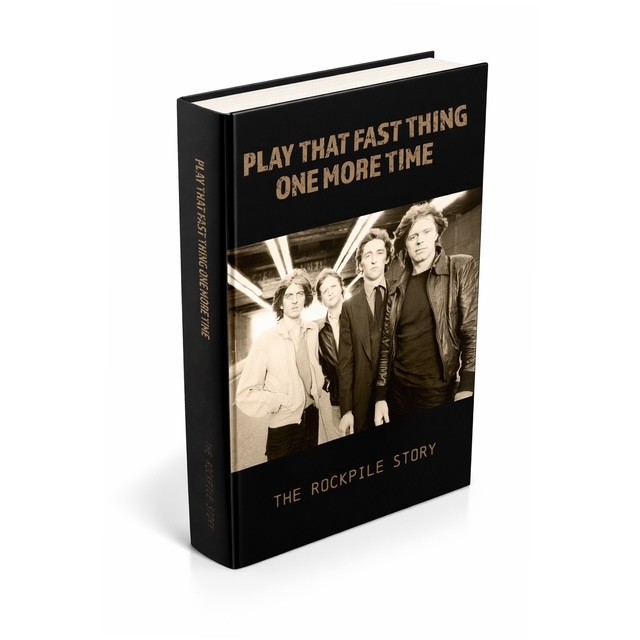
Play That Fast Thing One More Time: The Rockpile Story book cover.
In 1980, when journalist Allan Jones referred in the U.K. music paper Melody Maker to the breakup of Rockpile as “the end of civilization as we know it,” he was humorously expressing the fervent belief thousands of music lovers around the world had in a quartet that had packed a whole lot of rockin’ into less than four years of existence.
Bassist Nick Lowe, guitarists Billy Bremner and Dave Edmunds and drummer Terry Williams had joined forces when Edmunds recorded his debut album for Led Zeppelin’s new SwanSong label, Get It, which was released in April 1977. Williams had been the outstanding, innovative drummer (“a human metronome” in one account) for the progressive Welsh band Man, and was well acquainted with fellow Welshman Edmunds, going back to when he worked with him in the group Love Sculpture. Edmunds had a reputation as a meticulous one-man updater of Phil Spector’s Wall of Sound, with several British and American hit records to his name, including an astonishing remake of Smiley Lewis’ 1955 classic “I Hear You Knocking.”
Lowe had performed with, and written numerous excellent songs for, the pub-rock band Brinsley Schwarz, and Bremner, like Lowe a seasoned vocalist and songwriter, had paid his dues with several acts, including most recently Neil Innes’ Fatso.
What happened to these four men before, during and after their tenure with Rockpile is the subject of a beautifully designed, detailed history edited by the Swedish writer Rikard Bengtsson, titled Play That Fast Thing One More Time after a song Lowe wrote for Brinsley Schwarz’s LP, Please Don’t Ever Change. Deeply researched, and including many new and previously unpublished interviews with the major players in a complex tale, the 2026 book is at heart a love letter to one of the greatest, and mostly unsung, groups in rock history.
In their brief lifetime Rockpile recorded three albums, issued, for contractual reasons, under Edmunds’ name (Tracks on Wax 4, Repeat When Necessary and Twangin’...), one under Lowe’s (Labour of Lust), and a lone disc under the Rockpile name (Seconds of Pleasure) just before they broke up. They also provided crucial back-up to Mickey Jupp’s Juppanese and Carlene Carter’s Musical Shapes LPs.
But it was their live shows that cemented their legacy. Often taking songs at a breakneck speed (“That’s the first time I’ve heard a band finishing a song before they’ve even started it,” said Graham Parker about a rendition of “Ju Ju Man” at London’s Nashville Rooms in 1977), they rocked crowds into a frenzy, whether playing small clubs like Hollywood’s Whisky a Go Go or New York’s Bottom Line or big halls and festivals opening for Bad Company and Blondie.
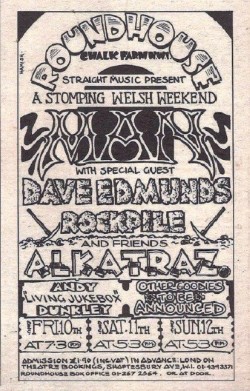
The book provides an indispensable list of audio and videos releases (legal or not), along with many humorous eyewitness accounts of gigs from fans and writers. “Despite their minimal gear, utterly ordinary clothes and almost nonexistent stage presence,” they might have been what Trouser Press magazine dubbed “the last rock ’n’ roll band.” An interview with Terry Williams by Michael Heatley provides his insight: “We didn’t have a Bono or Robert Plant walking the front of the stage. I don’t mean singing, I mean a kind of frontman. There was no frontman in Rockpile. That’s why we were so great at club levels in America, the 2-3,000-seater places.”
The technical side of recording is covered very well, with illuminating interviews with sound engineers Roger Bechirian, Barry Farmer, Neill King and Aldo Bocca, and there are plenty of amusing “stories of the road” from group members, tour manager Andy Cheeseman, and, in a chapter titled “One Lucky Bastard,” from fan Fred Mossberg, who went to great lengths to see Rockpile three times during a New England tour.
For the ins and outs of record label politics, artist and management relations, track sequencing and marketing, the new interview with Columbia A&R man Gregg Geller is clarifying, and the intersecting history of Stiff Records and the F-Beat label is chronicled by Will Birch, Michael Heatley and others. If you want to know how Lowe’s attempt to get out of a recording contract backfired when he issued singles under the names Tartan Horde (“Bay City Rollers We Love You”) and the Disco Bros. (“Let’s Go to the Disco”), or how Rockpile ended up playing 1979’s Concert for Kampuchea, Bengtsson is your man.
Any musicians who crave the skinny on Edmunds’ and Lowe’s equipment—including Nick’s unusual 8-string Hamer bass and Edmunds’ blonde Gibson ES-335—will be delighted by the chapter about their gear. As Edmunds told Trouser Press, “I’m going for a guitar sound like James Burton got on the old Everly Brothers records. It’s not distorted and fuzzy like what you usually hear these days. It’s just pure sound with a lot of sustain, a hard edge and nifty playing. That’s what Billy’s really good at and what I’ve really wanted to be good at. We complement each other.”
With a large number of photographs, memorabilia and illustrations across 318 pages, Play That Fast Thing One More Time is a visual treat, aside from the prose. With Edmunds in ill health, Bremner and Williams retired, and Lowe still busy with his successful solo career, there’s not going to be a Rockpile reunion. Along with their extant recordings, YouTube videos and social media chat groups, this wonderful book is the next best thing.
Rockpile always had a substantial Scandinavian following, which helps account for the English-language, made-in-Sweden publication. A second (revised) edition is available for pre-order through August 15, 2026, by writing to [email protected]. For American buyers, the cost (inclusive of postage) is 519 Swedish Krona (about $55).
Watch a full Rockpile concert from 1980




2 Comments so far
Jump into a conversationAlso a Swedish publication as Bremner lives in Sweden and has kept the Rockpile name and catalog active by continuing performances.
Bad ass band that time forgot. These chaps are wonderful and I swear I thought I saw them on Saturday night live many moons ago.