
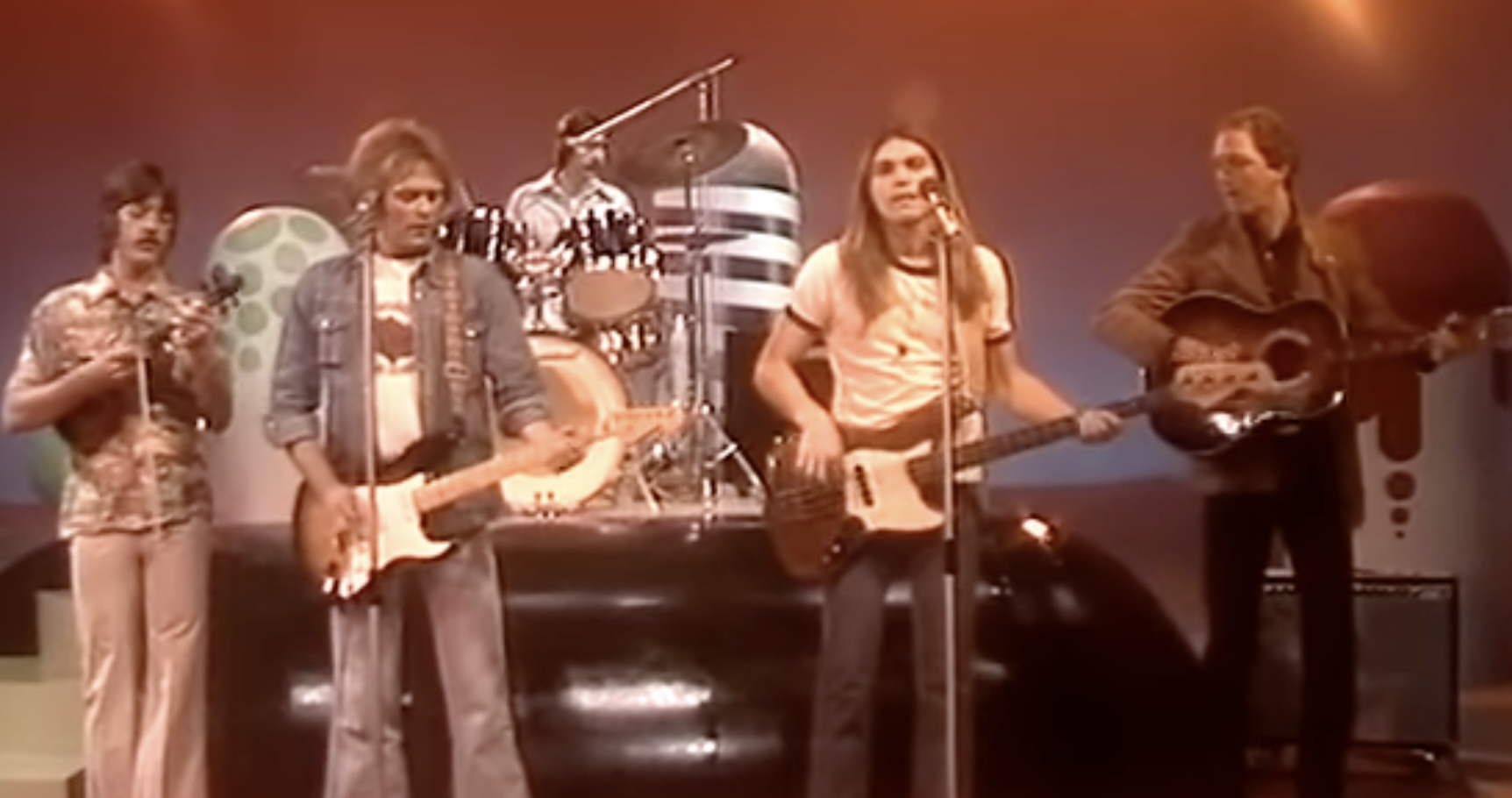
Poco, performing in 1976, is consistently one of the most overlooked bands of the era.
Poco never quite got their due. Born from the breakup of Buffalo Springfield in 1968, the group’s crucial early lineup featured Richie Furay and Jim Messina alongside Rusty Young, George Grantham and Randy Meisner, who would go on to help found Eagles. In many ways, Poco was the missing link between Buffalo Springfield and the California country-rock explosion that followed. [When bassist Meisner departed Poco to help found Eagles, he was replaced by Timothy B. Schmit. In an odd twist, when Meisner left Eagles in 1977, it was none other than Schmit who again stepped into his role!]
Significant commercial success eluded them—just two of their albums achieved Gold status—but the music has endured. These 13 tracks make the case that one of country-rock’s true pioneers deserved far more recognition than it ever received.
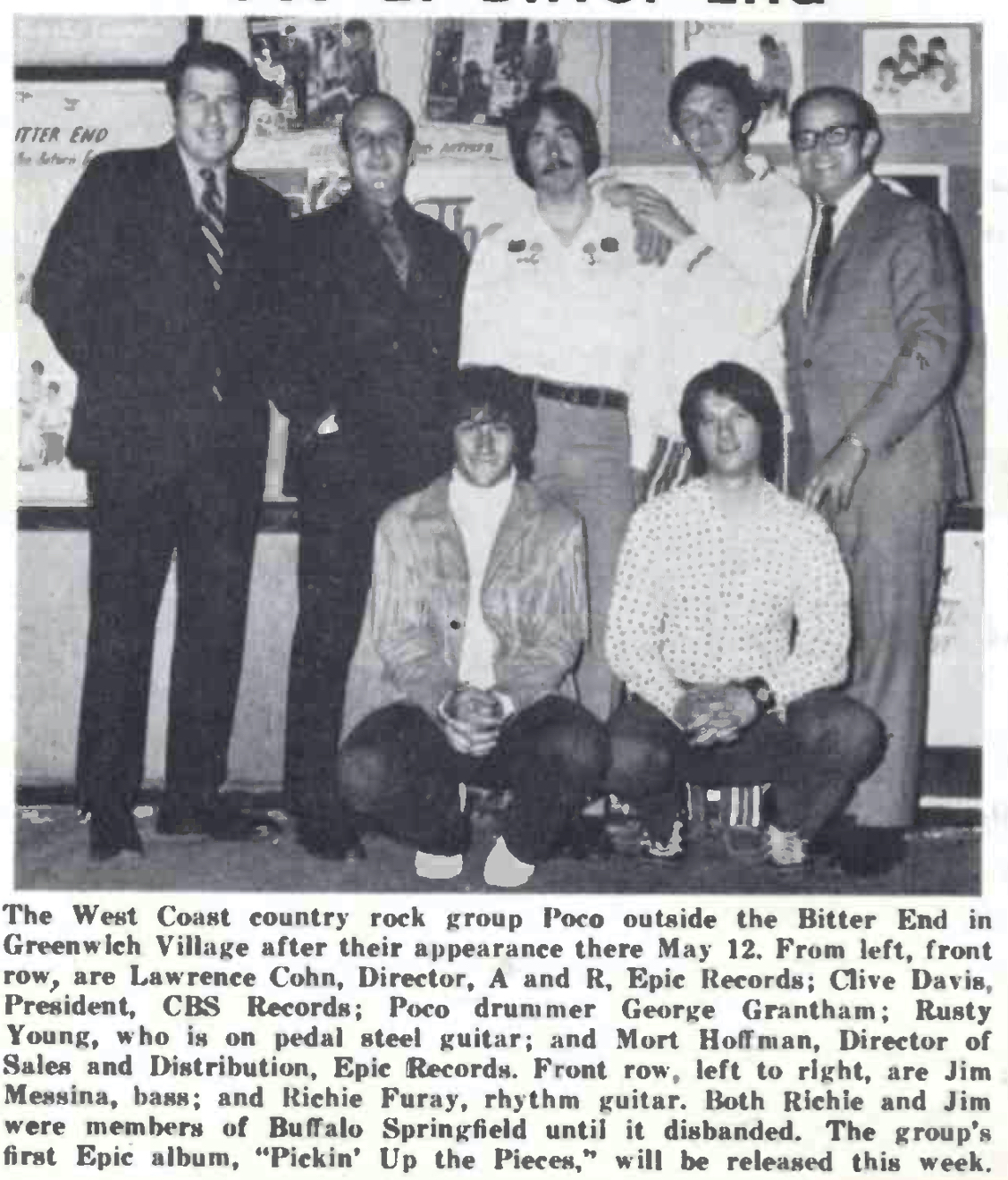
This early photo of Poco at New York’s Bitter End appeared in the May 24, 1969 issue of Record World.
“Pickin’ Up the Pieces” (Pickin’ Up the Pieces, 1969)
Written by Richie Furay, this bright debut title track served as a definitive declaration of independence from Buffalo Springfield’s shadow. The effortless blend of country roots and rock energy immediately established the band’s signature melodic template.
“You Better Think Twice” (Poco, 1970)
The energetic Jim Messina composition proved the group could deliver plenty of rock and roll muscle alongside their acoustic influences. Driven by crisp guitar interplay and tight vocal harmonies, the track stood out as the centerpiece of their sophomore LP.
“Bad Weather” (From the Inside, 1971)
This atmospheric Paul Cotton composition beautifully showcased his emerging importance as a principal songwriter for the group. Highlighted by a memorable, reflective melody and a polished studio arrangement, it quickly became an enduring fixture in their live sets.
“Just for Me and You” (From the Inside, 1971)
Serving as the gorgeous closing track to their third studio album, this warm ballad perfectly balanced rich acoustic textures with the band’s hallmark vocal chemistry. The track showcased a sophisticated, radio-friendly pop accessibility while maintaining their core country-rock integrity.
Related: Our Album Rewind of Poco’s Deliverin’ LP
“A Good Feelin’ to Know” (A Good Feelin’ to Know, 1972)
Anchored by a driving rhythm and an infectious, optimistic hook, this strong anthem stands as a towering cornerstone of the entire country-rock movement. Despite receiving heavy airplay on progressive FM radio, the song remarkably failed to break into the Hot 100 chart.
“Sweet Lovin'” (A Good Feelin’ to Know, 1972)
An easygoing Furay track seamlessly blends a soulful, gospel-inspired warmth with polished, early-’70s California studio production. Driven by an infectious chorus and swelling, organ-like pedal steel textures, the standout closing track beautifully highlighted the band’s remarkable resilience and evolving maturity.
“And Settlin’ Down” (A Good Feelin’ to Know, 1972)
This understated Furay gem features a relaxed, soulful groove that perfectly complements the increasingly sophisticated vocal blend of the era. The tasteful arrangement allows the band’s elegant, multi-part harmonies to take complete center stage.
“Fool’s Gold” (Crazy Eyes, 1973)
A blistering, fast-paced bluegrass instrumental written by Rusty Young serves as a masterclass in lightning-fast solo picking. Clocking in at a tight two minutes, this acoustic tour de force highlighted the formidable musicianship that anchored the final album of the original lineup.
“Rocky Mountain Breakdown” (Seven, 1974)
Following Furay’s departure, the band forged ahead as a four-piece with this lively, fast-paced bluegrass showcase written by Young. The track leans heavily into spirited banjo picking and a rowdy barn-dance vocal delivery, proving the group’s foundational identity remained firmly intact.
“Keep On Tryin'” (Head Over Heels, 1975)
Timothy B. Schmit delivered one of the band’s most enduring triumphs with this breathtaking, heavily a cappella-driven ballad. Released as a mainstream single, the gorgeous showcase for Schmit’s crystalline tenor climbed to #50 on the Hot 100.
“Rose of Cimarron” (Rose of Cimarron, 1976)
Inspired by the legendary Oklahoma outlaw tale of Rose Dunn, “Rose of Cimarron” stands as Rusty Young’s definitive songwriting achievement. The sweeping epic combines atmospheric Dobro flourishes with some of the grandest vocal harmonies in the entire catalog.
“Crazy Love” (Legend, 1978)
After a decade of perseverance, Young finally delivered the massive commercial breakthrough the band long deserved. This breezy, acoustic-led ballad scaled the charts, becoming their biggest career hit, peaking at #17 on the Billboard Hot 100 and spending seven weeks at #1 on the Adult Contemporary chart.
“Heart of the Night” (Legend, 1978)
Featuring an unforgettable saxophone hook and a stellar lead vocal from Paul Cotton, this atmospheric tribute to New Orleans nightlife served as the perfect follow-up single. The hit track successfully kept the band’s commercial momentum alive, climbing to #20 on the Hot 100.
Poco’s catalog is available in the U.S. here, in Canada here and in the U.K. here.




10 Comments so far
Jump into a conversation‘You Better Think Twice’ was one of the first singles I ever bought with my $5 allowance.
As a DJ a few years later I was fortunate to be playing awesome songs such as ‘Indian Summer’ and ‘Heart of the Night’.
There were some great songs after the Legend album—“Under the Gun,” “Call It Love,” “Midnight Rain,” and “Ghost Town.” Rusty wrote 7 of the 9 Songs on “Legend.” Poco’s last hit Top 20 hit, “Call It Love,” was written by Rick Lonow (later of Poco) and Ronnie Gilbeau (both from the Flying Burrito Brothers) who later joined Poco members Jack Sundrud and Michael Webb (both of Poco) in Cimarron 615.
Not being a country-rock fan, I was bowled over when I heard “Crazy Eyes.”
I’d replace a couple or three of these with cuts from the “Cantamos” album – “One Horse Blue”, “High and Dry”, and “Western Waterloo”. The song “Under the Gun” is one of my favorites from them, as is “Midnight Rain”, and they did a great cover of J.J. Cale’s “Cajun Moon”. And I think “Ghost Town” might be the best piece of music Rusty ever came up with.
Great article and great selections, however, I am biased, as I have a special musical place in my collection for Poco, and most all of its derivatives.
One album that seems to be underappreciated, generally speaking, is Poco’s 1989 “reunion” album “Legacy” which brought back the songwriting and musical talents of many of the original Poco founders, including Jim Messina, Richie Furay, Randy Meisner, George Grantham, and Rusty Young.
“Legacy” (IMO) is a terrific effort by the band, and many/most of the songs on the album could be included in this article’s listing, especially, but not limited to;
“When It All Began” (A well executed return to the country-rock roots that first defined Poco).
“Nothing To Hide” (Randy Meisner’s vocal delivery is distinctive, to say the least…)
“Call it Love” (A bit leaning to the pop side, but nonetheless, Rusty Young’s lead vocals and Poco’s trademark harmonies take front and center).
Sure wish this lineup could have stayed together this time around after “Legacy”, for a few more releases, and treated us to a few more slices of ear candy.
An astute observation Baybluesman, I agree with your assessment of the Legacy record. I clearly recall Randy’s stunning vocal performance of Nothing To Hide from a show during the tour in support of that album. Randy stole the show on that day when Richie was away at church. His spirited performance of Take It To The Limit, no doubt inspired by the double rainbow that magically appeared over the mountains right on cue, remains a top-five concert moment for me almost 40 years later.
As a longtime Poco fan, it was a joy to read this article, so thanks for publishing it.
When I was 15, I first saw them February 12, 1971 at Carnegie Hall (two shows in one night, both sold out: I went to the early one) when Paul Cotton just joined.
A few weeks after that show, I bought a pedal steel guitar at the old Manny’s on 48th St. I was 15 and had difficulty mastering it because of the difficulty of keeping the instrument in tune (long before electronic tuners existed). Oh well…
That said, with their high harmonies, they were a beacon of optimism amid the Vietnam War. Poco eased my teenage anxiety about that (would I ever be drafted?) and all the social upheaval at the time. In the end, Poco mattered.
nobody had ever heard of “from the inside..” except you guys!! keep it up, guys( and girls!)
I had the pleasure of watching POCO when Jim Messina was in the line up.
The look at the audience who wasn’t sure what they were listening to, but they sure liked it. Damn nice folks to deal with as well.
Wow, cool to see Poco getting some well deserved attention. 15 favorites is a pretty hard pick as I’m a fan of pretty much every era.