
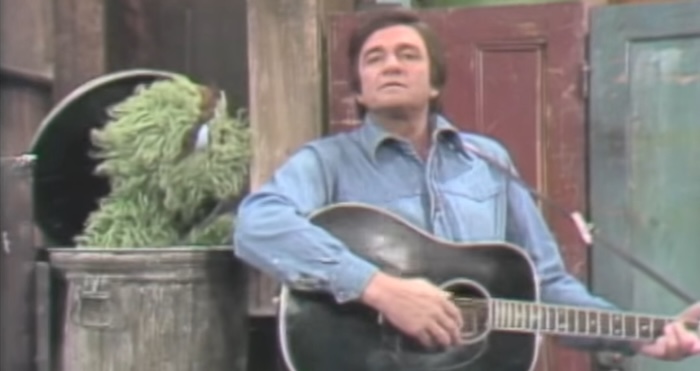
Johnny Cash performing on Sesame Street with Oscar the Grouch.
Sesame Street premiered on PBS on November 10, 1969, and music was woven into its format from the very beginning. Pete Seeger was the program’s first musical guest, setting a precedent that would bring everyone from folk icons to jazz virtuosos through the doors of 123 Sesame Street. Over the decades, the show earned 11 Grammy Awards, including one for 2001’s Elmo and the Orchestra, proving that its musical ambitions were anything but child’s play.
Rather than treating famous performers as novelty cameos, the producers often built entire segments around them. These 12 appearances show how deeply Sesame Street connected children’s television with the wider world of classic rock, soul, country and jazz.
Paul Simon—“Me and Julio Down by the Schoolyard” (Paul Simon, 1972)
A stripped-down 1977 stoop performance turned a Hot 100 Top 25 hit into an intimate acoustic moment. No band, no elaborate staging—just a guitar, a brownstone and the songwriter’s melodic instincts.
Stevie Wonder—“Superstition” (Talking Book, 1972)
The 1973 appearance arrived just after the single reached #1 on the Hot 100. Backed by a full touring band, the segment played less like children’s TV and more like a live funk club dropped into daytime television.
Alison Krauss & Union Station—“Sesame Jamboree” (2004)
Her 2004 visit paired virtuoso bluegrass playing with the Count counting dancing chickens mid-song. The performance later appeared on the 2007 DVD Kids’ Favorite Country Songs, giving it a second life beyond the original broadcast.
Johnny Cash—“Nasty Dan” (1974)
Season 5 introduced a deadpan acoustic exchange aimed squarely at Oscar the Grouch. The segment has since become one of the most widely circulated vintage Sesame Street clips among classic-country fans.
Carly Simon—“Be With Me” (In Harmony: A Sesame Street Record, 1980)
Recorded for the 1980 children’s compilation, the performance later appeared on-air with Telly Monster. The album itself won the Grammy for Best Recording for Children, adding a bit of hardware to the story.
Ray Charles—“The Alphabet Song”/“Bein’ Green”/“Believe in Yourself” (1989–1990)
A 1989 NBC anniversary special paired Charles with a chorus of Muppets for an alphabet-themed number and a duet of “Bein’ Green” with Kermit, followed by a 1990 return featuring a piano-led rendition of “Believe in Yourself” with Elmo and Telly. The back-to-back appearances brought genuine rhythm and blues royalty into the Sesame Street universe.
Norah Jones—“Don’t Know Y” (Come Away with Me, 2002)
Her 2004 segment cleverly transformed a Grammy-winning Song and Record of the Year into a playful lesson about the letter Y. The joke worked because the source material was already one of the decade’s most recognizable pop-jazz hits.
Lou Rawls—“The Alphabet Song” (1970)
Among the earliest major musical guests, Rawls appeared during the show’s first season in 1970. The smooth soul baritone reportedly needed a second attempt after repeatedly skipping the letter G, a wonderfully human moment in Sesame Street history.
Linda Ronstadt—“La Charreada”/“Y Andalé” (Canciones de Mi Padre, 1987)
Taped during Season 20 in 1988, the mariachi-themed performances were tied to Ronstadt’s album, then the best-selling non-English-language release in American recording history. The charro costumes and full mariachi ensemble gave the show one of its most authentic Latin-music showcases.
Related: When Sesame Street got its own U.S. postage stamp
Cyndi Lauper—“Twister Sisters” (Elmocize, 1996)
A wildly energetic 1996 workout segment introduced a new character named Twyla alongside two Muppet monsters called the Twister Sisters. The fitness parody perfectly matched the irreverent spirit that had made Lauper an MTV-era superstar.
Sheryl Crow—“I Soak Up the Sun” (C’mon, C’mon, 2002)
Crow’s 2003 appearance reworked a recent top 20 Hot 100 hit into a cheerful celebration of the letter I, joined by Elmo, Telly, Rosita and Zoe. It was a smart example of how Sesame Street updated contemporary radio hits for a preschool audience without losing their charm.
Wynton Marsalis—“Take the A Train” (1991)/“No Matter What Your Language” (Our Music Can Be the Same) (1998)
The jazz giant visited several times, including a 1991 performance of Duke Ellington’s classic with the “Duck” Ellington Orchestra. Earlier and later appearances featuring Hoots the Owl turned jazz improvisation into a playful musical conversation that children could actually follow.
What makes these segments endure is not nostalgia alone. They capture legendary performers meeting young audiences on equal terms, whether through Billboard-charting funk, Grammy-winning folk-pop, classic country storytelling or Ellington-style jazz. In the process, Sesame Street quietly assembled one of the most remarkable musical guest books in television history.
Bonus Video: Watch Elvis Costello and Elmo sing “A Monster Went and Ate My Red 2”
Sesame Workshop is the global nonprofit behind Sesame Street and so much more. For over 50 years, they have worked at the intersection of education, media, and research, creating joyful experiences that enrich minds and expand hearts, all in service of empowering each generation to build a better world. Their beloved characters, iconic shows, outreach in communities, and more bring playful early learning to families in more than 190 countries and advance their mission to help children everywhere grow smarter, stronger, and kinder.
Sesame Street items are available in the U.S. here, in Canada here and in the U.K. here.




1 Comment so far
Jump into a conversationI was walking on the pier in Huntington Beach with my two kids. They suddenly stop and pointed out Ritchie Havens who was fishing. They knew him from Sesame Street. Nice man who talked to us for awhile