
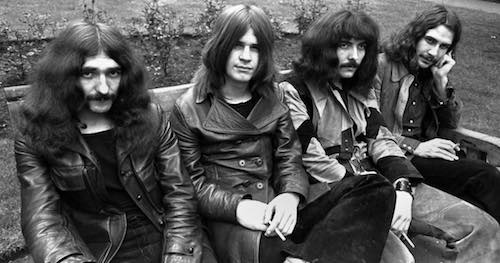
Black Sabbath (from their Facebook page)
There’s a reason so many classic rock fans can still remember the first time they heard that opening riff—the one built on torrential rain, a tolling bell and a chord progression so unsettling it practically came with its own warning label. When Black Sabbath released their self-titled debut on February 13, 1970, the band didn’t just make heavy music; it helped define what heavy metal could be.
Four musicians from Birmingham, England—Ozzy Osbourne, Tony Iommi, Geezer Butler and Bill Ward—fused industrial gloom, blues-club grit and ominous riffing into something rock audiences had never quite heard before. As the years unfolded, that sound didn’t fade so much as fracture and evolve, first into Sabbath’s increasingly ambitious 1970s studio experiments and later into Osbourne’s unpredictable, often triumphant solo reinvention. What follows is a journey through that transformation: 13 essential songs that chart the full arc from the birth of heavy metal to one of its most enduring second acts.
Black Sabbath—“Black Sabbath” (Black Sabbath, 1970)
Tony Iommi built the title track around the tritone: the “Devil’s interval” long associated in music theory with tension and dread. Osbourne’s vocal doesn’t fight the molten riff; it follows its sense of horror all the way down. By the time the track explodes into its fast-paced closing section, the blueprint for an entire genre was set in stone.
Black Sabbath—“N.I.B.” (Black Sabbath, 1970)
Geezer Butler kicks off the track with his fuzz-drenched “Bassically” solo, establishing a groove as instantly recognizable as any guitar figure of the era. While the occult title suggested something sinister to contemporary critics, the lyrics were, of all things, a love song written from the perspective of Lucifer, one of Butler’s cleverest lyrical twists.
Related: Our Album Rewind of Sabbath’s self-titled debut… where metal began
Black Sabbath—“War Pigs” (Paranoid, 1970)
Originally titled “Walpurgis” during early live performances, the track evolved into a blistering anti-war statement aimed directly at political leaders. Clocking in at nearly eight minutes, its dramatic tempo shifts, air-raid-siren atmosphere and Butler’s sharply aimed lyrics make it one of the defining pillars of early heavy metal.
Black Sabbath—“Paranoid” (Paranoid, 1970)
The ultimate filler track that became a legend. Written quickly at the end of the sessions to help round out the running time of the band’s sophomore album, it became Sabbath’s breakout hit, reaching #4 on the U.K. Singles Chart and #61 on the Hot 100.
Black Sabbath—“Iron Man” (Paranoid, 1970)
Driven by Iommi’s lumbering central hook and Ward’s swing-influenced drumming, the track unfolds like a dark science-fiction fable about a time-traveling man transformed into steel. Few riffs in rock history have been quoted, covered and imitated more often.
Black Sabbath—“Sweet Leaf” (Master of Reality, 1971)
The famous opening cough, reportedly captured after Iommi took a hit from a joint during studio playback, signals a seismic sonic shift. The album found Sabbath tuning down their instruments, creating a heavier, more resonant sound that helped lay the groundwork for doom metal and stoner rock.
Black Sabbath—“Sabbath Bloody Sabbath” (Sabbath Bloody Sabbath, 1973)
By 1973, the band was stretching its creative wings. Combining acoustic guitar passages, intricate synthesizer textures and one of the heaviest breakdown riffs ever committed to tape, the title track demonstrated a new level of arrangement sophistication. The album reached #4 in the U.K. and #11 on the Billboard 200.
Ozzy Osbourne—“Crazy Train” (Blizzard of Ozz, 1980)
All aboard! When Osbourne launched his solo career after leaving Sabbath, guitarist Randy Rhoads proved to be the ideal musical foil. His classically influenced guitar work and dazzling solo helped propel the single into permanent rock-radio rotation. It reached #9 on Billboard’s Mainstream Rock chart and announced Ozzy’s rebirth as a solo superstar.
Ozzy Osbourne—“Mr. Crowley” (Tribute, 1987; studio version on Blizzard of Ozz, 1980)
The tragedy of Rhoads’ death in 1982 cut short one of rock’s most promising guitar partnerships. The live version featured on the 1987 archival release, recorded during the 1981 tour, captures the gothic organ introduction and Rhoads’ breathtaking extended soloing in electrifying detail.
Ozzy Osbourne—“Mama, I’m Coming Home” (No More Tears, 1991)
Co-written with Motörhead mastermind Lemmy Kilmister, this power ballad revealed a melodic sensitivity that balanced Osbourne’s “Prince of Darkness” image. Supported by Zakk Wylde’s soaring guitar work, it became Ozzy’s highest-charting solo hit on the Hot 100, peaking at #28.
Ozzy Osbourne—“No More Tears” (No More Tears, 1991)
Built around a sinuous bass line written by Mike Inez and recorded by longtime collaborator Bob Daisley, the seven-minute title track brought Osbourne squarely into the modern rock era. The single climbed to #10 on the U.S. rock chart, helping the album go quadruple platinum in there.
Ozzy Osbourne—“Under the Graveyard” (Ordinary Man, 2020)
Recorded after a period of severe health setbacks, this lead single stripped away glossy excess in favor of a more personal, autobiographical reckoning. Listeners responded immediately, sending the track to #1 on the U.S. Mainstream Rock chart.
Ozzy Osbourne—“Patient Number 9” (Patient Number 9, 2022)
Featuring the late guitar legend Jeff Beck, the title track to Osbourne’s 2022 studio album proved his instinct for drama remained as potent as ever. The album debuted at #2 in the U.K. and earned two Grammy Awards, serving as a remarkable late-career triumph for one of heavy metal’s defining voices.
Sabbath’s catalog and merch are available in the U.S. here, in Canada here and in the U.K. here. Ozzy’s solo work is available in the U.S. here, in Canada here and in the U.K. here.




2 Comments so far
Jump into a conversation‘Jack The Stripper/Fairies Wear Boots’.
Where have I heard that riff?
Also has the ultimate parents’ rap: ‘Smokin’ and trippin’ is all that you do’.
Partly cool! Would have been better not to combine Ozzy with the Sabbath stuff, and had a deeper dive into the band. Certainly there’s enough to choose from! But I get it.