
The Inside History of the Electric Light Orchestra
by Dennis Elsas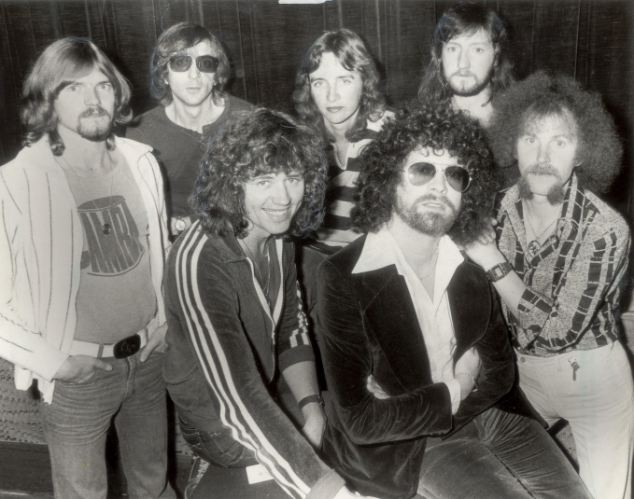
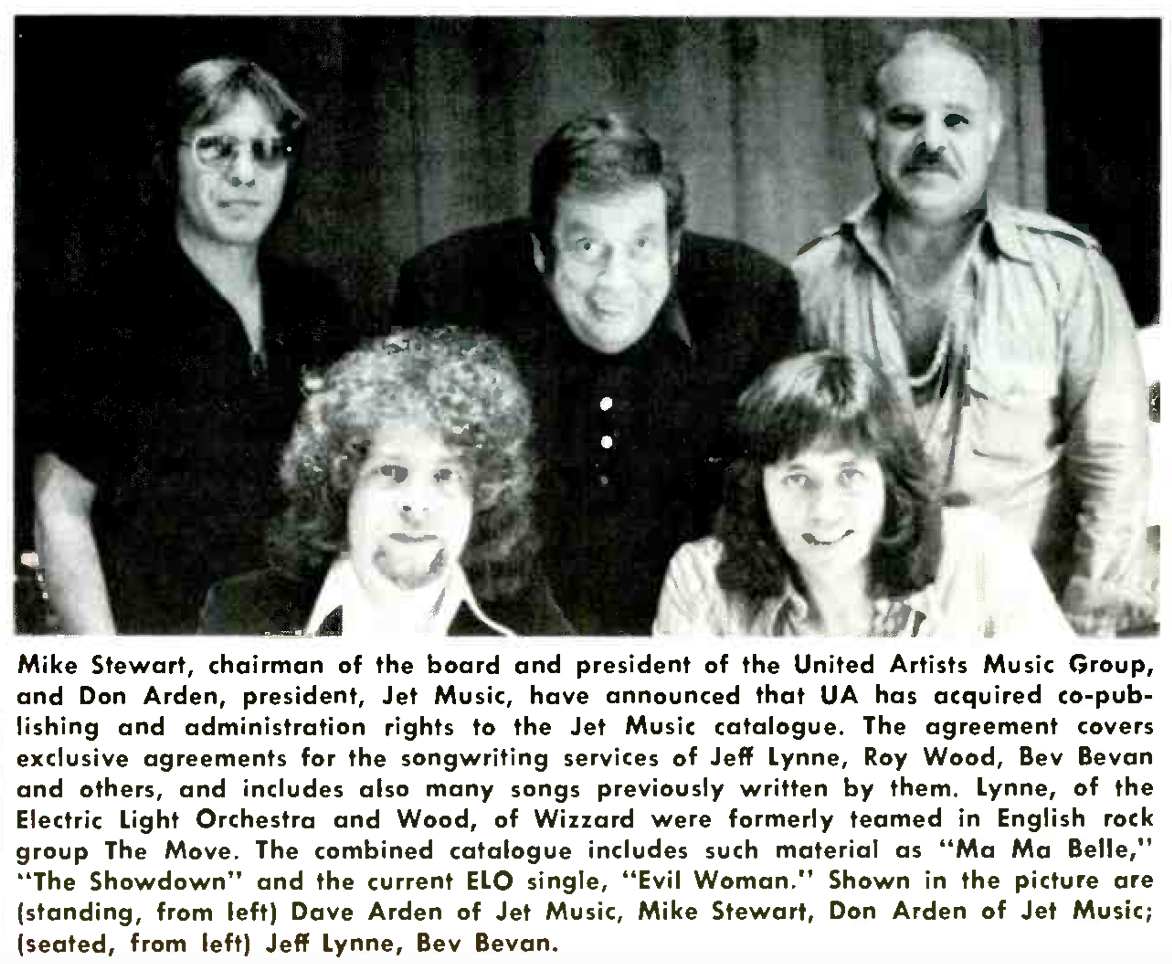
Bev Bevan, smiling at center (to Jeff Lynne’s right) via an undated photo from Bevan’s Facebook page
Though the Electric Light Orchestra was eligible for induction into the Rock and Roll Hall of Fame in 1997, it wasn’t until December 2016 that they were selected to the Class of 2017.
The ELO members honored were Bev Bevan, Jeff Lynne, Richard Tandy and Roy Wood. Bevan announced, however, that he wouldn’t be able to attend the induction ceremony, which took place on April 7, 2017 at the Barclays Center in Brooklyn, N.Y.
Bevan, born November 25, 1944, was an original member of The Move—which earned five straight Top 5 U.K. singles in 1966-1968—and co-founder of ELO in 1970, and stayed with them until they disbanded in 1986.
Bevan explains how the Move evolved into ELO in this interview with Dennis Elsas from December 5, 1977, on New York City’s legendary WNEW-FM, when ELO was in the midst of a string of hits from 1976’s A New World Record and 1977’s Out of the Blue.
The two bands were working simultaneously. “The interest was just waning in the Move, we were really just in it for the money,” he says. Why did Wood leave ELO? “I think he could see that it was gonna be Jeff’s band, really.
“He left Jeff and I rather in a mess because he took some of the guys from ELO with him and there was a lot of bad feeling at the time.”
Elsas is, as many Best Classic Bands readers know, one of the most respected album rock air personalities in the nation. From a quarter-century-plus stint as a DJ and music director at WNEW-FM to his endeavors today as afternoon drive host at the esteemed WFUV and as co-host of the weekly Beatles talk and “call-in” show, “Fab Fourum,” heard exclusively on the Beatles Sirius/XM Channel (18) plus weekend shifts on Sirius/XM’s Classic Vinyl Channel (26), he has earned the regard of listeners and artists alike. Dennis occasionally presents his Rock ‘n’ Roll Never Forgets live multimedia show, a real treat that greater New York metro area rock fans should not miss. He celebrated his 50th anniversary on New York radio in 2021 where he continues to appear.
Best Classic Bands is pleased to be publishing excerpts of many of his interviews with classic rock legends as a regular feature: The Dennis Elsas Conversation.
Dennis Elsas: Talking with Bev Bevan, the man who played drums for the Move during their history and has played drums for the Electric Light Orchestra in their history. What happened that the Move became almost–and with the exception of some personnel changes–the Electric Light Orchestra?
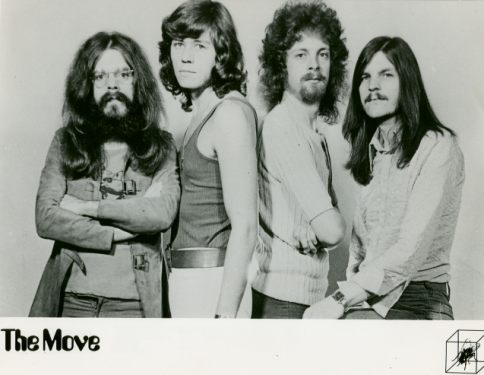
The Move in an undated publicity photo, (L-R) Roy Wood, Bev Bevan, Jeff Lynne and Rick Price
Bev Bevan: Well, when Carl Wayne left the band, we asked Jeff Lynne to join and he refused. He got the Idle Race and he was doing OK with them because he had total control of that group… they made two albums together. Eventually we got Jeff to join us. Jeff [and] Roy Wood were very close friends, for years and years. They had been talking for years about forming a group.
We didn’t have a name at the time, but a group that was to sound like Electric Light Orchestra, a group that involved classical instruments and a totally unique sound to put on stage. When Jeff did join us and we started to talk about it more thoroughly, the interest was just waning in the Move. We were really just in it for the money; it became that in the end.
The money went toward setting up ELO. When we first told our record company in England, that we wanted to drop the Move entirely and form a new band called Electric Light Orchestra…naturally they thought we were pretty crazy because the Move were still a very successful group. And even the last single we made as a group, “California Man,” was a Top 5 single.
Watch The Move perform “California Man.” Not to be missed…
And yet we didn’t want to record any more as the Move. So we talked them into it by doing two things at once, recording as two bands.
DE: There was a period when there was a Move and ELO simultaneously?
BB: In the studio, yeah. Neither band were working on the road. It was a pretty strange situation.
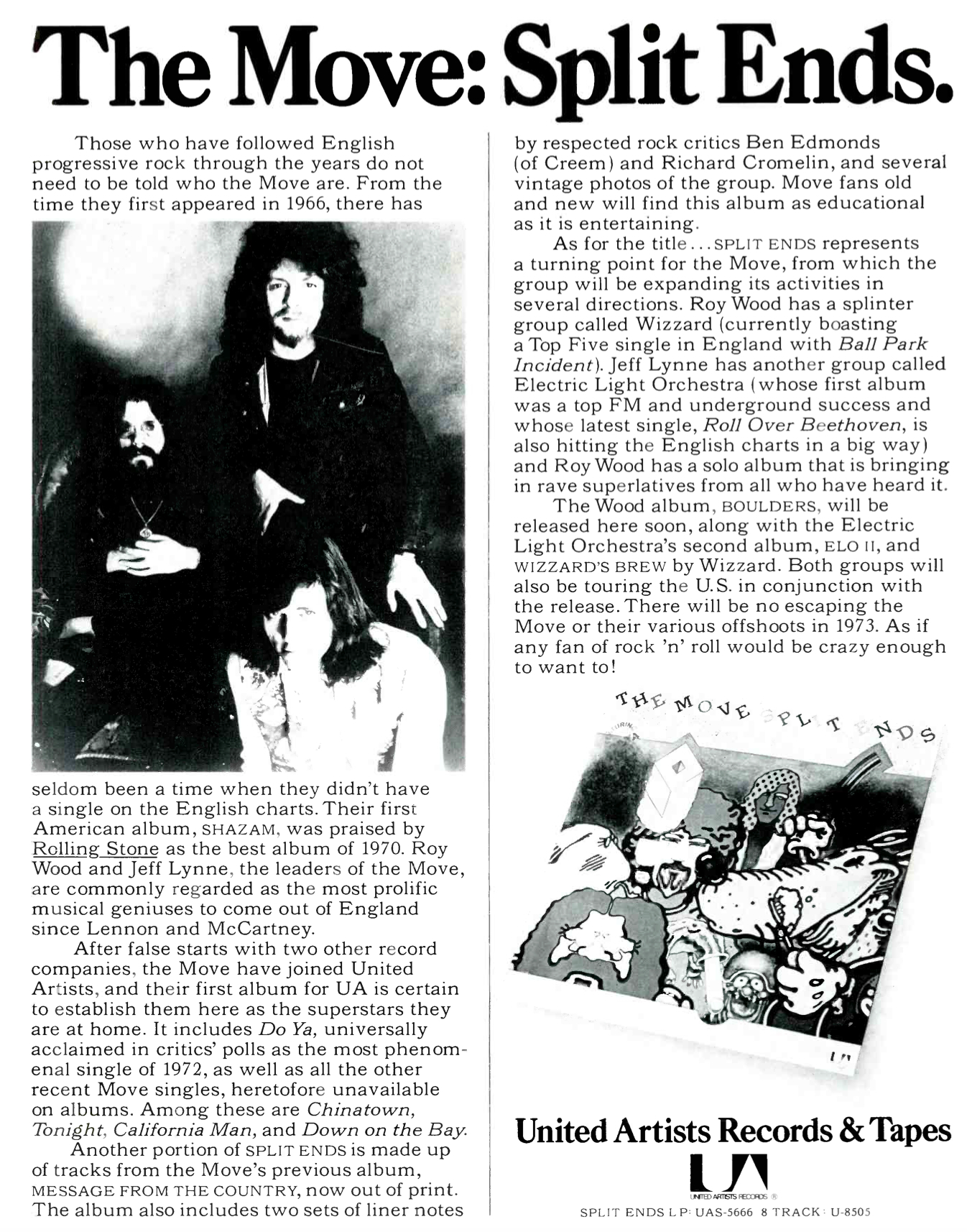
This ad appeared in the March 10, 1973 issue of Record World. “Roy Wood and Jeff Lynne, the leaders of the Move, are commonly regarded as the most prolific musical geniuses to come out of England since Lennon and McCartney.”
DE: Jeff had only joined the group toward its very last year or two.
BB: Yeah, I think his first record with us was “Brontosaurus” and then we had one called “When Alice Comes Back to the Farm” [both 1970], which bombed completely. Jeff was beginning to write stuff for the albums and a couple of B-sides. Roy Wood still controlled the single situation and that was our prime market, making hit singles.
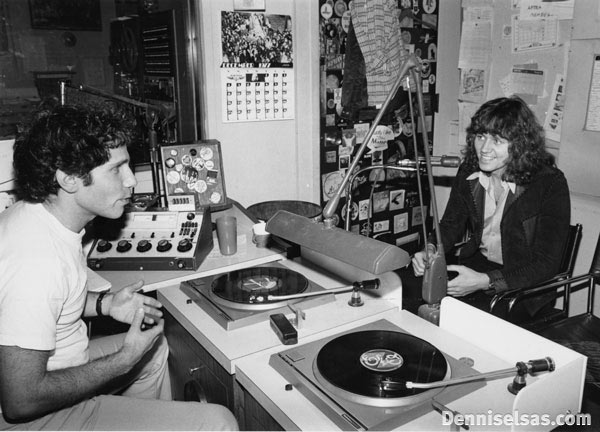
Dennis Elsas and Bev Bevan at New York’s WNEW-FM in 1977. (Photo courtesy of Dennis Elsas personal archives)
DE: Why did [ELO] re-record “Do Ya?” That is the only Move song to ever transform into being an Electric Light Orchestra song?
BB: It’s such a great stage number that we used to include it for years on the ELO show. A lot of people asked us to record it and we kept thinking about it. The crunch finally came when I was doing a radio interview and the guy said, “I saw the concert last night and I noticed that you do ‘Do Ya.’ Are you a Todd Rundgren fan?” So I thought that about does it. So I told Jeff and he said, “Right, let’s re-do it and let everyone know once and for all we were the originators of it.”
Related: Jeff Lynne’s ELO lights up the Garden (Review)
DE: In its very earliest foundations, the Electric Light Orchestra had Roy Wood and Jeff Lynne and Bev Bevan and who else?
BB: That was really it. It was a three-man group. In the studio we had two other guys who helped us out, Steve Woolam on violin and Bill Hunt on French horn, who came in on a couple of tracks. but it really was a three-man effort. The first album is one that I don’t look back on with very fond memories because the whole time was spent in the studio. Roy and Jeff spent the most time in the studio. I used to pop down to London occasionally from Birmingham. Actually, on some of those tracks, the drum was put on last. On a couple of those tracks, the timing isn’t too clever because there’s no drummer there in the first place to lay down the solid foundation.
DE: From their first album…is there any significance to the number “10538 Overture?”
BB: This is the best track on the album and the first thing we ever recorded as ELO, a track I really like a lot. It’s one of Jeff’s songs. When Jeff was young, his next-door neighbor was a guy who was pretty nutty. He used to think he could fly. This guy was so crazy he used to, in ballpoint pen, write numbers across his forehead and he used to think he was some kind of space case. Jeff couldn’t remember the right numbers but this song was kind of dedicated to this guy and he made up the numbers 1-0-5-3-8.
[During the actual live interview, Elsas played “10538 Overture” and then segued into The Beatles’ “Strawberry Fields Forever.”]
DE: The reason I played the two together is because through the years in my ears and my mind, and I know in the mind and ears of listeners and critics, a definite correlation between the Beatles and the Electric Light Orchestra. I’ve often thought that had the Beatles gone on to record things in a vein similar to that in which they had done in Magical Mystery Tour, that maybe they would have wound up recording similarly to what Electric Light Orchestra came out to be. Was there, at the time of “10538 Overture” and the first album, a Beatles influence?
BB: Yeah, there’s no denying the fact that, when we used to listen to things like “Strawberry Fields” and “I Am the Walrus,” that was like in the beginning before we even formed ELO and we really did say things like “Imagine a band that sounded like that going out on the road?” That was one of the reasons that ELO was formed and I’m sure the Beatles had a lot to do with it. They weren’t doing it so we thought we’re not treading on their toes. The band doesn’t actually exist except in the studio. Yeah, they’re one of the major reasons why ELO formed.
Related: Coverage of ELO’s 2017 Rock Hall induction
DE: Have you ever met any of them or have they ever commented on your music, that you’re aware of?
BB: Yeah, I meet them occasionally. I don’t know any of them very well… probably Ringo better than anybody else. I did hear a quote recently that John Lennon had said somewhere or other when he was asked, “If the Beatles were together now, what do you think they would sound like?” And his reply, I’m told, was “Well, I guess we’d sound a lot like Electric Light Orchestra.”
This photo of ELO (with Jeff Lynne and Bev Bevan in front) appeared in the Nov. 15, 1975 issue of Record World
DE: Certainly, when we got to speak to him several years ago, he was very praiseworthy of the band. At that time, “Showdown” was the most recent thing when he was here. He discussed how much he enjoyed the music and…he felt that there was certainly some kind of relationship to the sound the Beatles were making in that Magical Mystery Tour period. Album number two was the first breakthrough for the group commercially in America with the great success of “Roll Over Beethoven.”
BB: Just before we went into the studios for ELO 2 was when Roy Wood left the band.
DE: Why?
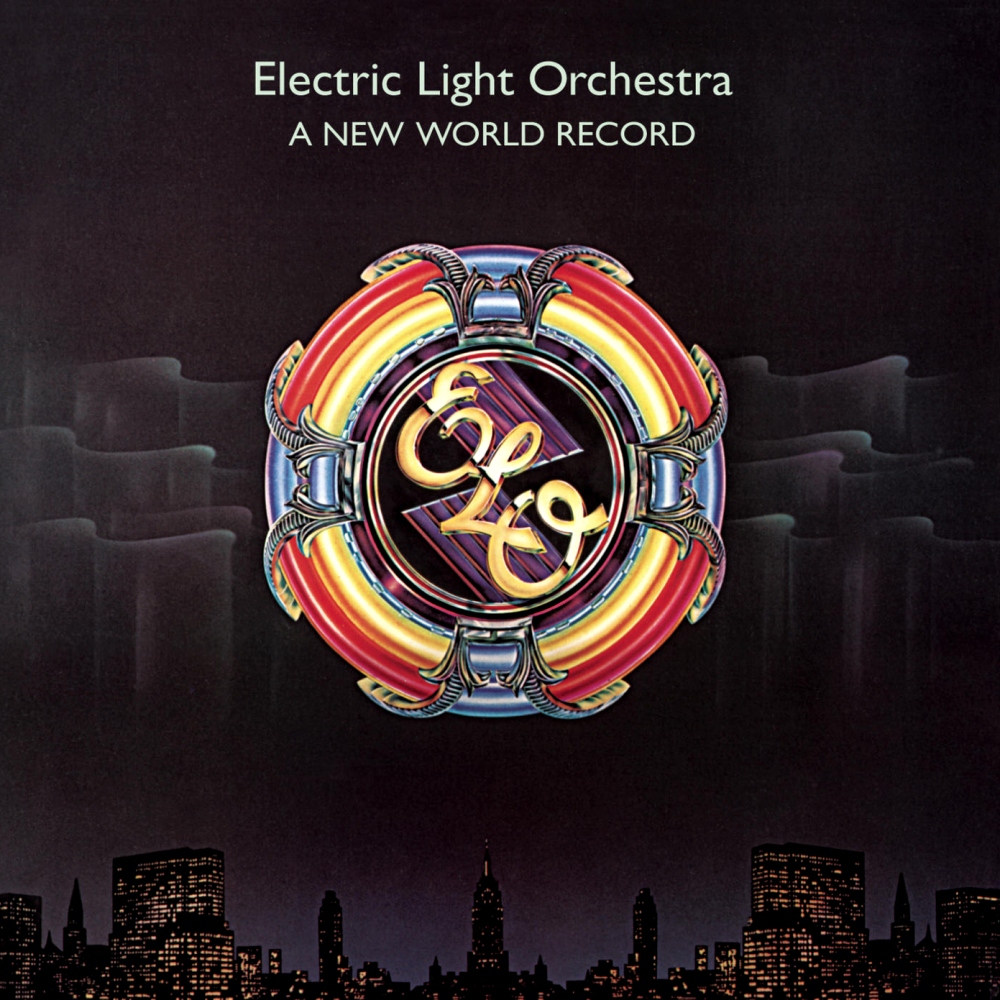
The now-iconic ELO logo made its debut on the cover of 1976’s A New World Record
BB: Well, I think he could see that it was gonna be Jeff’s band, really.
He was having trouble writing songs that would fit in for ELO. The last big single that we had with the Move, which was while ELO was on the road by this time–but we were still recording as the Move–was “California Man,” a big back-to-the-’50s rock ‘n’ roll song. And I think Roy got really into this and he left ELO to form a band called Wizzard, which did just ’50s early ’60s rock ‘n’ roll.
He left Jeff and I rather in a mess because he took some of the guys from ELO with him and there was a lot of bad feeling at the time. Time heals and now when we see him, of course, we’re friends again.
In fact, he did us a favor, really, because on stage, ELO was a real mess in the early days. We didn’t know what we were doing, we had the wrong equipment, we had too many people on stage. And when Roy left, it gave Jeff and I time to actually re-form ELO. We kept Richard Tandy on keyboards, who’s excellent. And brought in a whole new rhythm section, a new bass player. Made it a seven-piece group. In fact we still use the same instrumentation to this day. We still use lead bass, drums, keyboards and three-piece string section.
Related: ELO cellist, Hugh McDowell, died in 2018
[There’s a lot more, including Elsas’ wild coincidence of what he was playing on-air at the moment NYC’s famous 1977 blackout occurred. Listen to their entire conversation here.]
The extensive ELO catalog is available in the U.S./worldwide here, in Canada here and in the U.K. here.



2 Comments so far
Jump into a conversationNotice how he mentioned twice that it was going to be Jeff’s band? Bev Bevan and all the former band members is what makes up ELO. Not just Jeff alone. It may be Jeff’s band legally but to the fans it is all of the players!
Jeff is ELO.
Nobody is denying the others contributions at all but ELO’s success was because of Jeff.