
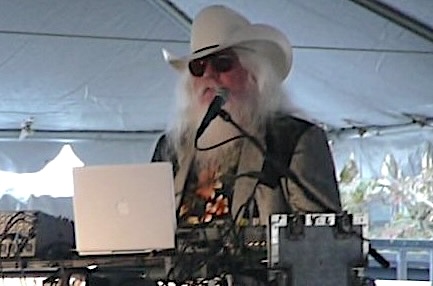
Leon Russell performing in Hoboken, NJ, in 2009. (Photo © Jeff Tamarkin; used with permission)
Leon Russell was one of those musicians whose fingerprints seemed to be everywhere. Born on April 2, 1942, he became a first-call session player in Los Angeles, a key figure in Joe Cocker’s Mad Dogs & Englishmen tour, a songwriter whose compositions became standards and eventually a star in his own right, he brought gospel, country, blues, R&B and rock ’n’ roll together in a sound that was unmistakably his own. He was inducted into both the Rock & Roll Hall of Fame and the Songwriters Hall of Fame in 2011.
Russell‘s catalog is sprawling and sometimes downright eccentric, which makes reducing it to 16 songs no easy task. These selections trace the essential arc: the landmark 1970 debut, the Shelter years, Carney, the theatrical Leon Live, his Hank Wilson country alter ego and his late-career collaboration with Elton John. Russell died on Nov. 13, 2016, at age 74.
“If It Wasn’t for Bad”—(The Union, 2010)
His album with Elton John was more than a comeback story. It put two distinctive piano-playing songwriters together, and this was one of its highlights. The track earned a Grammy nomination for Best Pop Collaboration with Vocals, while the album reached #3 on the Billboard 200. Enjoy this live performance.
“Back to the Island”—(Will O’ the Wisp, 1975)
By this point, he was exploring a looser, more relaxed sound. The track reflects that shift, bringing together the rootsy and soulful elements that had always been part of his musical vocabulary.
“Lady Blue”—(Will O’ the Wisp, 1975)
This gave him one of his biggest solo hits, reaching #14 on the Billboard Hot 100. There is a polished, almost pop-oriented quality to the recording, but his distinctive vocal and piano playing keep it firmly within his musical universe.
“Roll in My Sweet Baby’s Arms”—(Hank Wilson’s Back!, 1973)
He put his rock-star persona aside and returned to the country music he had loved since childhood, recording under the Hank Wilson pseudonym. His version of the traditional favorite reached a modest #57 on the Billboard country chart and #78 on the Hot 100. It was proof that he could inhabit country music as naturally as rock, blues or gospel.
“Queen of the Roller Derby”—(Leon Live, 1973)
The live version captures him at the height of his stage powers. Although recorded during the Carney sessions, it first appeared as the non-album B-side of the “Tight Rope” single in 1972. It was subsequently included on the sprawling live set, where the performance gives the song considerably more muscle.
“Out in the Woods”—(Carney, 1972)
Few songs in the catalog sound quite like this. Driven by percussion and a strange, almost hypnotic vocal arrangement, it demonstrates the experimental side of an artist who could move from a piano ballad to something downright primal without missing a beat.
“This Masquerade”—(Carney, 1972)
The eccentricity of the album makes the elegance of this ballad all the more striking. He delivers a melancholy portrait of a relationship falling apart with unusual restraint. George Benson’s later recording became a major hit and won the 1977 Grammy for Record of the Year.
Related: Our interview with Leon Russell
“Tight Rope”—(Carney, 1972)
Arguably the quintessential Leon Russell recording: theatrical, slightly surreal and completely memorable. It became his biggest solo hit, reaching #11 on the Hot 100, while the album climbed to #2 on the Billboard 200.
“Jumpin’ Jack Flash/Young Blood”—(The Concert for Bangladesh, 1971)
He nearly steals the show during George Harrison’s historic benefit concerts at Madison Square Garden. He tears into the Rolling Stones’ “Jumpin’ Jack Flash” before moving into “Young Blood” (co-written by Doc Pomus, Jerry Leiber and Mike Sttoller and made famous by the Coasters), displaying the flamboyant piano playing and larger-than-life stage presence that made him such a formidable live performer.
“Crystal Closet Queen”—(Leon Russell and the Shelter People, 1971)
Odd, funky and unmistakably his, this shows why conventional genre labels never quite fit. Its loose-limbed arrangement and eccentric character are typical of an artist who was rarely interested in playing it safe.
“Stranger in a Strange Land”—(Leon Russell and the Shelter People, 1971)
The second album found him expanding rather than simply repeating the formula of the debut. This Don Preston co-write has a tougher, more expansive feel, with its writer sounding like both a rock star and a bandleader. The album reached #17 on the Billboard 200.
“Superstar”—(Mad Dogs & Englishmen, 1970)
Co-written with Bonnie Bramlett, this began as “Groupie (Superstar)” before becoming a standard. Rita Coolidge sang it with Joe Cocker’s ensemble, helping establish it before the Carpenters turned it into a major hit. His role is an important reminder that his influence extended well beyond his own records. [The album is available in the U.S./worldwide here, in Canada here and in the U.K. here.]
“Roll Away the Stone”—(Leon Russell, 1970)
Another showcase for his knack for combining gospel, blues and rock, this driving number features Eric Clapton, Bill Wyman and Steve Winwood. Released as a single, it peaked at #109 on Billboard’s Bubbling Under chart.
“Delta Lady”—(Leon Russell, 1970)
Written for Rita Coolidge, this became one of his signature compositions. Joe Cocker had already recorded it for his self-titled 1969 album, but the rousing original version brings its Southern-soul character into sharp focus. Check out this live version.
“Dixie Lullaby”—(Leon Russell, 1970)
There is nothing sleepy about this “lullaby.” Co-written with Chris Stainton, it is a loose, gospel-tinged rocker that establishes the earthy character of the first solo album. The debut also featured an extraordinary cast of musicians, including Clapton, George Harrison, Ringo Starr and Joe Cocker.
“A Song for You”—(Leon Russell, 1970)
One of his defining compositions, this is a remarkably direct plea for intimacy and understanding. Its emotional power made it one of the most recorded songs in his catalog, with more than 200 artists taking it on, among them Aretha Franklin, Willie Nelson, Herbie Hancock and, again, the Carpenters. It was inducted into the Grammy Hall of Fame in 2018.
Russell’s solo recordings are available here.
Related: Our interview with Russell




No Comments so far
Jump into a conversationNo Comments Yet!
You can be the one to start a conversation.