
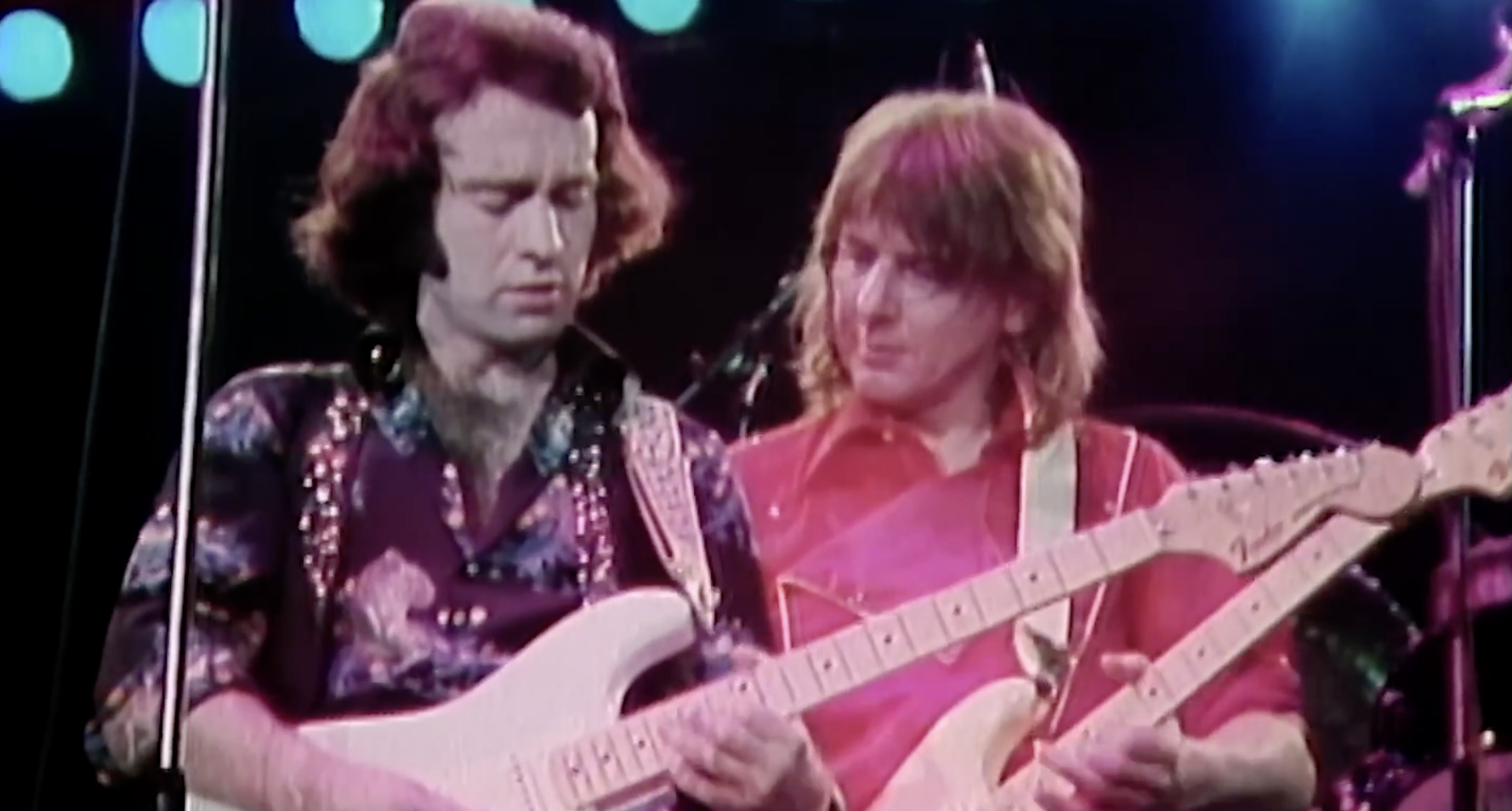
Paul Rodgers and Mick Ralphs of Bad Company
A great rock song can stop you mid-conversation, sending you rushing to turn up the radio, and leaving you humming the chorus long after the DJ had moved on. The 1970s delivered plenty of those moments, with bands that knew their way around a killer riff, a dramatic buildup and a chorus that practically demanded to be sung along with.
In Part 1 (including songs from Fleetwood Mac and the Allman Brothers Band) and Part 2 (with classics from BTO and Foreigner), we revisited more of the decade’s unforgettable recordings. Part 3 delivers more classic-rock essentials, from twin-guitar fireworks and progressive-rock epics to a country-rock favorite reborn. And it’s all a reminder that rock was an essential part of the Top 40 radio format.
Kansas—“Carry On Wayward Son” (Leftoverture, 1976)
Intricate instrumental passages, layered vocals and a chorus tailor-made for full-volume singalongs come together in this Kerry Livgren composition. The band’s first Top 20 hit on the U.S. Hot 100 peaked at #11 in 1977, proving that progressive-rock complexity and an irresistible hook could make a formidable team.
Styx—“Come Sail Away” (The Grand Illusion, 1977)
Starting with Dennis DeYoung’s reflective piano opening before gradually giving way to a synthesizer-powered climax, this track turns a thoughtful ballad into an arena-sized anthem. Released as a single in 1977, it reached #8 on the Hot 100 in January 1978.
Thin Lizzy—“The Boys Are Back in Town” (Jailbreak, 1976)
Interlocking guitar lines from Scott Gorham and Brian Robertson give Phil Lynott’s tale of old friends returning to familiar territory its unmistakable swagger. The Irish band’s breakthrough American hit reached #12 on the Hot 100 in 1976, turning its twin-guitar attack into an enduring hard-rock calling card.
Bad Company—“Can’t Get Enough” (Bad Company, 1974)
Over a guitar riff that makes its point without unnecessary fuss, Paul Rodgers delivers a bluesy, no-nonsense vocal. The supergroup’s debut single—written by their underrated songwriter Mick Ralphs—climbed to #5 on the Hot 100 in 1974, with Rodgers and drummer Simon Kirke bringing the chemistry they’d developed together in Free.
Foghat—“Slow Ride” (Fool for the City, 1975)
A chunky guitar riff and an unhurried blues-rock groove give this performance its staying power, while the original album version lets the band stretch out beyond the shorter single edit. The single peaked at # 20 on the Hot 100 in 1976, helping bring the British blues-rock outfit a much wider American audience.
The Edgar Winter Group—“Free Ride” (They Only Come Out at Night, 1972)
Produced by Rick Derringer and written and sung by Dan Hartman, this exuberant rocker reached #14 on the Hot 100 in 1973. The same album also yielded “Frankenstein,” the instrumental that topped the chart, showcasing two very different sides of the group’s musical personality.
Related: Our deep dive into the “monster” album
Yes—“Roundabout” (Fragile, 1971)
From Steve Howe’s acoustic introduction, the arrangement opens the door to Chris Squire’s distinctive bass, Rick Wakeman’s keyboards and Jon Anderson’s unmistakable vocals in a progressive-rock showcase full of twists and turns revealing their exceptional musicianship. The original runs for more than eight minutes, while the heavily edited U.S. single was trimmed to 3:27 and reached #13 on the Hot 100 in 1972.
Journey—“Lights” (Infinity, 1978)
Before the band’s later stadium-rock dominance, Steve Perry’s warm vocal and Neal Schon’s melodic guitar work revealed a gentler side of the group. Perry recalled that he originally wrote the song in and about Los Angeles, before reworking it upon joining Journey into an affectionate tribute to San Francisco, the city his new band called home.
Blondie—“One Way or Another” (Parallel Lines, 1978)
Behind Debbie Harry’s cool delivery and the track’s buoyant rhythm lies a darker backstory: the lyrics were inspired by her experience of being stalked by a former boyfriend. Co-written with bassist Nigel Harrison, whose musical idea helped shape the recording, it became a standout from the album that helped turn the New York band into an international sensation.
Linda Ronstadt—“When Will I Be Loved” (Heart Like a Wheel, 1974)
Originally recorded by the Everly Brothers in 1960, this Phil Everly composition got a spirited country-rock makeover from Ronstadt. Her version reached #2 on the Hot 100 in 1975 and topped Billboard’s country singles chart, giving the song a remarkable second audience.
Some of the biggest rock acts and tracks from the era that spawned Album Oriented Radio (AOR) are the subject of a 2026 collection from Cherry Red Records. The title, No Static at All: A Journey Into AOR 1976-1986, is available to order here.





No Comments so far
Jump into a conversationNo Comments Yet!
You can be the one to start a conversation.