
Lowell George’s Sole Solo LP, ‘Thanks I’ll Eat It Here’: Review
by Mark Leviton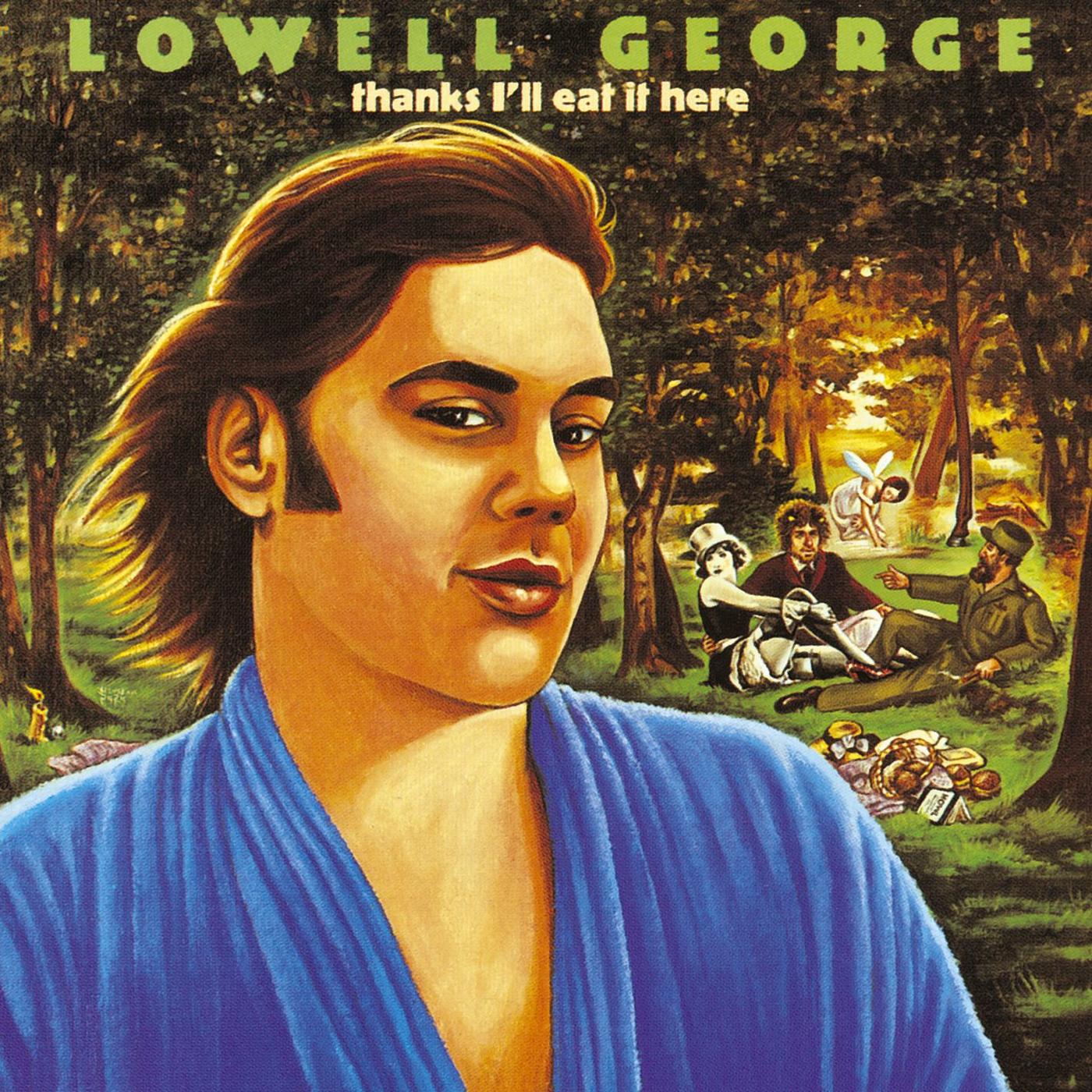 In the brief time Lowell George graced our planet with his unique presence, he was deeply loved by a large group of family and friends who knew him intimately and impressed many thousands of people who only “met” him through his recordings or while he was entertaining them on stage as a slide guitar master and vocalist with Little Feat. He could write songs of deep emotion and playful wit and sing them with a number of shades of melancholy and humor, but he was also an enigmatic and troubled man.
Born in Los Angeles on April 13, 1945, he departed this realm June 29, 1979, collapsed in a hotel room in Arlington, Virginia, the day after playing a show at Lisner Auditorium in support of his debut solo album, Thanks I’ll Eat It Here, released just months earlier on March 2. The coroner determined George died of a heart attack, but anyone who knew him well connected his demise to his prodigious use of heroin, cocaine and alcohol, and the binge eating that sometimes pushed his weight near 300 pounds.
Immediately after his death, and to this day, his friends and biographers use colorful terms to describe a man of many talents and contradictions. More than one bandmate described him as both hugely generous and infuriatingly stubborn. According to Jerry Garcia, the Grateful Dead picked him to produce their Shakedown Street LP because “we wanted someone who understood band mechanics” and could grab an instrument to demonstrate a point if he had to.
Van Dyke Parks, an early advocate for Little Feat at Warner Bros. Records, suggested George “had the audacity of a schizophrenic…a madness in his work that he wanted to explore, and he had the integrity to do it.” Those who do not throw around the word “genius” lightly don’t hesitate to apply it to him: Jackson Browne once described George as “the Orson Welles of rock.” He was interested in art and took his financial health as beside the point: “I think of all those pop groups making money every night, and I can’t imagine doing that. I wouldn’t last a week…the idea of accumulating wealth has never appealed to me.”
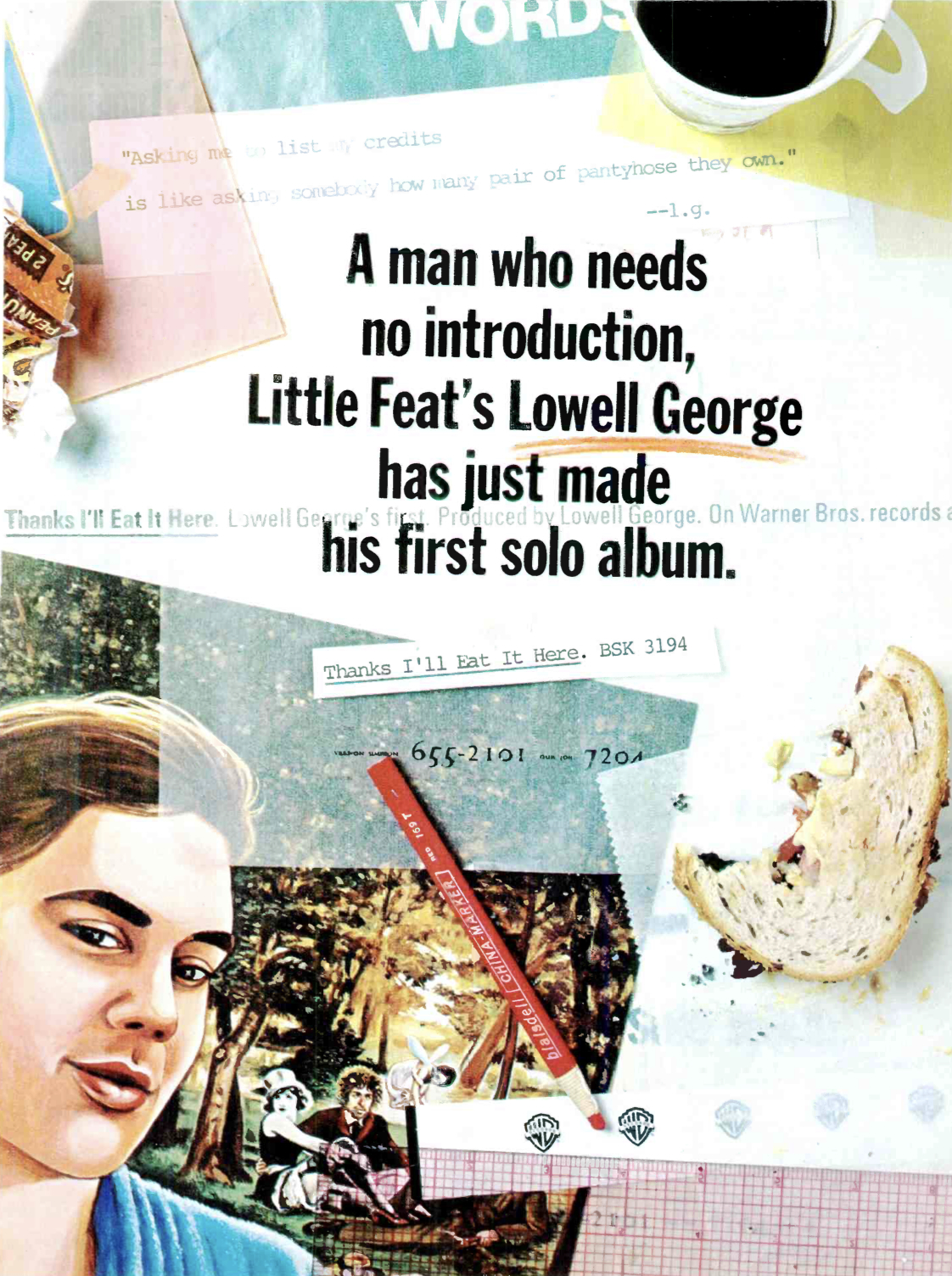
This ad for the album appeared in the March 31, 1979, issue of Record World.
The gestation of Thanks I’ll Eat It Here began in Little Feat’s frustration with George’s on-stage slip-ups, and his growing indifference to diligent work in the recording studio as they struggled to finish a new LP, eventually called Down on the Farm. “Before Lowell died the band fired him because things were totally out of control drug wise,” explained George’s friend and co-writer Fred Tackett during a 2018 appearance on the Powertalk podcast. “Everybody was out of control except [band co-founder and keyboardist] Billy Payne.”
After George’s death, Tackett worked with the band to finish a song he’d written with George, “Be One Now”: “It was a horrible time because we were in the studio and we’re overdubbing guitar parts and harmony parts and listening to Lowell singing, ‘If you want to love me/Be my friend/Be one now.’”
In an interview about six months before his death, George told me, “I tried not to use anyone from the band” on his own sessions. “It’s tough to separate myself from the group, but these sessions were really my own. I started recording in September of 1976 and whenever I had time—when we weren’t on the road or recording—I’d book some time and work on it. Our drummer Richie Hayward does appear on one track, a Jimmy Webb song called ‘Himmler’s Ring,’ but the rest of the playing is by Jim Keltner, Chuck Rainey, Dean Parks, Jeff Porcaro, David Foster, James Newton Howard, Fred Tackett, Jerry Jumonville and others who really did some great stuff. We even got Bonnie Raitt and J.D. Souther to do some back-up vocals.”
Although half of any 1978 Little Feat live show still consisted of Lowell George songs, their fans certainly noticed that George authored only five of the 17 tracks on their last two studio albums, The Last Record Album and Time Loves a Hero. According to George’s guitar-slinging bandmate Paul Barrere, George hit a dry spell, enabling other members to contribute more material. He also became disillusioned with the group’s forays into what he dismissed as “progressive rock.” (George also had a couple hospital stays, reportedly dealing with hepatitis.)
Related: Our Album Rewind of Waiting for Columbus
George explained to me the songs he’d been writing in ’78 and ‘79 weren’t exactly consistent with the current Little Feat style. Basically, he didn’t want his album to sound too much like a continuation of Little Feat, given it was possible the group would break up for good once his termination became commonly known. And yet he didn’t want to start completely from scratch and put out something Little Feat fans wouldn’t relate to. The whimsical album cover by Neon Park, Little Feat’s usual LP sleeve artist, shows George in a bathrobe near a recreation of Édouard Manet’s painting Le Déjeuner sur l’herbe crashed by Bob Dylan, Marlene Dietrich and Fidel Castro. Another link to the band he was rejecting.
Thanks, I’ll Eat It Here lives in an ambiguous musical and marketing space. George can’t resist his penchant for re-doing already-released material, in a version of “Two Trains,” found in earlier form on Little Feat’s Dixie Chicken, and arranged with much more complexity here. The first 40 seconds show off a masterful interplay of guitar lines, but since the seven guitarists who contribute to the album aren’t credited track-by-track, there’s no telling who to praise outside of the leader himself. (The liner also credits 10 keyboard players, seven drummers and three bass players, most of them the top studio musicians in L.A.)
George was proud to feature a new discovery, Rickie Lee Jones, with one of her songs, “Easy Money” (her version was released a mere week before his). His re-imagining of the 1973 Ann Peebles R&B hit, “I Can’t Stand the Rain,” shows his interest in unusual rhythms and the colors available from blending acoustic and electric string instruments, as does “Cheek to Cheek,” a mariachi number he wrote with Van Dyke Parks and Martin Kibbee, which Martin Gerst’s harp enlivens greatly.
“I Can’t Stand the Rain” has a magnificent horn arrangement (probably helmed by trumpeter Jim Price if it’s not Jumonville), a slide guitar solo to die for, and a vocal that shows George’s ability to swoop into falsetto at will. Coming at the end of the first LP side, it provides a perfect bookend to the album’s opening track, a super-soulful, horns-drenched version of Allen Toussaint’s “What Do You Want the Girl to Do.”
Tackett contributes two excellent compositions which show his flexibility and wide range, attributes that allowed him to join Little Feat full-time in 1987 after the hiatus brought about by George’s death. He’s the sole author of “Find a River” and co-wrote “Honest Man” with George.
“Find a River” is folky, with a tender weariness that seeks some shelter, in the arms of a woman, God or anywhere: “I want to find a river/And take it down to the sea…You know you could help me through/You know I would return in kind/I want to find a city/That’s open wide/That’s open all night/Where I could not hide.” George’s vocal is heartbreaking. “Honest Man” is a clavinet-driven funk workout with another terrific gospel chorus and horn section.
The most unique composition on the album is “Twenty Million Things to Do,” a song George co-wrote with his eight-year-old son Jed. “I gave Jed a tape recorder for Christmas,” he explained to me, “and he and a friend had lots of fun singing into it. One day I overheard them when they were playing it back—there was a lot of giggling and laughing on it, but also some lyrics that went ‘I’ve got twenty million things to do/And I’m only thinking of you.’ I worked on those words for a long time, tried to improve, but I couldn’t, so that’s pretty much how it ends up on the album.”
One song that didn’t make the cut for the disc must be mentioned. “China White” is a George original that had been around for years waiting for a home, and while he left it off Thanks I’ll Eat It Here, a previously unreleased version from 1978 was included in Little Feat’s rarities compilation Hoy-Hoy! two years after George’s passing.
No matter how anguished, a song about heroin in this context is quite unsettling: “My sweet China white/She ain’t here tonight/Her love has robbed me blind/Cast away, cast away/From this ball of pain.” The arrangement is a full gospel raver with its foundation in the blues; background vocals are by the Waters and Maxine Dixon, with Gordon DeWitty adding organ. George sings it with a fervor that shows his full range, from exaltation to resignation. As British journalist Richard Williams wrote, “Of all the hundreds of white boys who fell in love with the blues, few used the idiom with such brilliance as Lowell George.”
With many cast members coming and going, Little Feat has not just survived, but thrived, even though the Lowell George years are naturally considered their peak. Bill Payne’s highly anticipated memoir Carnival Ghosts is scheduled to arrive in February 2027, about the time Jesse Lauter’s detailed film Little Feat: The Documentary will hit theaters.
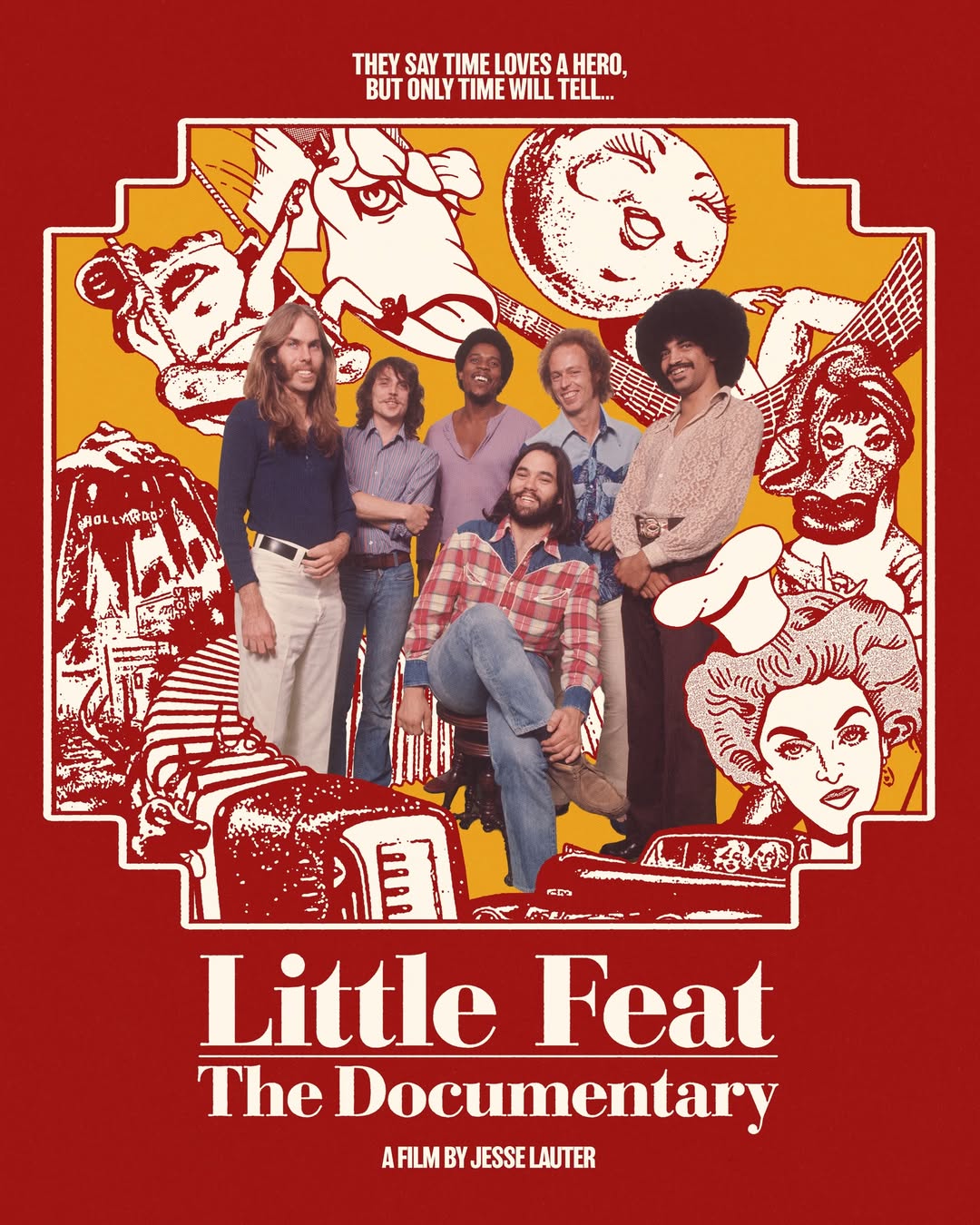
Related: Our review of Little Feat: The Documentary
Little Feat’s last two albums, Sam’s Place and Strike Up the Band, are well worth seeking out, and what they’ve waggishly dubbed the Last Farewell Tour continues into 2027. [The band’s recordings—including many expanded editions—are available in the U.S. here, in Canada here and in the U.K. here.]
The Little Feat catalog is full of gems, songs still being newly recorded by a variety of contemporary and legacy artists. Omnivore Records’ 2026 reissue of the Lowell George tribute album Rock and Roll Doctor, with tracks by Taj Mahal, Randy Newman, Bonnie Raitt, Emmylou Harris and many more, reminds us of the quality and ubiquity of George’s songs, from ballads “Willin’” and “Long Distance Love” to rockers like “Rocket In My Pocket” and “Feats Don’t Fail Me Now.” His talent and personality continue to resonate.
Many of George’s solo albums are available in the U.S. here, in Canada here and in the U.K. here.



No Comments so far
Jump into a conversationNo Comments Yet!
You can be the one to start a conversation.