
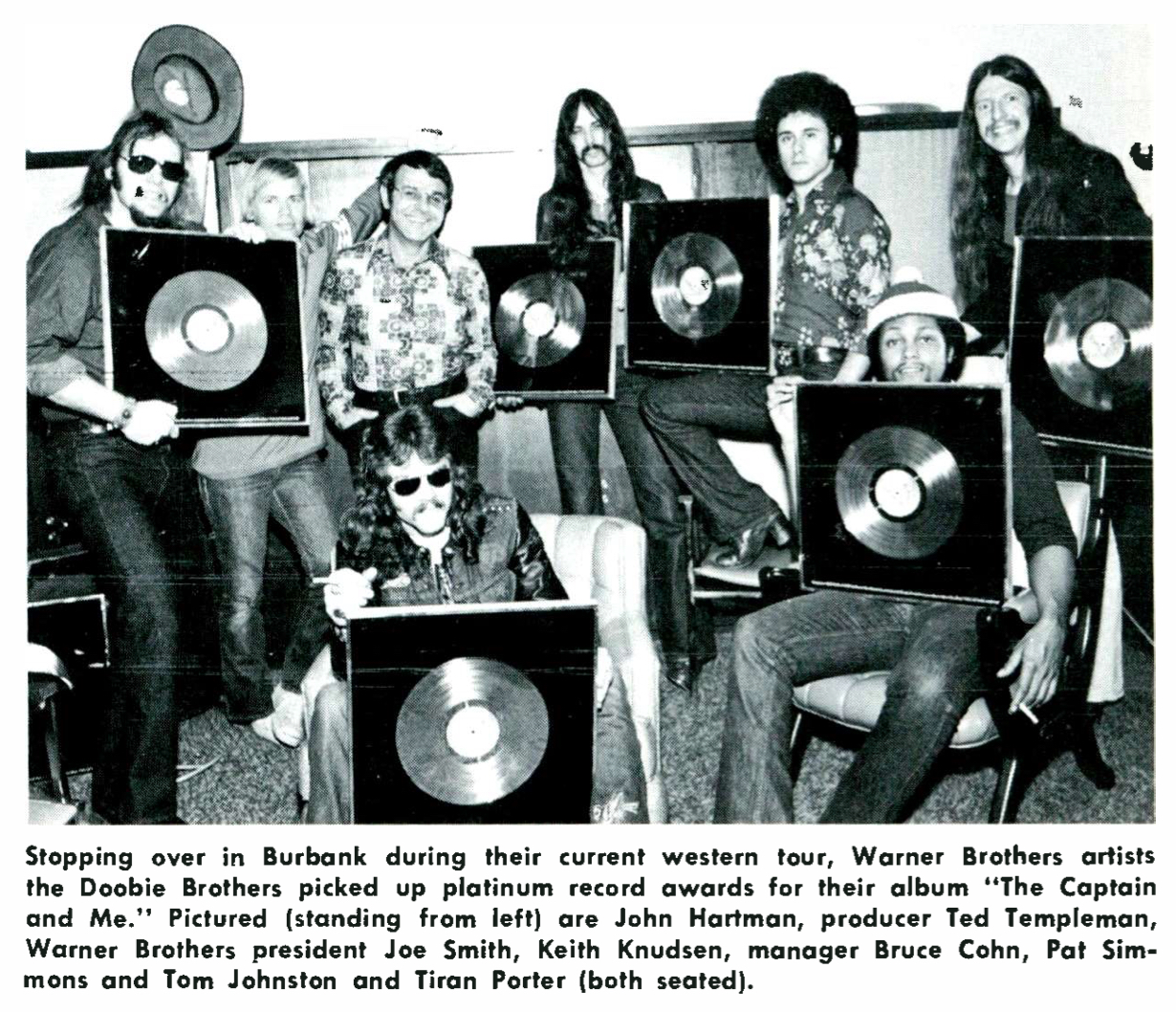
The Doobie Brothers receiving a Platinum award for The Captain and Me in this photo from the April 6, 1974, issue of Record World.
The Doobie Brothers were one of radio’s most consistent hitmakers throughout the 1970s. Tom Johnston powered the early run—writing and singing lead on such classics as “Listen to the Music” (#11, 1972), “Long Train Runnin’,” (#8, 1973) and “China Grove” (#15, 1973)—before a health crisis sidelined him. (Fellow founding member Patrick Simmons was also a significant writer penning, most prominently, 1974’s #1 smash “Black Water.”) Michael McDonald stepped in for Johnston, gradually reshaping the band’s sound toward a smoother, R&B-influenced direction with songs like “Takin’ It to the Streets” (#13, 1976). “What a Fool Believes,” co-written by McDonald and Kenny Loggins, topped the chart in ’79 and won Grammys for Record of the Year and Song of the Year. The band was inducted into the Rock & Roll Hall of Fame in 2020.
Beyond those hits, albums like 1972’s Toulouse Street, 1973’s The Captain and Me, 1974’s What Were Once Vices Are Now Habits and ’75’s Stampede are full of tracks, produced by longtime Warner Bros. Records A&R exec Ted Templeman, that were never major singles but stand out nonetheless. Here are 11 worth revisiting.
“Mamaloi” (Toulouse Street)
Simmons brought a breezy Caribbean flavor to this early deep cut with Johnston’s lead vocals. On their second album, the band was already pushing beyond straightforward boogie rock.
“Natural Thing” (The Captain and Me)
First track on the third album, this Johnston creation hit hard with intricate synthesizers and strings —one of the dreamiest tracks from the band’s early years. The LP eventually reached #7 on the chart and became one of the band’s biggest sellers.
“South City Midnight Lady” (The Captain and Me)
This acoustic ballad, written and sung by Simmons, became one of the most melodic songs in the band’s catalog. Jeff “Skunk” Baxter’s pedal steel gave the song its late-night feel. The gorgeous song was inspired by a relationship that Simmons had while living with his girlfriend in California.
Related: Our appreciation of the album’s “Long Train Runnin'”
“Eyes of Silver” (What Were Once Vices Are Now Habits)
Released as a single, the Johnston-penned song only reached #52 on the Hot 100. The track featured Bill Payne of Little Feat on the organ and the Memphis Horns providing the heavy brass backing. (The album took off once radio stations discovered “Black Water.”)
“Road Angel” (What Were Once Vices Are Now Habits)
Despite its easygoing title, “Road Angel” was one of the hardest-driving tracks the band recorded during the era. Gritty vocals from Keith Knudsen, Johnston and Simmons, and the band’s twin-drummer attack (John Hartman and Michael Hossack) drove the song hard.
“You Just Can’t Stop It” (What Were Once Vices Are Now Habits)
This groove-heavy track leaned into funkier and more syncopated rhythms than the band’s earlier material. It hinted at where the band would soon be heading. (The album became the band’s highest-charting LP at the time, reaching #4 record in the U.S.)
“Neal’s Fandango” (Stampede)
Simmons wrote this tribute to Neal Cassady, the legendary Merry Pranksters figure associated with Ken Kesey and the Beat Generation. It’s a high-octane, electrified country-rock shuffle that helped make it a longtime fan favorite and one of the defining album cuts.
“Slack Key Soquel Rag” (Stampede)
Inspired by traditional Hawaiian slack-key guitar music, this instrumental revealed a far more understated side of the band far from the radio hits. (The 1975 album also reached #4 in the U.S.)
“I Cheat the Hangman” (Stampede)
Placed second on side two of the original LP, and released as a single, this ambitious composition from Simmons leaned into darker and more atmospheric territory. There was really nothing else in the band’s catalog quite like it.
“Double Dealin’ Four Flusher” (Stampede)
Johnston, Knudsen and Simmons shared lead vocal duties on this gritty blues-rocker, the closing track from their fifth album. Even as the band’s sound evolved, tracks like this kept their rock and roll roots intact.
“Echoes of Love” (Livin’ on the Fault Line)
Co-written by Willie Mitchell, Earl Randle and Simmons, it blended Memphis soul influences with the band’s polished late-’70s sound. Though released as a single, it never became as well-known as many of the band’s other songs from that period, reaching just #66 on the Hot 100. (The song had originally been intended for Al Green.)
The Doobie Brothers are still very much active. The current lineup—Tom Johnston, Patrick Simmons, Michael McDonald and John McFee—released Walk This Road in June 2025, their 16th studio album and the first to feature all four in the studio together. In 2026, the band is out on two separate North American runs: a summer amphitheater tour with Carlos Santana and a fall headline swing tied to the 50th anniversary reissue of Takin’ It to the Streets. Tickets are available here and here.
Their first greatest hits collection, 1976’s Best of the Doobies, has sold over 10 million copies in the U.S. alone. Their recordings are available in the U.S. here, in Canada here and in the U.K. here.
The band shows no sign of slowing down. For a group that started in San Jose bars in 1970, that’s a run worth noting.





11 Comments so far
Jump into a conversationWhere is Without You, one of the Doobies best hard rock song, that is a fan favorite in live shows?
Absolutely. In fact, I am going to crank it up now, thanks to you!
Rocking Down The Highway
Larry and Rudestar—Both are great tracks. We just decided to limit the story to these 11.
Who knows? Maybe we’ll do a Part 2 at some point.
Disciple
Clear as the Driven Snow
Without You
Another Park, Another Sunday
Sweet Maxine
I love the Doobies, and for me, the album “Vices” is pure gold from start to finish. Great job!
All great songs but my favorite is Clear as the Driven Snow.
I would have included “Clear as the Driven Snow,” from “The Captain and Me,” one of my all-time favorite Doobie Brothers tracks
Always love “you just can’t stop it” from vices. I would include “dark eye Cajun woman” that is a fantastic song but I agree “clear as the driven snow” is top 10.
I always thought I knew all the Doobies best songs. Few years back I heard the song “Nobody”. Wondered how the heck that ever slipped by me. Helluva song right there!
“UKIAH” from the Captain & Me album. A top ten song.