
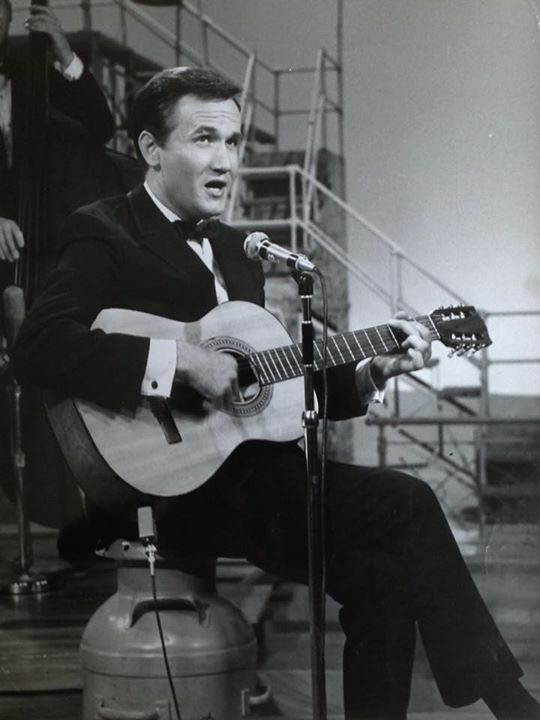
 One of the most praiseworthy characteristics of Top 40 AM radio in the ’60s was its willingness to give airplay to music from nearly any genre, as long as it appealed to a sizable percentage of listeners. Even at the height of the British Invasion in 1964-66, while rock music commanded the largest audience, AM stations in the U.S. played songs that fell into the jazz category (Louis Armstrong, Stan Getz), pop/easy listening (Barbra Streisand, Frank Sinatra) and R&B/soul (James Brown, Ray Charles).
For the week ending Feb. 8, 1964, for example, the very week those lads called the Beatles arrived in America, New York City’s top-rated WABC listed hits on its survey by jazz trumpeter Al Hirt, soul singer Major Lance, crooner Andy Williams and Motown’s Martha and the Vandellas, alongside rock and roll by the Rivieras, the Trashmen, Freddy Cannon and those cheeky youngsters from Britain.
Country music, too, showed up on the more inclusive general radio stations as early as the ’50s, whether from Patsy Cline, Buck Owens, Jim Reeves, Tammy Wynette or any number of others. As long as listeners stayed tuned, Top 40 stations ignored genre. One artist in particular proved repeatedly, starting in 1964, to be a favorite among those who might’ve come for the rock and roll but didn’t tune out when they heard a bit of twang. With 15 songs landing in the Billboard Hot 100, five of them climbing into the Top 10, Roger Miller became the undisputed country-pop crossover king of the era.
Miller was a different kind of country artist. While he was perfectly adept at singing a heartwarming, even heartbreaking ballad, most notably “King of the Road,” his biggest hit of all, he injected humor and tongue-twisting wordplay into many of his releases, the majority of which he wrote himself.
His very first Hot 100 hit, 1964’s “Dang Me,” caught on with the general record-buying public, not only because of its goofy take on scat singing but also due to Miller’s clever way with a lyric: No one had ever heard a rhyme like “Roses are red and violets are purple/Sugar’s sweet and so is maple surple,” simply because no songwriter had ever gone there before.
That song, released on Smash Records—as were all of his hits of that period—soared to #7 nationally even as the Fabs and their British colleagues seemed to be laying waste to the careers of many American singers. Miller’s followup, “Chug-a-Lug,” was another novelty hit, this time a paean to the consumption of moonshine, and it followed “Dang Me” right into the Top 10. “Do-Wacka-Do” somehow built an entire song around that silly phrase, and was followed by “King of the Road,” the song that would forever be associated most closely with its composer. Miller’s shuffling tale of the easygoing itinerant hobo, as a traveling homeless person was called then, would not only become his biggest hit but would be covered by hundreds of artists, from Dean Martin to Jerry Lee Lewis to R.E.M.
Unsurprisingly, this string of hit singles began earning Miller Grammy awards right from the start—five for his 1964 output alone (including Best New Country and Western Artist), then six more the following year, mostly for “King of the Road.” But while Miller might have been new to the majority of those who enjoyed these first hits, for the artist himself it had been a long time coming. Born in Ft. Worth, Tex., on Jan. 2, 1936, Roger Dean Miller had already established himself as an in-demand songwriter by the time his run of hits under his own name began. At first, he had little luck, and even took jobs as a fireman and a “singing bellhop” to make ends meet. Finally, Miller’s songs found their way to big-name country recording artists such as Ernest Tubb and Faron Young, and when Jim Reeves took Miller’s composition “Billy Bayou” to #1 on the Billboard country chart in 1959, the songwriter was on his way.
Miller had already signed to Decca Records in 1958, but had no success there, then switched to RCA Victor, where he first made the country singles chart in 1960 with “You Don’t Want My Love.” “When Two Worlds Collide,” the following year, gave Miller his first Top 10 country single, but real success as a performer continued to evade him until he signed with Smash and began turning his attention to novelty tunes.
Watch Miller perform “You Don’t Want My Love” for some friends in the ’80s
The hits came in quick succession once he gained a foothold: Both “Dang Me” and “King of the Road” topped the country charts, but it was really his success as a crossover sensation that made Miller a star. Following “King of the Road,” in 1965 he released the ballad “Engine Engine #9,” which set a woeful story of love lost to a sweet, happy-go-lucky melody and found its way to #7 on the pop charts. He sang: “Engine, engine number nine, coming down the railroad line/I know she got on in Baltimore/A hundred and ten miles ain’t much distance but it sure do make a difference/I don’t think she loves me anymore,” and who with a heart didn’t feel for the poor guy? “Kansas City Star,” also in ’65, borrowed its title from that city’s daily newspaper, and one can only wonder what its editors thought of a song that went “Kansas City star, that’s what I are/Yo del de del a de, you ought a see my car.”
There would be several other hits for Miller, most notably late 1965’s “England Swings,” which managed to capitalize on the era’s obsession with all things British while sounding pure Nashville: “England swings like a pendulum do/Bobbies on bicycles, two by two/Westminster Abbey, the tower of Big Ben/The rosy-red cheeks of the little children.” One of Miller’s more serious numbers, “Husbands and Wives,” examined the sadness of “angry words, spoken in haste/Such a waste of two lives,” before Miller returned to the silly (but lotsa fun) stuff with “You Can’t Roller Skate in a Buffalo Herd” and “My Uncle Used to Love Me But She Died” in 1966.
By that time, the pop audience was beginning to tire of what he had to offer, although Miller continued to be a presence on the country charts well into the ’70s and even the ’80s. His cover of “Little Green Apples,” a song written by Bobby Russell and recorded by Miller in 1968, squeaked into the top 40, and though it won a Grammy for Song of the Year, the award was for O.C. Smith’s R&B version that came out several months after Miller’s. One of Miller’s final hits to do well on the country charts, reaching #12, an early cover of Kris Kristofferson’s “Me and Bobby McGee,” predated Janis Joplin’s chart-topping version by more than a year but failed to make it into the Hot 100.
Miller had more or less hung it up as his career stalled in the late ’70s, save for the occasional project, notably Old Friends, a 1982 duets album with Willie Nelson, but he resurfaced again in 1985 when he was offered a gig writing the score for, and acting in, a new Broadway musical titled Big River, based on the classic Huckleberry Finn story. The musical earned seven Tony Awards, including Best Score, but Miller’s career wound down once again. He was diagnosed with cancer in 1991 and died the following year (on Oct. 25, 1992, at just 56), leaving behind a catalog of songs and recordings that was truly unique and continues to find new fans even today. Roger Miller was inducted into the Country Mudic Hall of Fame in 1995.
Watch Roger Miller mime “Dang Me” on American Bandstand
He’s the subject of an extended exhibition at the Country Music Hall of Fame and Museum. Roger Miller: Wit, Wisdom, and Wonder “follows the story of the musical savant whose multifaceted career earned him a flood of accolades and widespread affection from the public.” Visitors will see clothing, awards, handwritten notes, song manuscripts, instruments and rare footage of Miller’s television appearances and performances. The exhibit is included with museum admission and runs from Nov. 6, 2026 until March 2028.
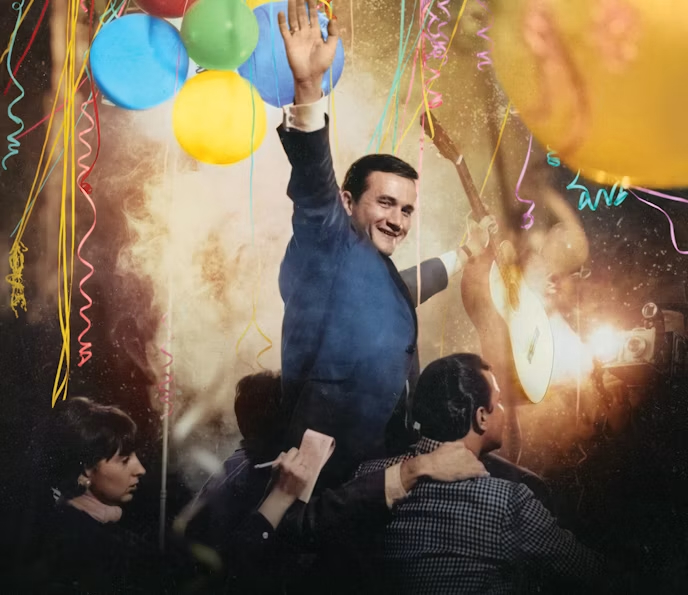
Roger Miller (Photo courtesy of the Country Music Hall of Fame and Museum)
Several Miller collections are available in the U.S. here, in Canada here and in the U.K. here.




No Comments so far
Jump into a conversationNo Comments Yet!
You can be the one to start a conversation.