

Tom Jones on stage (Photo from his website)
Even in his 80s, Tom Jones refuses to become an oldies act. Although he still sings his big hits at most (but not all) of his shows, he is constantly adding new, contemporary material to his sets and offering up new arrangements of classics from the worlds of blues, country, rock, etc.
A few years ago, after the release of his studio album Spirit in the Room—produced by Ethan John and including songs by Leonard Cohen, Bob Dylan, Blind Willie Johnson, Paul McCartney and Paul Simon, as well as Joe Henry, the Low Anthem and others—the legendary Welsh singer, born June 7, 1940, and whose voice is as strong as ever and whose performances still knock ’em dead everywhere he goes, sat down for a chat with Best Classic Bands editor Jeff Tamarkin. Most of this interview had never before been published until 2017.
Where does your drive come from, that desire to always keep moving ahead?
I love music, to start with. I want to continue to do it as long as possible. And it seems to me now that I have more freedom than I used to have. I don’t know exactly how to put this but when you’re young and starting out and you get some hit records, people start to form an image of you. Then as you get older, it seems that if people really want to hear me sing, they’re going to like it the more intimate I get.
You had a Dylan song,“What Good Am I?” on your 2010 album Praise & Blame, and then in 2012 you did “When the Deal Goes Down” on Spirit in the Room. What attracts you to Dylan?
I’ve always wanted to do a Dylan song—“Lay Lady Lay” or “Knockin’ on Heaven’s Door.” But those were iconic records so you can’t really do much more than what Dylan did with those things. So when I heard “What Good Am I?”—he speaks it more than sings it so I thought there’s room there for a different interpretation, and I love the sentiment. It’s a tremendous song, and it applies to all of us—we see things happening and we don’t do anything. That worked tremendously; everybody felt we’d nailed it. So [then] I thought, I’d like to do another Bob Dylan song so we listened and we did “When the Deal Goes Down.”
Watch Jones perform “What Good Am I?” at a 2013 benefit concert
Your arrangement of “Just Dropped In” is completely different from Kenny Rogers and the First Edition’s hit.
Yes. I’ve always loved [songwriter] Mickey Newbury and I’ve recorded quite a few of his songs. When I heard his version of “Just Dropped In” it was very basic. Then Kenny Rogers did it and popped it up. He did it on my [1960s] TV show and I thought, he’s taken that song, which I thought was a really interesting song, but he made a commercial record of it. I think you miss the point. My producer [Ethan Johns] said, “It’s an eerie song. It’s a mind trip.” So that was it.
You grew up listening to the BBC and you’ve said they played a lot of blues and country and rock ’n’ roll. Was that your primary source of American music?
You had to search for it. The thing with the BBC is now you’ve got BBC1, BBC2, but when I was growing up they played anything. You may have programs—a symphony program or a blues program—but they had to play it because it was only one station. Big Bill Broonzy would come on and you’d get Mahalia Jackson.
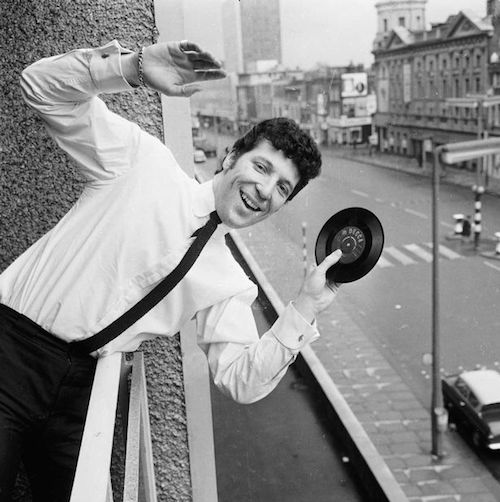
Tom Jones in the mid-’60s
What about American roots music appealed to you?
There was an honesty there that I did hear locally but it was coal miners singing in pubs. I liked it when they sang. When the miners would get up at the pubs in Pontypridd [Wales], they’d sing songs like “My Mother’s Eyes” or “My Yiddishe Momme.” They were songs that made you think—there was something very human about them. There was a similarity there about working class life or family life and struggles.
Related: Jones released a commanding new album in 2021
How old were you when you realized you had something that people seemed to really like?
I wanted to sing all the time. When I did, people would listen. When kids do something, if they have a talent, people listen to them. They don’t say, “Oh, shut up.” I was at my cousin’s wedding and my family was used to me singing because we all sang, but then there’d be strangers coming in and this fellow who had never heard me sing before—I remember he had a flat cap on; he was a coal miner. He threw it on the floor and said, “You don’t expect this kid to sing for nothing!” And everybody said, “Oh, it’s Tommy,” and he said, “This kid is a star!” So they threw money in the cap. That was the first time. I think I was about nine or 10 and somebody was hearing me that didn’t know me.
How did you get discovered in Pontypridd? This was not a place where stars came from.
I had this idea because I was singing in nightclubs for working class people. So I got this band together and took the place of another singer, and once I started singing with this group I thought we could play these clubs now. Because of the attention we were creating, I thought, somebody’s got to see it—somebody that can do something has to see it sooner or later. As it happened, [Jones’ future manager] Gordon Mills came from the same area. He came to visit his mother and saw me in this club and said, “You should be in London.”
How did “It’s Not Unusual” find its way to you?
Gordon had become a songwriter and he was writing for other people and I would do demos. Gordon said, “I’ve got the makings of this thing called ‘It’s Not Unusual.’” I said, “How does it go?” He said, “I’ll sing it to you in the car.” He’s singing it and when we got to the studio we did it, made this demo. It was supposed to be for [singer] Sandie Shaw, but when I heard it, I said I wanted it.
Watch Jones sing “It’s Not Unusual” on The Ed Sullivan Show
Any recollections of your first American tour?
The first thing that comes to mind is that America is a big country. We did it on a bus. In Britain you can move around pretty easily in a car or a van and it doesn’t take that long. But in America, Jesus Christ, we’d get on this bus after the shows and by the time we got to the next stop it was time to do the next show. You couldn’t go out between shows because there were so many kids. It was something I hadn’t experienced before.
I understand you didn’t really want to sing “What’s New Pussycat?”
When I did “It’s Not Unusual,” to me it was a pop song. [Producer] Peter Sullivan said, “This is not really a rock song but we have to try to make it one.” That’s why we had Jimmy Page playing on it, to try to rock it out. The B-side was a Burt Bacharach side, “To Wait for Love.” So I go to this flat in London, and [Bacharach] was with [actress] Angie Dickinson then, and I’m sitting there, I’m 24, and he said, “I’ll sing you the song” [“What’s New Pussycat?”]. I knew the Dionne Warwick songs he’d done and Chuck Jackson’s “Any Day Now.” He doesn’t sing very well, he knows that. I couldn’t quite get the melody of it. When he finished he said, “So what do you think?” I said, “No, I can’t. I’m sorry. I love what you’ve done, Mr. Bacharach, but I don’t understand why you would want me to sing that? I can’t make head nor tail of it.” He said, “Look, this is [for] a crazy movie. It’s a crazy song. You’ve got to sing the hell out of it and then it’ll make sense.” He said, “Don’t think of it as a rhythm and blues song. Just think of it as being for a Woody Allen film. Get the spirit.” I said, “I’ll tell you what, I’ll demo it for you.” He showed me a bit of the film and I demoed it and at least I got the melody down. I got the structure of the song but I was still unsure. He said, “Well, try it,” and we went in and did it.
By the late ’60s you were no longer considered hip by the Woodstock crowd, yet you had your TV show and were singing duets with artists like Janis Joplin, Joe Cocker, and Crosby, Stills, Nash and Young. What did they know that the younger audience no longer seemed to?
That was my idea. I said, “If you want me to do this show, it’s not going to be like Andy Williams’ or Dean Martin’s shows. I can do part of that, but I must have people of my generation, my contemporaries. So if you want me to sing with Robert Goulet, I’ve got to have Wilson Pickett on. If you want me to sing with Barbara Eden, I’ve got to have Jerry Lee Lewis. I need Crosby, Stills, Nash and Young. I need Blood, Sweat and Tears and Janis Joplin, Ray Charles, Aretha Franklin. I need people I can do duets with. Then I’ll do a middle of the road person if you like.”
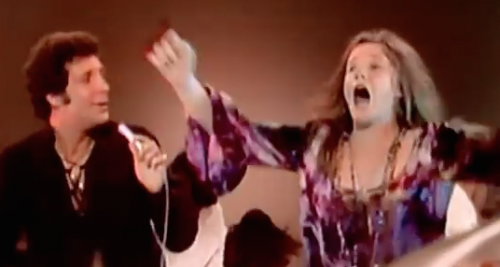
Janis Joplin’s guest performance on This Is Tom Jones aired in the U.S. on December 4, 1969.
How did you get started playing Vegas, where you became a huge star all over again in the ’70s?
I was doing Ed Sullivan’s show and in ’65, TV went to color and they couldn’t transmit in color from New York so they moved the show to L.A. So the next time I came I went to L.A., and I’m out there and with The Ed Sullivan Show they used to have you for a week. Even though you didn’t do it till the following Sunday, you were there on Monday. While I was in L.A., I thought, I’d love to go to Vegas. I went to Las Vegas and funnily enough Ed Sullivan was there. I’m looking at these shows and I thought I could tear the sh*t out of these buildings. I could see it. There were established entertainers in the main rooms—the lounges would have rock and roll but not in the main room. Then in ’68, I was offered to go sing at the Flamingo. But I wasn’t thinking maybe I can be a Vegas act—it was a great place to play, with a lot of other entertainers.
You went country for a while in the ’80s and then your career sort of died down for a bit. Would you say that the rebirth of your music started with your 1988 cover of Prince’s “Kiss”?
I was waiting for it. I was biding my time. In the ’80s I signed with PolyGram Records and they said, “What about a country album?” I said sure. Then I got locked in there for a while. I thought I had to get out of this so I started looking for a new song to get back on Top 40 radio. I was doing the “Kiss” song on my live show. Then I got with the [group] Art of Noise and they showed me how to do it and when I heard the finished thing, I thought if this is not a hit… Thank God it was. That started the ball rolling.
Watch Tom Jones perform Randy Newman’s “You Can Leave Your Hat On” in 2007
Jones has dates on his concert calendar. Tickets are available via Ticketmaster and here. His recordings are available in the U.S. here and in the U.K. here.



4 Comments so far
Jump into a conversationI’ve seen Tom Jones live on several occasions, and he has a voice that can knock down walls. He’s perhaps the most virile, masculine singer I’ve ever heard. What a voice! What a persona! Listen to him sing and then compare him with the pseudo-talent that’s out there now. No one–and I mean no one–can come close to his range and power, and he’s 83 years old!. The guy can sing anything and make it sound good.
Having seen him about a dozen times, I would not argue with what you said. I also saw him on this tour and he’s as good as ever.
A really nice guy . He would arrive at the theatre about 3 or 4pm to go over the cues with the local pickup band then spend the rest of the day with the crew eating a big bowl of pasta fagioli , a beer and watching The Simpsons and Jeopardy . About 8pm hed say “ok its time to go turn into him” and 15 minutes later hed be back in his tux ready to go out and do a killer show .