

Woody Guthrie (Photo by Al Aumuller, from Guthrie’s website)
Dust Bowl balladeer. Political activist. Union organizer. Protest singer. Writer. Rambler. Forefather of the Folk Revival. Iconic American archetype. Born in Oklahoma on July 14, 1912, Woody Guthrie, his life and work, has had influence, relevance and resonance right up to the current day. Here are 15 reasons why, introduced by his foremost musical acolyte.
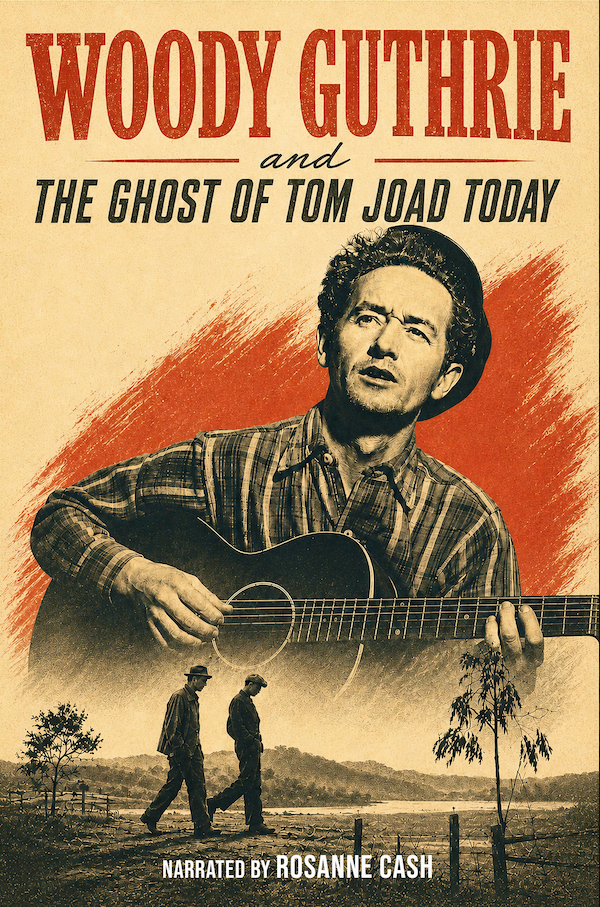
Woody Guthrie and the Ghost of Tom Joad Today, a new documentary directed by Greg Mitchell and narrated by Rosanne Cash, exploring the life, work and enduring impact of Woody Guthrie, is available to screen on PBS.org here.
Bob Dylan—“Song to Woody”—One of only two songs he wrote on his 1962 debut album, Bob Dylan, a paean to his idol and role model, incapacitated and hospitalized by that time with what was then known as Huntington’s Chorea, now more commonly referred to as Woody Guthrie’s Disease. Its melody is derived from Guthrie’s song “1913 Massacre” (see Arlo Guthrie, below).
Charlie Feathers—“Oklahoma Hills”—Co-written with his cousin Jack Guthrie, who scored a #1 hit with it on the country charts in 1945, this version was recorded by the 1950s rockabilly legend for his comeback album Charlie Feathers, issued in the short-lived, highly regarded Nonesuch American Explorer series.
Sharon Jones and the Dap-Kings—“This Land Is Your Land”—Written in response to Irving Berlin’s “God Bless America,” as a more inclusive, expansive take on an American anthem, here recorded by the great retro-soul singer and her band on their second album, Naturally. Guthrie’s most covered song.
Jefferson Starship—“Pastures of Plenty”—Describes the place of the migrant worker in American society during the Great Depression, from the band’s penultimate album, Jefferson’s Tree of Liberty, in 2008 (their last with founder the late Paul Kantner), harkening back to his roots in folk music.
The Highwaymen—“Deportee (Plane Wreck At Los Gatos)”—A further illustration of the plight of the migrant, in this case immigrant, worker, recorded by Johnny Cash, Willie Nelson, Waylon Jennings and Kris Kristofferson (with an assist from Mexican-American country star Johnny Rodriguez) in their first outing as a supergroup, 1985’s Highwayman.
Ry Cooder—“Do Re Mi”—Commentary on the economy of the State of California, from his first solo album, Ry Cooder, in 1970. Originally found on Guthrie’s concept album, 1940’s Dust Bowl Ballads, and decidedly not to be confused with a song of the same name from The Sound of Music.
The Byrds—“Pretty Boy Floyd”—In which a tune about a Depression-era outlaw and latter-day Robin Hood is transformed into a bluegrass-style track from the Gram Parsons-era Byrds’ seminal country-rock album Sweetheart of the Rodeo in 1968. Another song from Dust Bowl Ballads.
U2—“Jesus Christ”—The saga of Jesus is sung and the suggestion made that he would have suffered the same fate in the present day as he did in biblical times. From Folkways: A Vision Shared—A Tribute to Woody Guthrie and Leadbelly, a 1988 various artists collection.
Related: Our interview with Woody’s son, Arlo Guthrie
Bruce Springsteen—“Vigilante Man”—A song about the violent goons who were hired to prevent Dust Bowl migrants from settling in California. One more from the 1988 album Folkways: A Vision Shared—A Tribute to Woody Guthrie and Leadbelly, originally included on Dust Bowl Ballads.
Swamp Dogg—“Dust Bowl Refugee”—The ever-eccentric and eclectic singer, songwriter and producer Jerry “Swamp Dogg” Williams Jr. has been making records since the 1950s but this is likely the first time he’s covered a Woody Guthrie song—on Home in This World: Woody Guthrie’s Dust Bowl Ballads, from 2020.
Indigo Girls with Ani DiFranco—“Ramblin’ Round”—The life of the itinerant Dust Bowl refugee in search of work as described in the duo of Amy Ray and Emily Saliers’ 2005 release Rarities, a compilation of stray studio and live recordings, covers and originals and collaborations, here with folk artist and activist DiFranco.
Arlo Guthrie—“1913 Massacre”—He has recorded many of his father’s songs over the course of a long career and this recounting of the death of striking mine workers and their families at a Christmas celebration appeared on 1972’s Hobo’s Lullaby, which also featured Arlo Guthrie’s greatest hit, “The City of New Orleans.”
Donovan—“Car Car (Riding in My Car)”—When he wasn’t busy organizing and protesting, Woody Guthrie wrote light-hearted children’s songs. Donovan included what is likely the most popular one on his 1965 debut album What’s Bin Did and What’s Bin Hid, re-named Catch the Wind for release in the U.S.
Dan Zanes with John Doe—“So Long (It’s Been Good to Know Yuh)”—The once and occasional Del Fuego turned to children’s music after leaving that group and here teams with Doe of X on yet another Dust Bowl Ballads song for his album Night Time! in 2002.
Bob Dylan—“I Ain’t Got No Home”—When he chose to re-emerge from seclusion after his 1966 motorcycle accident, Dylan gathered the Hawks (soon to become the Band) around him and rocked Carnegie Hall with three songs on January 20, 1968, released on A Tribute to Woody Guthrie, Part 1 in 1972. This one’s still another from Dust Bowl Ballads.
Woody Guthrie died on Oct. 3, 1967, at age 55. His recorded legacy is available in the U.S. here, in Canada here and in the U.K. here.




1 Comment so far
Jump into a conversationGREAT to learn about new doc w/ Rosanne Cash re WOODY and never knew of JEFF AIRPLANE album presented or Sharon Jones/Dap Kings ver of THIS LAND IS YOUR LAND, great version… Country Joe did full album of Woody’s tunes, and saw him in acoustic concert in San Diego # of yrs ago, singing & telling stories, and his closing tune was THIS LAND IS YOUR LAND, which brought tears to my eyes, the level of emotion he brought to it, never impacted me like that before, loving the song as I do…many people think it should be our national anthem, esp now…love how WOODY and Pete Seeger have remark re their instruments kill fascism…everything old is timely again…THANKS BCB for including WOODY, his tunes and presented covers…