
Mark Knopfler and Emmylou Harris’ ‘All the Roadrunning’: Two Unique Voices
by Mark Leviton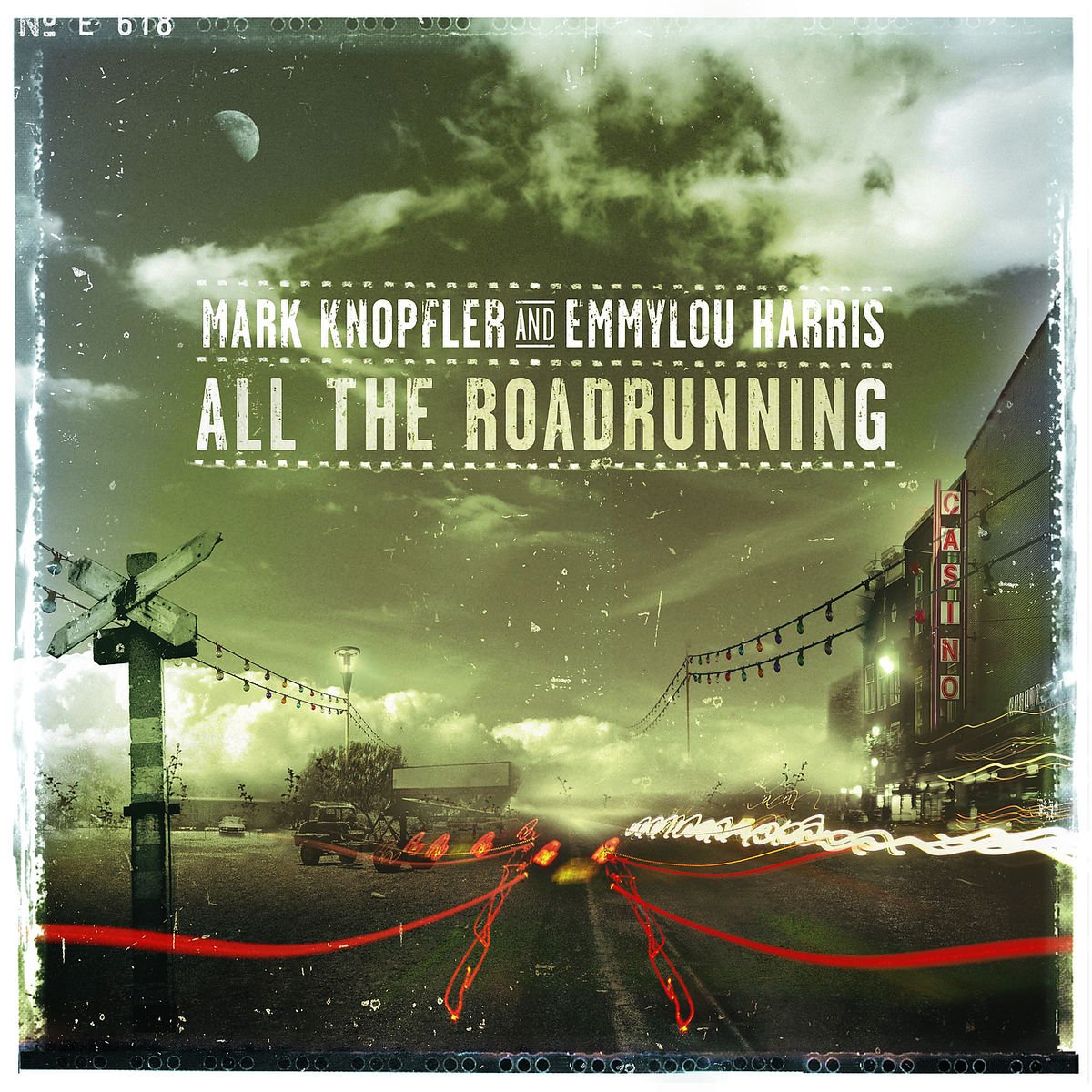 Speaking to journalist Jaan Uhelszki in spring 2006, Emmylou Harris explained why the release of her duet album with Mark Knopfler, All the Roadrunning, was so satisfying to collaborate on, even though the recordings had taken nearly seven years to complete: “I can’t say I really prefer singing lead over doing a duet. I feel like I started as a folk singer in my teens. And then working with Gram Parsons as a duet singer just opened up something in my heart and my head, and the world that I live in now is really because of singing with Gram. He led me to my solo voice, in a way.
“I guess I approach duets in the same way,” she continued, “except that I have to pay attention to the person who’s singing lead. I always think of the harmony as just another melody, but I’m following the lead. It’s just like catching a wave.”
In another interview at the time, she described her work with Knopfler as particularly gratifying: “When you combine two unique voices it creates a third, phantom voice…I love the third voice that Mark and I create. We noticed right away that our voices blended pretty effortlessly.”
Knopfler had achieved superstardom with his band Dire Straits, but had burned out after punishing promotional schedules and multiple world tours. As he told writer James McNair, “I’m not posing as a great singer or anything, but I think I’ve been steadily improving since I gave up cigarettes. Around 1996 [when he released his debut solo LP Golden Heart], I was down to a gasp and a whisper.”

Knopfler and Harris (YouTube screen grab)
Harris and Knopfler had first met in 1987 when they appeared on a Chet Atkins television special, but didn’t record together until a 1998 Thanksgiving session in Nashville intended to supply material for Knopfler’s second album, Sailing to Philadelphia. Working on the ballad “Donkey Town” and the Cajun-infused dance number “Red Staggerwing,” the duo grabbed hold of the idea of expanding a guest appearance into a full-blown collaboration. Both artists had plans and commitments that required them to shoehorn meetups onto their calendars one day at a time; Harris estimates they were together in the studio only about two weeks during that full seven-year period of gestation. More than a dozen musicians contributed, in a number of recording locations.
Newly signed to the Nonesuch label, Harris released her outstanding Red Dirt Girl (2000) and Stumble into Grace (2003), unusually featuring many self-penned songs. Her fanbase expanded, and she received a Grammy award for some of her most challenging material. In March 2003, Knopfler was seriously injured in a motorbike crash, canceled a tour to promote his ambitious The Ragpicker’s Dream LP, and couldn’t play guitar for seven months. Finally recovered, he put out Shangri-La in September 2004. In 2005 they finished their duets album.
“Beachcombing” leads off, Knopfler’s characteristically snaking electric guitar combining with Glen Duncan’s mandolin and fiddle, and a peppy rhythm from Glenn Worf and either Chad Cromwell or Danny Cummings drumming. Harris is used sparingly, and the purity of her high tone is immediately in delightful contrast with Knopfler’s gruff and intimate low end, which can often recall the feel of Leonard Cohen or Bob Dylan. The lyrics are clever, using a beach stroll examining washed-up wreckage as a metaphor for the regret accumulating following the end of a love affair: “We had a harmony/I never meant to spoil/Now it’s lying in the water/Like a slick of oil.
Related: Our Album Rewind of Dire Straits’ Making Movies
“I Dug Up a Diamond” sounds not unlike an outtake from Dylan’s Desire, soaked in melancholy. (Knopfler was the producer for three Dylan albums, Slow Train Coming, Infidels and Down in the Groove, making him one of Dylan’s most sympathetic collaborators.) During the chorus, Harris’ harmony lines sometimes dip beneath Knopfler’s voice instead of staying above it, an unusual effect dependent on Harris’ ability to tap her lowest notes when necessary. A fuzzed-up guitar solos against mandolin, and it’s all over too soon.
“This Is Us” starts with a pumping synthesizer, then adds the acoustic instruments over a propulsive beat before the duo enters, channeling Johnny Cash and June Carter, trading lines with humor when they’re not harmonizing about looking through a photo album: “This is us down at the Mardi Gras/This is us in your daddy’s car/You and the missing link/Yeah, I’d had a little too much to drink.” The last minute or so features a gnarly electric guitar solo that reminds us just how great Knopfler can be on his Stratocaster.
“Red Staggerwing” uses the same method of flirty voice alternation, but with purposely absurd lyrics that echo the work of Bo Diddley, Howlin’ Wolf or Chuck Berry: “[Sung by Mark] If I was a Maserati/A red 300S/I’d ride around to your house baby/Give you a driving test/[Sung by Emmylou] If I was a mustang racer/White with a stripe of blue/You could ride me, baby/Whenever you wanted to.” It’s a novelty song, but well-designed.
“Rollin’ On” is a softly delivered, mid-tempo tune with a light reggae arrangement. As on “Belle Starr” (the only solo writing credit Harris takes), Harris adds tasteful acoustic guitar. She takes the lead vocal on both, her seemingly effortless command clearly heard.
Harris told McNair, “Love and Happiness” might be the only “proper” country song she’d written to that date. She got a leg up from Austin, Texas, singer-songwriter Kimmie Rhodes. “You can’t get fancy with that genre. Kimmie and I sat down as mothers and thought, what are the things that we would want for our children? What are the metaphors for that deep desire that your child will dodge certain bullets? And what will they need to help them deal with the bullets they aren’t able to dodge? Kimmie had the first verse in the bag, and with that wonderful structure of hers, we wrote the rest in an afternoon. Sometimes they come easy.”
Related: Our Album Rewind of Harris’ Wrecking Ball
For his part, Knopfler resonated with an essay Martin Amis had written about the 9/11 attacks, and the writer’s realization that we can’t protect our children. “That was something for me to look at,” Knopfler said. “I think we addressed it in Em’s song ‘Love and Happiness,’ and because you have a man and a woman singing it, both of whom are parents, it intensifies things.” Each verse contains a simple prayer: “You will always have a lucky star/That shines because of what you are/Even in the deepest dark/Because your aim is true/And if I could only have one wish, darling/It would be this/Love and happiness for you.” There are more than a few moments where the style and heart of George Jones and Tammy Wynette seem the template for Knopfler and Harris. Dan Dugmore’s acoustic guitar joins Knopfler’s gently delivered electric lines.
“Right Now” is a contemporary blues, with the album’s first slide guitar work powering a rhythmically powerful tempo. (If it’s not Knopfler on slide it could be Richard Bennett, who as a member of his tour band Knopfler praised for his “encyclopedic knowledge of all kinds of roots and rock music, from hillbilly to Hawaiian, played effortlessly on a variety of instruments.”) Harris’ loose and feisty vocal makes “Right Now” one of the standout tracks of the set.
The album’s longest cut, at 5:42, “Donkey Town” is a slow-and-steady tune that echoes both Texan balladeers like Joe Ely and Townes Van Zandt and the Caribbean feel of guitarist Joseph Spence. True to its roots in a Knopfler solo session, it features him with Harris’ minimal but effective support, wordlessly keening in the background, like a benign ghost.
“Beyond My Wildest Dreams” is perhaps the most Dire Straits-sounding cut on the set, but melodically and in the careful arrangement it’s also not miles from Roy Orbison’s early-’60s sound. Knopfler’s co-producer Chuck Ainley and his team of sound engineers deserve kudos for giving each instrument and voice its own identifiable space, even as they all blend. (All the Roadrunning, released on April 24, 2006, was nominated for the Best Contemporary Folk Album Grammy, but was bested by Dylan’s Modern Times. Knopfler and Ainley won the same year in the Best Immersive Audio Album category for their 20th anniversary edition of Dire Straits’ Brothers In Arms.)
The title track is a mid-tempo waltz with Scottish roots (Knopfler was born in Glasgow), a stirring anthem about the life of musicians, led by Duncan’s fiddle. The lyrics put you right on stage: “The rimshots come down like cannon fire/And thunder off the wall/There’s a man in every corner/And each one is giving his all.” Harris gets one of the best verses: “The show’s packing up/I sit and watch the convoy leaving town/There’s no pretending I’m not a fool/For riding around and around.”
The high emotion of “All the Roadrunning” leads beautifully into the album’s concluding song, “If This Is Goodbye,” another tune inspired by the events of 9/11, when passengers on the hijacked United 93 and in the Twin Towers made final phone calls to loved ones. An essay by novelist Ian McEwan influenced Knopfler’s writing: “I remember the McEwan piece homing in on people using their mobiles, that final phone call home to say, ‘I love you.’ If there’s anything positive to take from 9/11, that expression of love is surely it. That, rather than what happened next, another wave of violence.”
Harris handles the deeply emotional first verse with the directness she’s mastered: “My famous last words/Are laying around in tatters/Sounding absurd whatever I try/But I love you/And that’s all that really matters/If this is goodbye.”
“There are bruised people on this record,” Knopfler said at the time, “and Em has a way of inhabiting those characters and making them real.”
The use of organ gives the track the feel of having been recorded in a church, although the lyrics are decidedly secular, asking, “Who knows how long we’ve got?/Or what we’re made out of/Who knows if there’s a plan or not?”
The album proved so popular the duo decided to film one of the concluding gigs of the subsequent tour, the June 28, 2006, show in Universal City, Calif. The follow-up CD/DVD Real Live Roadrunning arrived in November, and included a chunk of All the Roadrunning, along with Harris classics (“Boulder to Birmingham” and “Born to Run”), some Knopfler solo cuts (“Song for Sonny Liston,” “Speedway at Nazareth”) and a couple of Dire Straits songs that fit the concept (“Romeo and Juliet” and “So Far Away”).
Knopfler, born Aug. 12, 1949 and Harris, born April 2, 1947, continue to be good friends, dedicated activists and major forces in music, valued worldwide for the high quality and emotional connection of their recordings and live performances. Their roadrunning shows no sign of ending. [The album is available in the U.S. here, in Canada here and in the U.K. here.]
Watch a full Mark Knopfler-Emmylou Harris concert




No Comments so far
Jump into a conversationNo Comments Yet!
You can be the one to start a conversation.