
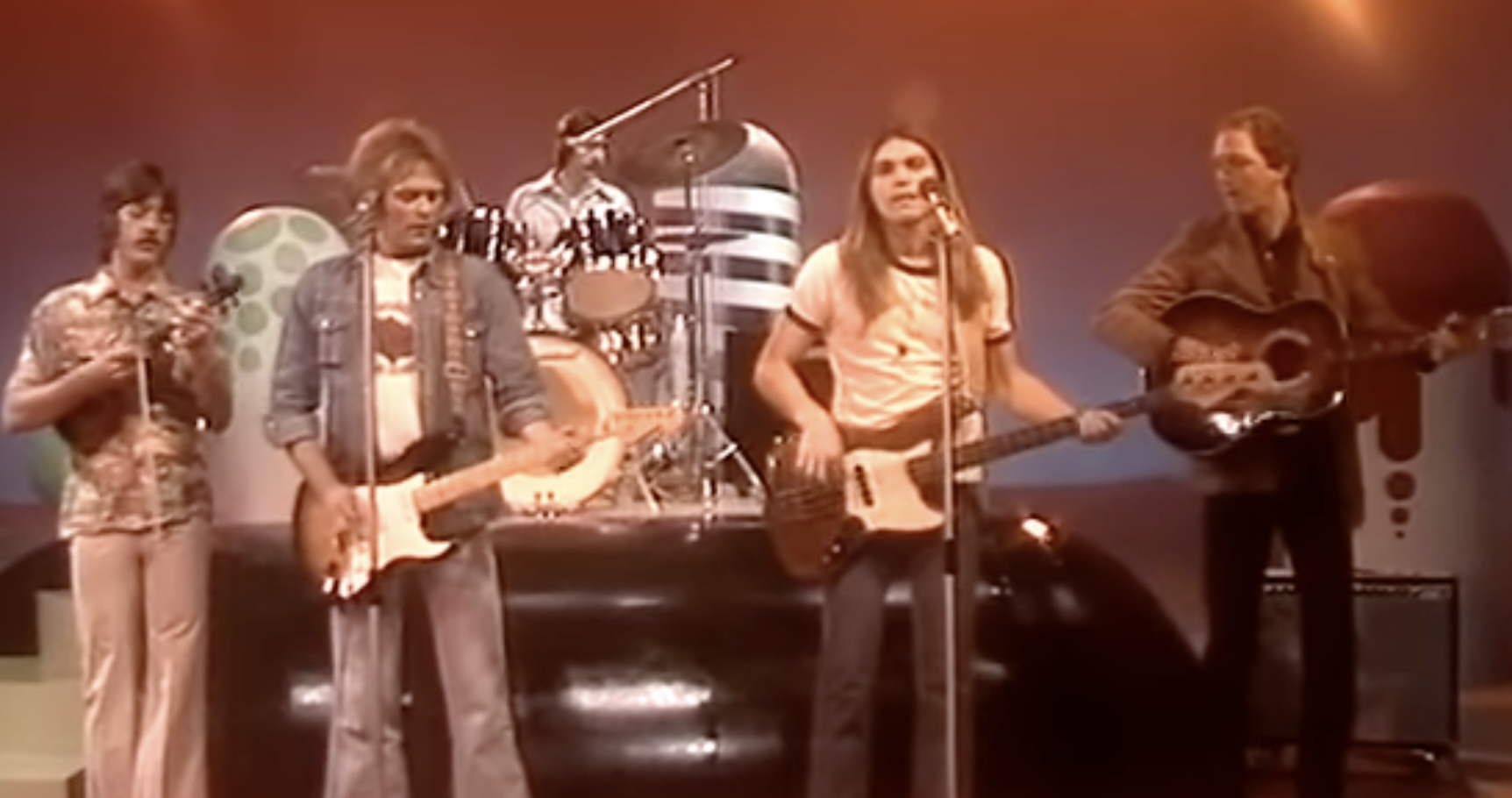
Poco, performing in 1976, is consistently one of the most overlooked bands of the era.
By the mid-1970s, FM radio featured plenty of singer-songwriters, soft-rock acts and hard-rocking guitar bands on station playlists. In ’76, Boston‘s debut was instantly embraced by the public. Fleetwood Mac‘s self-titled album yielded multiple hits a year after its 1975 release. Eagles continued their dominance. The Steve Miller Band delivered one of the decade‘s most consistent chart performances.
But the story of rock in 1976 offered far more than those superstars’ favorites. Over time, many other hit singles eventually dropped off the tight playlists from classic rock airwaves. In other cases, they were album tracks that achieved a brief radio following, as well as songs that became modest hits but never achieved their rightful recognition for a variety of reasons. Here are a dozen that may spark a distant memory.
Boz Scaggs—”It’s Over” (Silk Degrees)
Released as the album’s first single, at #38 it was vastly overshadowed by the two far more successful chart offerings, “Lowdown” (#3) and “Lido Shuffle” (#11). Like much of the album, “It‘s Over” is built on the slick sheen of blue-eyed soul crossed with classic studio sounds that allowed Silk Degrees to become one of the great albums of the decade.
Bad Company—”Young Blood” (Run With the Pack)
Written by Jerry Leiber, Mike Stoller and Doc Pomus, and first recorded by the Coasters, who earned a #1 R&B hit in 1957. Though Bad Company’s rougher blues-rock version reached #20 on the Hot 100 it is not as well-known as many of their other singles.
Sutherland Brothers and Quiver—”Arms of Mary”(Reach for the Sky)
Soft folk-rock continued to represent a significant proportion of FM radio in ’76, and “Arms of Mary” proved the most successful worldwide chart hit for this combination of Scottish bands. Although peaking at only #81 on the Hot 100 in the U.S, the single, with its introspective lyric and delicate arrangement, scored considerably higher in the U.K. (#5) and gained a long life on adult contemporary radio.
Seals and Crofts—”Get Closer” (Get Closer)
Featuring prominent co-lead vocals from Carolyn Willis, a former member of Honey Cone, this track became one of the duo’s last major crossover hits. Though it’s tied for their highest-charting hit at #6 on the Hot 100, it’s been overshadowed by such singles as “Summer Breeze” and “Diamond Girl.” It perfectly showcased the increasingly slick production of mid-’70s soft rock.
Rod Stewart—“Get Back”(All This and World War II Soundtrack)
This ragged, barroom remake of the Beatles’ classic was released the very year he scored a massive U.S. #1 hit with “Tonight’s the Night (Gonna Be Alright)” and evocatively captured the rock and roll bravura that radiated from his mid-1970s persona. Though it was bypassed as a U.S. single, it was released internationally and cracked the Top 40 in many territories.
Blue Öyster Cult—“This Ain’t the Summer of Love” (Agents of Fortune)
As the album’s opening track, this song provided a heavy, darker complement to the record’s melodic FM accessibility, representing the sharp edge that most distinguished the band from its peers. Though the single never charted, the tune became highly popular with fans. The album became their only studio LP to go platinum, thanks largely to their first major mainstream hit, “(Don’t Fear) The Reaper.”
Kiss—“Flaming Youth” (Destroyer)
When Destroyer arrived, Kiss was just about to blow way beyond their weird, theatrical cult band status into the arena-rock sensation they became. It was a loud, glorious taste of the bigger, spruced-up sound they found with producer Bob Ezrin, who took the band’s primal, monstrous riffs and dressed them up in a widescreen studio sheen. Yet despite the success of “Rock and Roll All Night” just a few months earlier, and the mid-chart success of the album’s “Shout It Out Loud,” Top 40 programmers largely ignored this one as it reached a lowly #74 on the Hot 100. (Not long after, Kiss earned their biggest pop success with “Beth.”)
Ted Nugent—“Hey Baby” (Ted Nugent)
From his self-titled solo debut, this track quickly became one of the popular FM-rock staples of 1976 as Nugent continued to gain legendary status. Written and sung by rhythm guitarist Derek St. Holmes (who also contributed some songwriting on the next several albums), the song was a more subdued offering to the aggressive power of the album’s “Stranglehold,” seamlessly blending infectious melodic hooks with the frenzied guitar attack that would define Nugent‘s sound. Though only reaching #72 on the Hot 100, the single became a “gateway” for more casual hard-rock fans and a staple of his concert setlists.
The Doobie Brothers—“Wheels of Fortune” (Takin’ It to the Streets)
Driven by a dual lead-vocal attack from Patrick Simmons and the band’s early era lead singer Tom Johnston, this track is a spectacular time capsule. Its LP peaked at #8 on the Billboard 200 and ultimately went platinum, thanks to its massive title track, which climbed to #13 on the Hot 100 as well as the Michael McDonald-led “It Keeps You Runnin’.” “Wheels…” largely slipped under the radar, stalling out at #87. Still, it stands as the quintessential example of a legendary band caught in transition, catching the moment where their older, guitar-fueled biker-rock roots collided with a smooth, jazz-inflected studio production style.
Poco—“Rose of Cimarron” (Rose of Cimarron)
Country-rock had entered the wider American music consciousness. However, Poco was overshadowed commercially by many of the artists they inspired and are consistently one of the most overlooked bands of the era. Encapsulating Western themes, layered harmony singing and expansive production, the album’s title track, written by the band’s Rusty Young, was a quintessential group recording. Although the single reached only #94 on the Hot 100, the beautiful recording—with lead vocals by Paul Cotton and Timothy B. Schmit—earned a greater appreciation among album-rock fans over the years.
Cliff Richard—“Devil Woman” (I’m Nearly Famous)
While he had been ruling the U.K. charts as a massive superstar since the late 1950s, big American hits had become practically nonexistent for the singer by the mid-1970s. “Devil Woman” finally changed that, becoming his first big hit Stateside, scarily screaming all the way to #6 on the Hot 100. The pulsing beat and catchy hook provided him with a slick template that would propel him on subsequent hits like “We Don‘t Talk Anymore.”
Pratt & McClain—“Happy Days” (Pratt & McClain feat. Happy Days)
Most fans would probably just recall it as the theme song to the hugely popular television series, but the duo‘s full version went on to become a significant hit, reaching #5 on the Hot 100, during the show’s third season, amidst the wave of 1950s nostalgia begun by 1973’s American Graffiti.
Related: 12 overlooked rock songs from 1974



4 Comments so far
Jump into a conversationSorry but when I hear Youngblood all I can hear is Leon Russell’s version!
Happy Days? Really???
great selection of material mirroring the top 40’s diversity of decades gone by
Some nice entries regarding overlooked songs of ’76, but…really, “Devil Woman”? And “Get Closer”? How are top 10 hits overlooked? And the “Happy Days” theme? It was a top 10 hit AND the theme song to one of the most popular TV shows of the ’70s that has lived on in syndication. Pretty sure that can’t qualify as being overlooked, even though as far as I’m concerned, it SHOULD be. I’ve managed to overlook it for decades, and would like to keep it that way.