
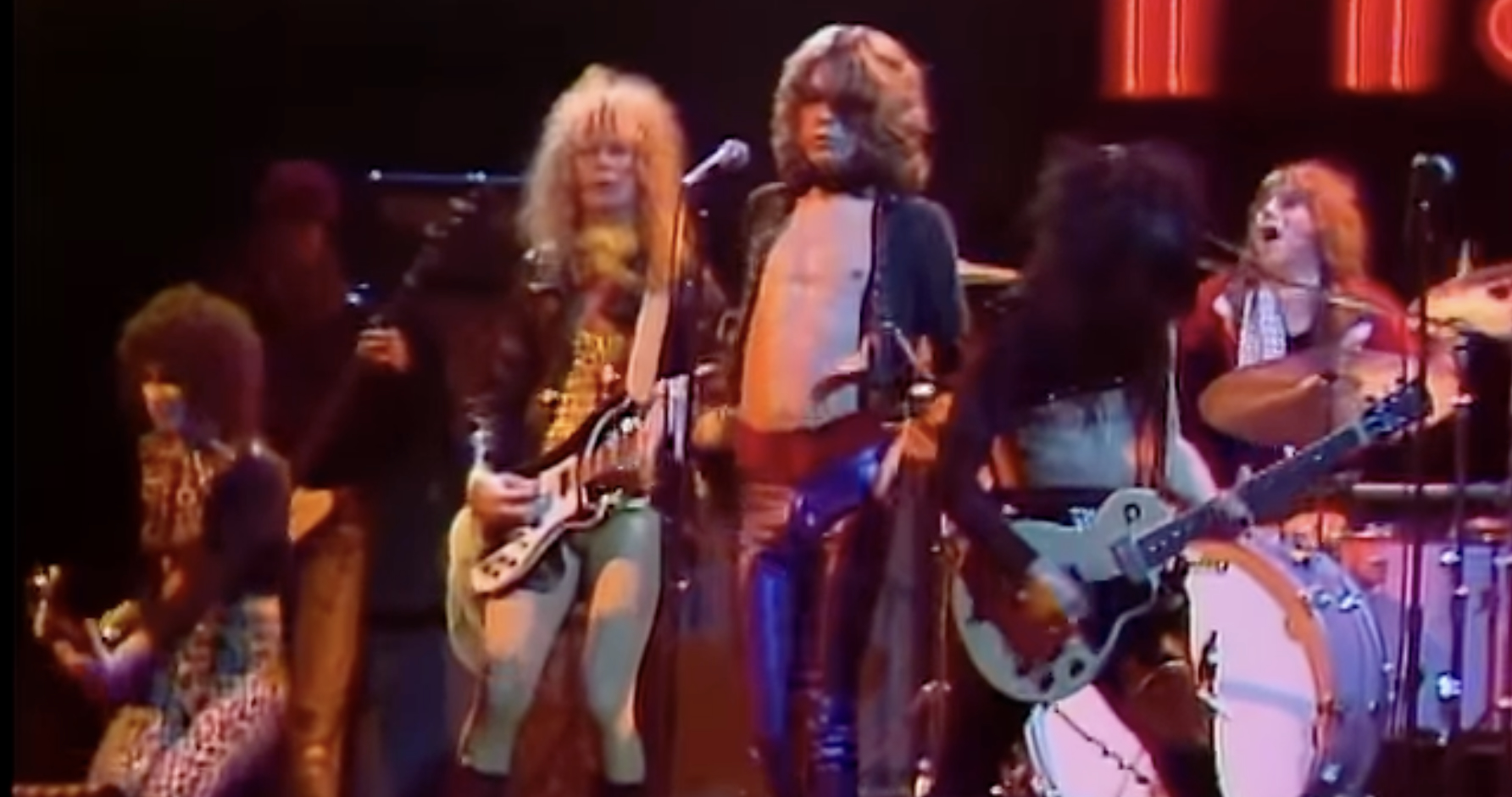
New York Dolls on The Midnight Special in 1973
The glam-rock explosion of the early 1970s proved that rock and theater were never mutually exclusive. Sequins, satin and platform boots grabbed the headlines, but beneath the glitter were songs of genuine substance—crunching guitars locked to irresistible hooks, delivered by performers who understood that spectacle and craft were not opposites but partners.
Whether they topped the charts or helped shape the movement from the margins, these 12 recordings represent the genre at its most compelling.
David Bowie — “The Jean Genie” (Aladdin Sane, 1973)
Inspired by Iggy Pop and titled as a playful nod to French writer Jean Genet, Bowie delivered a bluesy rocker as the lead single for the LP. Mick Ronson’s muscular guitar work drives the record, which became a late-’72 release that dominated the U.K. winter charts, peaking at #2, while reaching #71 in the U.S.
Related: Our Album Rewind of Bowie’s The Rise and Fall of Ziggy Stardust and the Spiders from Mars
T. Rex — “20th Century Boy” (Single, 1973)
Admit it… you thought we were going to feature “Bang a Gong”/”Get It On,” right? Few Marc Bolan performances captured glam-rock’s swagger more completely than this one. Built around one of the genre’s most recognizable guitar riffs, the single—a #3 U.K. hit, though it never charted in the U.S.—remains a thrilling blast of confidence, attitude and irresistible hooks.
Mott the Hoople — “All the Young Dudes” (All the Young Dudes, 1972)
Written and produced by David Bowie, this anthem famously rescued the band from the brink of breaking up. Its unforgettable chorus and celebration of youthful outsiders made it one of glam-rock’s enduring classics.
Slade — “Cum on Feel the Noize” (Single, 1973)
Few captured glam-rock’s celebratory spirit quite like this group from the U.K. Loud, joyful and built for audience participation, the song became one of the group’s biggest hits before finding a new generation through Quiet Riot’s successful cover a decade later.
Sweet — “The Ballroom Blitz” (Single, 1973)
Inspired by the violence that erupted during their concert in Scotland, this jam transformed chaos into one of glam’s greatest singles. Its pounding beat, theatrical vocals and explosive chorus remain instantly recognizable, helping it reach #2 in the U.K., #1 in Canada and at #5 on the Hot 100.
Related: Our feature on Sweet
Alice Cooper — “School’s Out” (School’s Out, 1972)
Blending hard rock with glam theatrics, he created one of rock’s definitive rebellious anthems. More than half a century later, the single still arrives in late spring every year as the unofficial soundtrack to the last day of school.
Suzi Quatro — “Can the Can” (Suzi Quatro, 1973)
As a leather-clad bassist and frontwoman, she challenged rock’s conventions while becoming one of glam’s biggest stars. The song reached #1 in the U.K. and established her as an international force.
New York Dolls — “Personality Crisis” (New York Dolls, 1973)
Raw, loud and gloriously untidy, they gave glam-rock a gritty downtown attitude. And the track from their debut album would become enormously influential on the emerging punk scene on both sides of the Atlantic.
Queen — “Killer Queen” (Sheer Heart Attack, 1974)
Before becoming one of the world’s biggest rock bands, the quartet broke through with this sophisticated glam masterpiece. Freddie Mercury‘s witty lyric earned him his very first Ivor Novello Award, while the elegant harmonies and polished production hinted at their global ambitions.
Mud — “Tiger Feet” (Mud Rock, 1974)
The best-selling U.K. single of 1974, the single perfectly balanced glam’s pop instincts with stomping rock rhythms. It remains one of the movement’s defining chart successes, reaching #1 in the U.K., though they were largely unknown in the U.S.
Gary Glitter — “Rock and Roll (Part 2)” (Glitter, 1972)
Driven by a pounding beat and an unforgettable chant, the song became one of the era’s most recognizable, chant-driven tracks. While it was once an inescapable stadium anthem, the song has been banned from venues by a variety of sports leagues following the artist’s criminal convictions, though it remains fixed in pop culture history.
Sparks — “This Town Ain’t Big Enough for Both of Us” (Kimono My House, 1974)
Russell Mael’s dramatic falsetto and Ron Mael’s eccentric songwriting made them unlike any of their contemporaries. The result was a brilliantly theatrical hit that pushed glam-rock into delightfully unpredictable territory.
Related: Want more? Part 2 of our series on glam-rock songs
A number of glam-rock collections are available in the U.S. here, in Canada here and in the U.K. here.





15 Comments so far
Jump into a conversationWhere’s Roxy Music?
i love glitter rock! except gary glitter..sexually abusing kids…not good! his real name was paul raven..a shame because some of his music was really good!
Actually, his real name is Paul Gadd. Raven was another stage name for his much earlier recordings.
Sorry to inform you are slightly wrong about Glitter’s name as Paul Raven that was his old stage name. His name is Paul Francis Gadd. I love Glitter’s music loved his stage shows but I can’t stand what he did and I believe he should never be let back into society
His real name is Paul Gadd.
Raven was one of many stage names
met the ny dolls in my groupie days…johnny thunders not good..but jerry nolan was a true irish gentleman…
‘Don’t Touch Me There’ by the Tubes.
Kind of a 70s Shadow Morton/Phil Spector homage.
And you can’t go wrong with ‘White Punks on Dope’. Produced by Zelig himself, Al Kooper.
Loved the album remote control by the tubes. Seen live 3 times.
I didn’t think anyone in North America knew of Tiger Feet. That’s Right!
Great tune, but ‘La la Lucy’ has more of a genuine glam-rock feel!
I thought the bay city rollers did some good stuff.
Incorrect I’m afraid. They were another constructed Boy Band. The music was generic rubbish and some were being abused by their manager, who took all of the money. Sad story but very poor band
It’s 2026 and the majority of Americans still don’t realise that Gary Glitter is a muti convicted pedophile who’s record were banned from the airwaves near on 15 years ago
Why no Cockney Rebel in the list?