
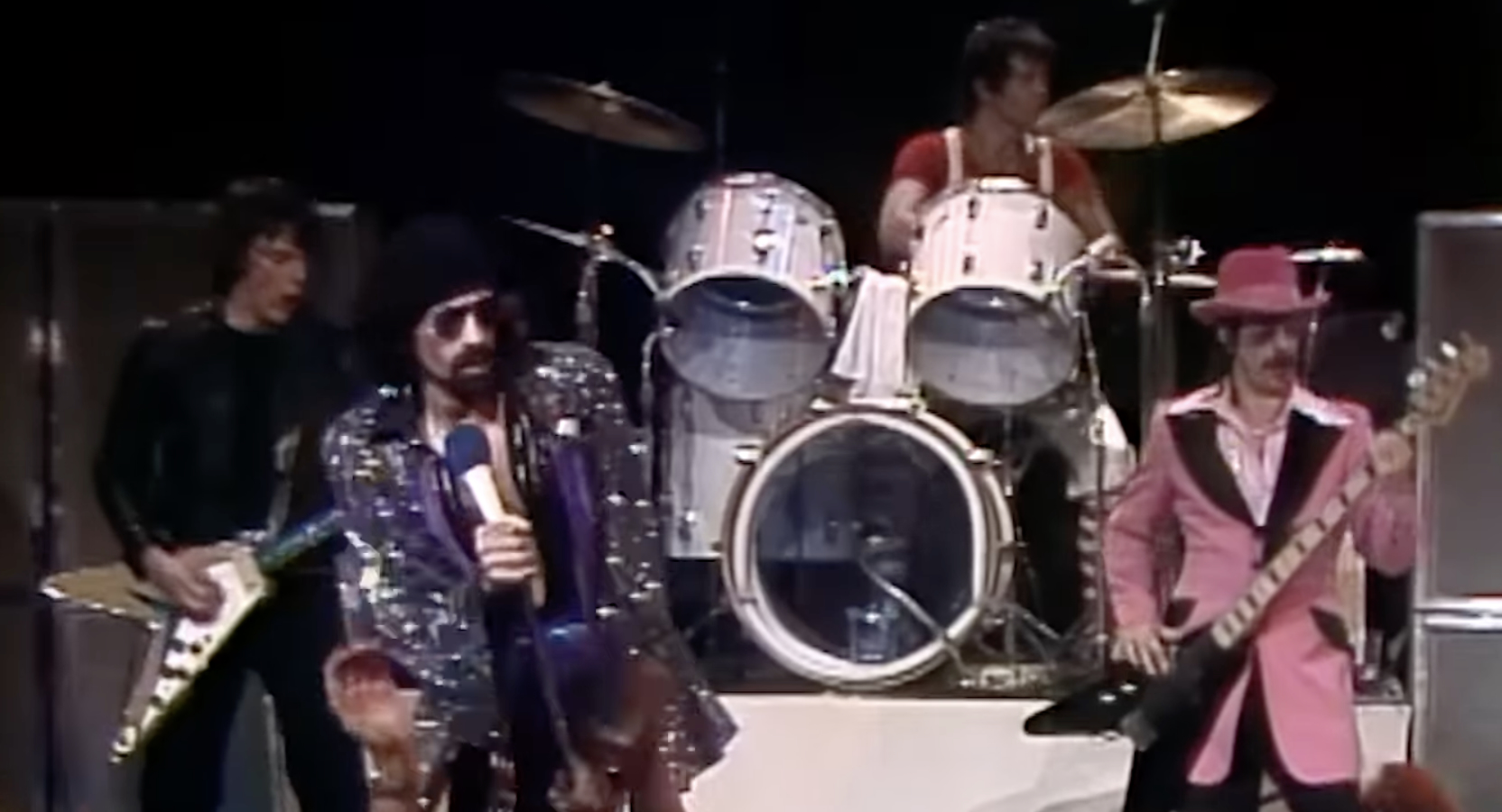
Members of the J. Geils Band on stage in 1975.
The J. Geils Band was not known as a singles band, and anyone who knows them only from “Centerfold” has heard one of the least representative things they ever did. Formed in Worcester, Mass., in 1967, the group grew out of an acoustic blues trio of guitarist J. Geils, harmonica player Magic Dick and bassist Danny Klein. They went electric and added drummer Stephen Jo Bladd and Peter Wolf on lead vocals, a New York City native who, after moving to Boston, had become a popular, fast-talking disc jockey. Keyboardist Seth Justman soon completed the lineup and became Wolf’s songwriting partner. Much of their early repertoire came straight out of Wolf’s record collection, R&B that the band pumped up for a rock ‘n’ roll crowd. More than once, they were tagged “the American Rolling Stones,” and onstage it was hard to argue.
The albums sold respectably, and Bloodshot became their first Top 10 album in 1973 when it peaked at #10, but hits weren’t what they were about. “Must of Got Lost” reached #12 in early 1975 and remained their highest-charting single until MTV came along and “Centerfold” went to #1, followed by “Freeze-Frame” at #4. By 1983, Wolf had left. The story of this band, though, was written long before that, in the clubs and theaters where they spent a decade earning their reputation. Here are 15 tracks that tell it.
“Hard Drivin’ Man”—The J. Geils Band (1970)
From the group’s debut, this is a compact introduction to its early sound: tough guitar, muscular rhythm, and Peter Wolf’s unmistakable presence. It established the rough-edged attack that would remain central to the band’s identity.
“Whammer Jammer”—The Morning After (1971)
Magic Dick takes center stage on this instrumental showcase, turning the harmonica into a lead rock instrument. It became one of the group’s signature performances, particularly in concert.
“Looking for a Love”—The Morning After (1971)
A cover of the Valentinos’ R&B classic became the group’s first Top 40 hit, reaching #39. Wolf performs its swagger while the band digs into the song’s soul roots.
“Cry One More Time”—The Morning After (1971)
The group showed that it could slow things down without losing its identity. Wolf delivers the heartbreak with feeling, while the restrained arrangement lets the melody and vocal carry the performance.
“First I Look at the Purse”—“Live” Full House (1972)
Recorded over two nights at Detroit’s Cinderella Ballroom on April 21–22, 1972, this live performance of a song originally recorded by Motown’s Contours, captures the band in the environment where it was arguably most formidable. Wolf, J. Geils, Magic Dick and the rhythm section turn the R&B favorite into a loose, hard-charging concert opener.
“Give It to Me”—Bloodshot (1973)
By this point, the group had its sound firmly established and was beginning to break through commercially. Driven by a hard-driving reggae-rock groove and Wolf’s commanding vocal, the track reached #30 on the Hot 100.
“(Ain’t Nothin’ But a) Houseparty”—Bloodshot (1973)
The band’s R&B instincts are impossible to miss here. The groove is loose, infectious and built for a crowded room, with every member contributing to the sense of controlled chaos.
Related: The final interview with bandleader J. Geils
“Southside Shuffle”—Bloodshot (1973)
This was the band at its most naturally commanding, driven by a blues-rock groove and an unmistakable party atmosphere. It captures the musicians’ ability to make even a tightly arranged studio recording feel like a live performance.
“Detroit Breakdown”—Nightmares…and Other Tales from the Vinyl Jungle (1974)
The group’s affection for Detroit and its musical culture comes through in this gritty, hard-swinging performance. It has the looseness of a bar-band workout without sacrificing the precision of a seasoned touring act.
“Must of Got Lost”—Nightmares…and Other Tales from the Vinyl Jungle (1974)
One of the group’s defining ’70s recordings, this turns romantic confusion into a full-scale soul-rock performance. It became a major hit, reaching #12 on the Hot 100. (We still wonder if anyone told them the correct phrase is “must have.”)
“One Last Kiss”—Sanctuary (1978)
The group had moved into a more polished period by the late ’70s, but the rock ’n’ roll spirit remained intact. This became a substantial hit, reaching #35 on the Hot 100.
“Love Stinks”—Love Stinks (1980)
The title track turned romantic misery into one of the band’s most memorable hooks. With its sharper production and increasingly prominent keyboards, it also pointed toward the sound that would dominate the group’s next phase.
“Come Back”—Love Stinks (1980)
The keyboards and rhythmic pulse show the band moving comfortably into the sound of the new decade. At the same time, the groove and Wolf’s vocal keep the performance rooted in the group’s R&B background.
“Centerfold”—Freeze-Frame (1981)
The breakthrough. Built around an instantly recognizable keyboard riff and an enormous pop hook, it spent a whopping six weeks at #1 on the Hot 100 and became the group’s defining recording of the early ’80s.
“Freeze-Frame”—Freeze-Frame (1981)
The title track proved that the success was no fluke. Its crisp production, keyboards and driving rhythm gave the band a contemporary sound without completely abandoning the groove that had defined its earlier work.
Many of the band’s recordings are available in the U.S. here and in Canada here. Peter Wolf published his memoir in 2025. It’s available in the U.S. here and in the U.K. here.




No Comments so far
Jump into a conversationNo Comments Yet!
You can be the one to start a conversation.