
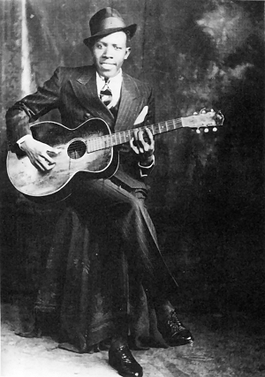
Robert Johnson in 1936 (from his Wikipedia page)
Robert Johnson was born on May 8, 1911, in Hazlehurst, Miss. He recorded 16 songs for Vocalion Records in San Antonio, Tex., in November 1936 and another 13 for Vocalion in Dallas in June 1937. He was booked to appear at producer John Hammond’s seminal From Spirituals to Swing at Carnegie Hall in New York City but died shortly before he could make that concert date in December 1938.
Twenty-three years then passed until Hammond, who had produced Bessie Smith’s last session, championed Count Basie and signed Billie Holiday (and would later sign Bob Dylan, Aretha Franklin and Bruce Springsteen, among many others, to Columbia Records), spearheaded the release of King of the Delta Blues Singers by Columbia in 1961, the first compilation of Robert Johnson masters, followed by King of the Delta Blues Singers, Volume II nine years later.
In 1990, a boxed set, Robert Johnson: The Complete Recordings, went platinum, selling over one million units. And with each reissue of his material another generation discovered Robert Johnson and was inspired to record his songs. Here are some notable examples, with alternate takes on each song that are worth a listen as well.
John Hammond—Stones in My Passway” (1964 or ’65)—It should come, perhaps, as no surprise that the son of the legendary A&R man would record at least 20 songs written by or associated with Robert Johnson over the course of his career, 14 of which were ultimately collected on the Vanguard Records compilation At the Crossroads: The Blues of Robert Johnson in 2003. This one was among the first of them but went unreleased until his fifth album, Mirrors, in 1967. Alternate take: John Mellencamp.
John Mayall and The Blues Breakers—“Ramblin’ on My Mind” (1966)—Eric Clapton quit the Yardbirds in 1965 in search of a more purist approach to the blues and found it in British blues pioneer John Mayall’s band, where he not only played lead guitar but sang lead vocals for the first time on record on this Johnson song from the Blues Breakers album. Alternate take: Otis Spann and Robert Jr. Lockwood.
Related: Our Album Rewind of the Blues Breakers LP
Cream—“Crossroads” (1968)—The short-lived supergroup featuring Eric Clapton, Jack Bruce and Ginger Baker delivered this supercharged live version of the song on its third album, Wheels of Fire. Alternate take: Ry Cooder.
Led Zeppelin—“Travelling Riverside Blues” (1969)—Performed live on the BBC but not released on record until 1990 in the career retrospective boxed set Led Zeppelin. Alternate take: Hindu Love Gods (Peter Buck, Mike Mills and Bill Berry of R.E.M. and Warren Zevon).
The Rolling Stones—“Love in Vain” (1969)—A Johnson lament included on Let It Bleed amidst the likes of “Gimme Shelter” and “You Can’t Always Get What You Want” that demonstrates that the Stones never stray far from their roots as a blues band. Alternate take: Madeleine Peyroux.
Jo Ann Kelly—“Come on In My Kitchen” (1969)—Before there was Bonnie Raitt there was Jo Ann Kelly from South London, England. An underappreciated country blues singer and expert acoustic slide guitarist, she performed this soulful Robert Johnson classic on her debut long player Jo-Ann Kelly. Alternate take: Delaney and Bonnie.
Bonnie Raitt—“Walking Blues” (1971)—From her debut album Bonnie Raitt, the third most covered Robert Johnson song, topped only by “Crossroads” and “Come on In My Kitchen,” it is even referenced in Paul Simon’s “Diamonds on the Soles Of Her Shoes.” Alternate take: The Paul Butterfield Blues Band.
Eric Clapton—“Malted Milk” (1992)—Clapton again! His MTV Unplugged album included both “Walkin’ Blues” and this song and sold in the millions, no doubt introducing Johnson to a still greater audience. Clapton proceeded to release both the Me and Mr. Johnson CD and Sessions for Mr. J DVD in tribute to his favorite bluesman in 2004. Alternate take: Lucinda Williams.
Cassandra Wilson—“Hellhound on My Trail” (1993)—The preeminent jazz vocalist of recent years, recently deceased, included at least one pure blues song on virtually every one of her albums after Blue Light ’Til Dawn, which included this haunted Johnson song and “Come on In My Kitchen” as well. Alternate take: Rory Block.
Keb’ Mo’—“Kindhearted Woman Blues” (1994)—The first photos of Johnson were published in the late 1980s; shortly thereafter, actor Kevin Moore played Johnson in a docudrama, Can’t You Hear The Wind Howl: The Life and Music of Robert Johnson—the physical resemblance was undeniable. His debut album, Keb’ Mo’, included this, the first song Johnson ever recorded, and “Come on In My Kitchen.” Alternate take: the Youngbloods.
The Jeff Healey Band—“Stop Breakin’ Down” (1995)—On the blind Canadian blues-rocker’s fourth album, the aptly named Cover to Cover, he interprets songs by Willie Dixon, Jimi Hendrix and Eric Clapton, and one by Johnson too. Alternate take: the White Stripes.
Peter Green Splinter Group—“When You Got a Good Friend” (1998)—When the Fleetwood Mac founder returned to recording after a long hiatus, his first album back included three Johnson songs; the second album, The Robert Johnson Songbook, 16 more, including this one. Alternate take: Johnny Winter.
Dion—“Terraplane Blues” (2005)—When Dion joined Columbia Records in the early 1960s, he made the acquaintance of John Hammond, who introduced him to the music of Johnson. When Dion finally got around to recording a blues album, Bronx in Blue, it featured four Johnson songs, including a double entendre ode to the Hudson Terraplane, the little red Corvette of its day. Alternate take: Foghat.
Gil Scott-Heron—“Me and the Devil” (2010)—Robert Johnson meets hip-hop halfway on the proto-rap poet’s final studio album, the autobiographical I’m New Here, his first in well over a decade. A remix was released the following year and Scott-Heron tragically passed away shortly thereafter. Alternate take: the Cowboy Junkies.
Todd Rundgren—“Last Fair Deal Gone Down” (2011)—As its title might suggest, Todd Rundgren’s Johnson is a less reverent tribute album than either of the Eric Clapton or Peter Green collections are, more of a nod to the over-the-top stylings of some of those who’ve covered Johnson in the past. Alternate take: Colin James.
Johnson was just 27 years old when he died on Aug. 16, 1938. Various editions of Robert Johnson: The Complete Recordings are available in the U.S. here, in Canada here and in the U.K. here. A 2020 book, Brother Robert: Growing Up with Robert Johnson, is available here.




No Comments so far
Jump into a conversationNo Comments Yet!
You can be the one to start a conversation.