
Blue Cheer
When you think of rock music that came out of the San Francisco Bay Area in the ’60s, your mind undoubtedly goes first to albums: Jefferson Airplane’s Surrealistic Pillow, Sly and the Family Stone’s Stand, Santana’s groundbreaking debut, Creedence Clearwater Revival’s three 1969 best-sellers, etc. Singles aimed at Top 40 radio were not the top priority once the San Francisco music scene became a national phenomenon in the latter years of that heady decade—it was all about the LP (and the live concert, but that’s another story).
That doesn’t mean there weren’t singles being recorded in the Bay Area though, some of them predating the explosion. Some became hits, others did not, but many are worth a fresh listen regardless of how they were accepted at the time. Here are a dozen.
Bobby Freeman—“C’mon and Swim”
Bobby Freeman was born in, and spent most of his life living in, the Bay Area. He broke in 1958 with his own composition, “Do You Want to Dance,” which reached #5 in Billboard and would later be covered by the Beach Boys, the Ramones, the Mamas and the Papas and others. Only three months later, Freeman followed it up with a strong rocker, “Betty Lou Got a New Pair of Shoes,” which topped out at #37. After that, he went back into the shadows until 1964 when, at the height of Beatlemania, he bounded back with another raucous dance fave, “C’mon and Swim,” co-authored by Thomas Coman and Sylvester Stewart, whose name, you will soon see, shows up a few more times in this story. Released on the San Francisco-based Autumn Records—owned by KYA disc jockeys Tom Donahue and Bobby Mitchel—Freeman’s last big hit landed him back at #5 on the Billboard Hot 100.
Related: Our feature on “Do You Wanna Dance”
Marty Balin—“I Specialize in Love”
Three years before he would co-found Jefferson Airplane, Marty Balin was an aspiring solo singer in the Gene Pitney mode who had previously performed musical theater but longed to make it as a rock and roller. While working as a session vocalist in L.A., he came to the attention of arranger Jimmie Haskell, who gave him three songs to record. The former Martyn Buchwald also cut a song he’d written, “I Specialize in Love.” The four pop tunes, on which Balin’s voice already boasted the soulfulness and smoothness he’d bring to the Airplane, were released on a pair of singles by Challenge Records but went nowhere. Not to worry—he’d be back.
Sopwith Camel—“Hello Hello”
Named after a World War I British fighter plane, the quintet led by vocalist/saxophonist Peter Kraemer recorded this charming, old-timey ditty that he co-wrote with fellow band member Terry MacNeil. Released in late 1966 by Kama Sutra Records, the same label that had struck gold with the Lovin’ Spoonful, the tune (“Wouldn’t you like some of my tangerine?” they sang) peaked at #26. The band broke up later that year, re-forming for a few years in the early ’70s without much commercial success.
The Beau Brummels—“Don’t Talk to Strangers”
Their name implied they were British, but the Beau Brummels, fronted by the great Sal Valentino, formed in San Francisco in 1964. Their first hit, “Laugh, Laugh,” written by band member Ron Elliott and produced by that fellow Sylvester Stewart mentioned previously—soon to become better known as Sly Stone—was the first true hit by a San Francisco rock band, reaching #15 in early 1965, also on the Autumn label. “Just a Little,” another Stewart production, fared even better at #8, while “You Tell Me Why” then made it to #38. “Don’t Talk to Strangers,” which also came out in 1965, stalled at #52 but stands as a classic sampling of the melodic folk-rock sound that the band was helping to popularize.
The Golliwogs—“Fight Fire”
You’d come to know them by a much more fanciful moniker—Creedence Clearwater Revival—but for a while, before that, John and Tom Fogerty, Stu Cook and Doug Clifford went by a few other names, first the Blue Velvets and then the Golliwogs. The band’s recordings for Fantasy Records went nowhere, so in 1965 they moved over to the local Scorpio label, None of the Golliwogs’ singles ever charted, but 1966’s “Fight Fire” is a solid garage-rocker that proves the quartet was already onto something. A return to Fantasy in 1968 would provide the ticket. [The Golliwogs’ recordings are available here.]
Related: How about that song about wearing flowers in your hair?
The Charlatans—“The Shadow Knows”
The Charlatans, a band whose drummer, Dan Hicks, later went on to much greater success fronting his own group, the all-acoustic, drummerless Hot Licks, are often considered the first band to perform in the style that has come to be known as the “San Francisco Sound.” In truth though, they really had little in common with outfits like Jefferson Airplane or the Grateful Dead. For one thing, they dressed in attire reminiscent of that favored by the gritty, grizzled men of the Old West, and spent much of their time performing in a saloon in Nevada. For another, they weren’t about long jams and freaky sounds. The Charlatans didn’t record a proper album until 1969, when they’d already been marginalized, but their 1966 cover of “The Shadow Knows,” a Leiber and Stoller novelty number that had been cut previously by the Coasters, was released as a single on the Kapp label, failing to gain any traction despite its good-time vibe.
Big Brother and the Holding Company—“Down on Me”
It wasn’t until they left the small Chicago label Mainstream Records and signed with the major Columbia that Big Brother and the Holding Company—fronted by a transplanted Texan named Janis Joplin—achieved success. But the few studio sides they recorded for Mainstream weren’t bad at all, hinting not only at Joplin’s power as a vocalist but the band’s eclecticism. “Down on Me” began its life as a spiritual from the early 20th century, but Joplin’s arrangement recast it as a soaring, acidic rocker. It didn’t chart but the band continued to work the song onstage during its brief time with Joplin.
The Great!! Society!!—“Someone to Love”
Like Big Brother, the Great!! Society!! (usually spelled without the punctuation) was fronted by a dynamic woman vocalist, in this case the former Grace Wing. The band included her husband, drummer Jerry Slick, and his brother, guitarist Darby Slick. The latter’s composition “Someone to Love,” produced by the same Sylvester Stewart we’ve met before, was recorded by the group in late 1965 and released on the small, local Northbeach Records. It made no impact chart-wise, and when Grace Slick received an offer to join Jefferson Airplane, a more popular San Francisco band, in the fall of 1966, she did. With them she transformed Darby Slick’s tune into a scorching rocker, retitled “Somebody to Love” and destined for a #5 placement in Billboard.
The Grateful Dead—“Dark Star”
If you’re thinking of “Dark Star” as an early Jerry Garcia-Robert Hunter collaborative vehicle that served as the template for many of the Grateful Dead’s most majestic improvisational flights, you’re not wrong. It was that. But first it was an unlikely single, not even three minutes long and performed at a much quicker pace than it later would be. Released on a 45 in the spring of 1968 on Warner Bros. Records, it went absolutely nowhere, reportedly selling a mere 500 copies. But when the band continually reworked it onstage and then led off with it on 1969’s Live/Dead album, slowing it down and stretching it out in infinite ways that came to define their adventurous musicality, it quickly became one of the most beloved numbers in the Dead’s huge canon of material. To be treated to a live “Dark Star” in concert was the dream of many a Dead Head for years to come, but it started out as a weird little quasi-pop tune.
[Grateful Dead’s extensive recorded legacy, books and merch are available in the U.S. here, in Canada here and in the U.K. here.]
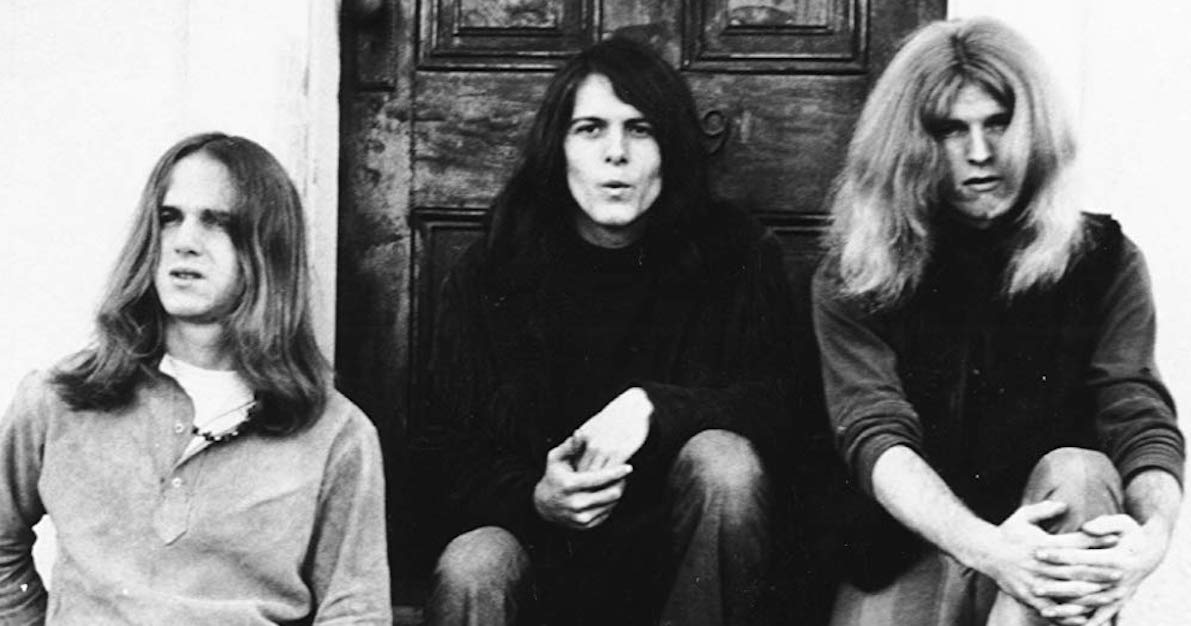
Blue Cheer—“Summertime Blues”
Co-written in 1958 by rocker Eddie Cochran, who died in a 1960 automobile accident, and songwriter/manager Jerry Capehart, the consummate rock and roll rebellion song went Top 10 and then embarked on a life of its own. Most rock fans will know it from the Who’s exciting cover on the 1970 Live at Leeds album; the track went to #27 in America when released as a single. But that was only after the even heavier version offered by the San Francisco power trio Blue Cheer had gone to #14 on the Billboard Hot 100 (and #3 in Canada).
The Mojo Men—“Sit Down I Think I Love You”
Chalk up another to producer Stewart, who took the folk-rockin’ Mojo Men into the studio in early 1967 and had them record a cover of the Buffalo Springfield tune “Sit Down I Think I Love You.” The song, written by Stephen Stills, had appeared on his L.A. group’s eponymous debut album in late 1966, and while the Mojo Men’s version was arranged similarly, Stewart and the group added a touch of whimsy, featuring mandolin, Dobro and several keyboards to give it a more baroque feel. The Mojo Men’s cover peaked at #36 in America while the Springfield never released it as a single.
Chocolate Watchband—“Are You Gonna Be There (At the Love-In)”
One of the raunchier garage bands on the scene, Chocolate Watchband was actually from the city of Los Altos, 50 miles south of San Francisco in Santa Clara County. Recording for Tower Records (the label, not the retail chain), they never placed a single or album on the charts, and it wasn’t until they were long gone that they found favor with garage-rock aficionados seeking out pre-punk rock and roll: The group’s “Let’s Talk About Girls” was featured on the revered, influential 1972 compilation album, Nuggets: Original Artyfacts from the First Psychedelic Era, 1965–1968. “Are You Gonna Be There (At the Love-In),” a 1967 release, demonstrates the rawness and pure psychedelia that has given the Chocolate Watchband a second life—and maybe a few more.





1 Comment so far
Jump into a conversationThank you, Jeff, for including Blue Cheer in your list. When I was a young teen, use to go to local Sacramento Valley teen dances and concerts and saw Blue Cheer at a lot of them. They are, to me, the original Power Trio. Paul Whaley was an outstanding drummer. Those were the days.