
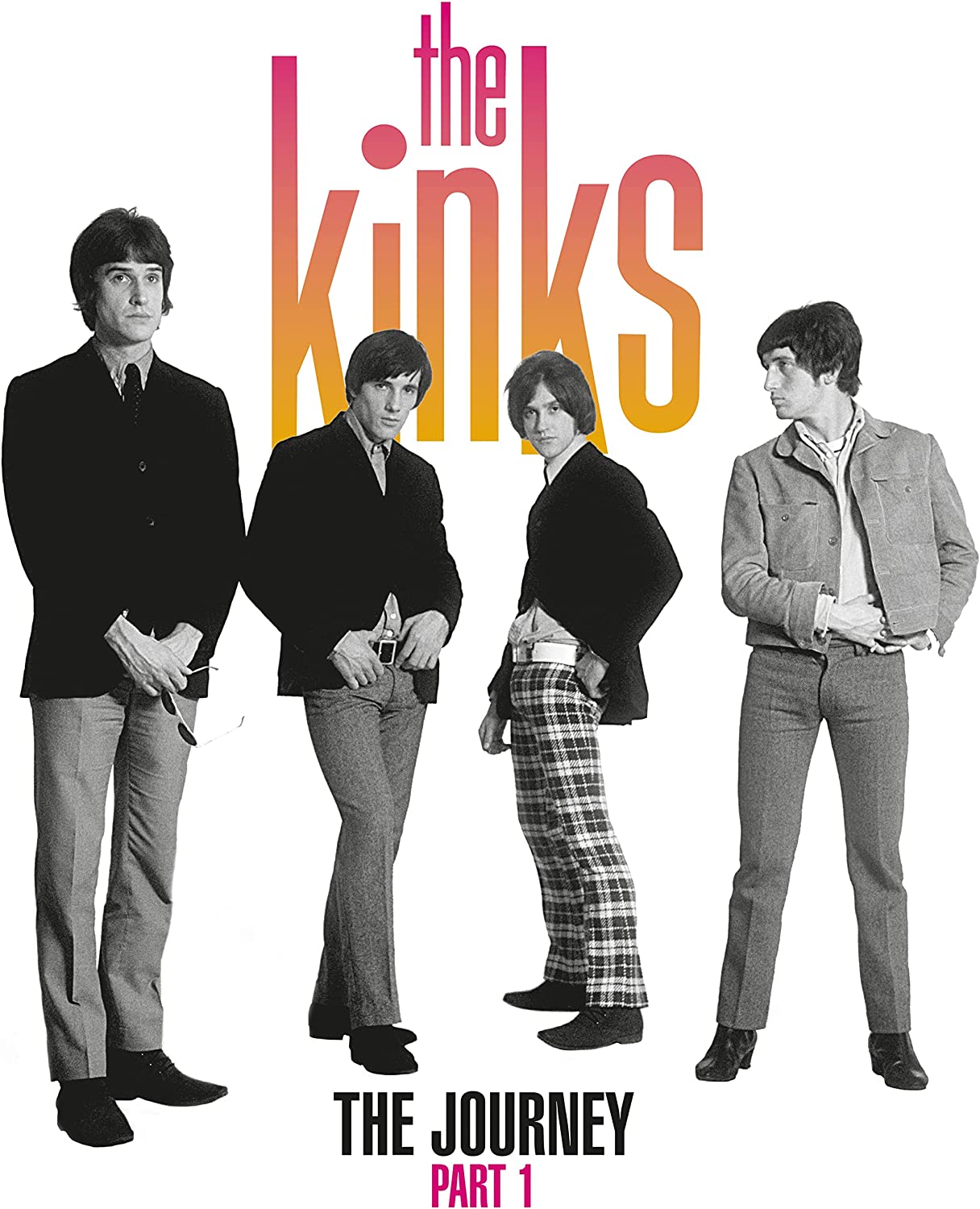
It’s been quite a journey for The Kinks
To many listeners, The Kinks’ singles discography begins with such songs as “You Really Got Me” and “All Day and All of the Night,” continues with “A Well Respected Man,” “Sunny Afternoon” and “Waterloo Sunset,” and concludes with “Lola.” Those records have been played by disc jockeys for decades, and continue to serve as the most accessible way into a catalog that was redefining British rock as far back as the mid-’60s. In the U.K., that string of singles made them one of the defining bands of the decade, with Ray Davies establishing himself as one of its most idiosyncratic songwriters.
In addition to Ray, who also sang most of the leads and played rhythm guitar, the original lineup consisting of his brother Dave Davies on lead guitar and vocals, Pete Quaife on bass and drummer Mick Avory is usually considered the classic one, but later editions of the band (the Davies siblings and Avory were always on board) produced some equally memorable material.
In the U.S., however, the Kinks’ story was different than in their homeland. They were banned from live work for most of the late ‘60s by the American Federation of Musicians, thus stalling their momentum at a crucial juncture, just as Ray Davies’ songwriting became more ambitious shifting on from sharp-edged singles to character studies and concept album statements. As a result, their commercial profile sagged. [Their 1979 song, “Catch Me Now I’m Falling,” could’ve described their album and singles chart numbers in the U.S.] And it wasn‘t until the release of ’79’s Low Budget that they actually scored gold album for a U.S. studio release.
The 15 tracks listed below reveal that broader trajectory: records that go beyond the familiar hits to illustrate how the band‘s writing, sound and persona could evolve with the times.
“Dead End Street” (1966)
The song was hugely successful in the UK, reaching #5 there. But in the U.S., it failed to capitalize on the top 15 success earlier in the year of “Sunny Afternoon,” reaching only #73. With its working-class feel, it delivered an injection of reality into a radio scene that had been consumed by sugar-coated pop, and also has that musical-hall-meets-contemporary sound which would flourish in the band‘s later years.
“Autumn Almanac” (1967)
The non-album single delivered once again in the U.K., reaching #3 there, but failed to chart in the U.S. Despite that, many consider it to be one of Ray Davies’ finest works. Brother Dave Davies calls the intricate song a “phenomenal recording.”
“David Watts” (1967)
The leadoff track from Something Else was not released as a single. Davies’ signature witty lyrics are on full display about a homoerotic schoolboy crush (“when I lie on my pillow at night, I dream I could fight like David Watts”). The song was covered by The Jam in 1978, reaching #25 in the U.K.
“The Village Green Preservation Society” (1968)
The titular song and leadoff track from the band’s sixth studio LP was released as a single, but failed to chart anywhere. However, through the years, the album—with more of Davies’ wry humor—became one of the more influential and well-loved of the band‘s catalog.
“Picture Book” (1968)
Despite its breezy rhythm, the song—also from Village Green—features its narrator’s contemplative mood while flipping the pages of a family photo album of snapshots from “a long time ago.” All the while, Ray strums a 12-string acoustic guitar.
“Big Sky” (1968)
The song—another from Village Green—takes a step back to observe normal life from afar. Most have interpreted the lyrics to be referring to a higher power. That’s understandable given the lyrics “they hold their heads in their hands and they cry/People lift up their hands and they look up to the Big Sky/But the Big Sky is too big to sympathize.” Davies has avoided acknowledging the reference to God, noting that he wrote the song while watching people one morning from a hotel balcony while attending a music industry conference in Cannes, France.
“Shangri-La” (1969)
Generally regarded as the highlight of the Kinks’ 1969 concept album Arthur (Or the Decline and Fall of the British Empire), it has a slow build, starting off quietly and developing a much fuller sound. The lyrics are a satirical reflection on suburban life (“a little man who gets the train got a mortgage hanging over his head”) and is one of the group’s best late-’60s works.
“This Time Tomorrow’’ (1970)
It would be easy to overlook this track from Lola Versus Powerman and the Moneygoround, Part One given the popularity of the album’s two singles, “Lola” and “Apeman.” The song deals with themes of traveling (opening, in fact, with the sound of an airplane). It’s fairly buoyant thanks, in no small part, to the piano from John Gosling, who made his Kinks debut as a fifth member on this album.
“Strangers” (1970)
This song was penned by Dave Davies, who also sings lead on this track about a mate from school who died of a drug overdose. It is now one of the band’s most celebrated deep cuts, featured in the Wes Anderson film The Darjeeling Limited, and in an episode of the TV series Ted Lasso.
“20th Century Man” (1971)
This song shows the change in the band‘s early-’70s sound to a more relaxed, traditionalist style. The lyrics embody the sentiment of the time. The only single from the Muswell Hillbillies album—named for the north London neighborhood where the brothers grew up—failed to chart in the U.K. or U.S. but it stands as one of the album‘s most distinctive songs. This also prefigures the band exploring their future direction.
“Celluloid Heroes” (1972)
From the Everybody‘s in Show-Biz album, the lyrics masterfully celebrate a bygone Hollywood in a tender way during a memorable stroll down the Walk of Fame. It’s consistently named as one of Davies’ best songs, with emotional depth that stays with the listener. Despite the single’s significant edit from the more than six-minute LP version, it failed to chart anywhere.
Related: Our feature story on this Kinks Klassik
“Juke Box Music” (1977)
From Sleepwalker. Although the single didn’t chart, it did receive FM airplay and was one of many tracks that guided their late-’70s commercial resurgence. The hook is classic Davies.
“(Wish I Could Fly Like) Superman” (1979)
Incredibly, Low Budget was the Kinks’ only studio album to be certified platinum in the U.S. This minor chart hit, with its catchy disco beat, peaked at #41, and helped the LP reach #11. Unlike the “Man of Steel,” the song’s protagonist is a lightweight at nine stone (the U.K. equivalent of 126 pounds).
Related: The song is included in our feature story, 12 disco songs by classic rockers
“Catch Me Now I’m Falling” (1979)
Brother Ray used a Marvel Comics character to symbolize current events, notably the tense relations between the U.S. and Iran (“This is Captain America calling/I bailed you out when you were down on your knees, so will you catch me now I’m falling”). The rocking track from Low Budget holds up extremely well.
“Destroyer” (1981)
The rocking song from Give the People What They Want reintroduced the riff used in “All Day and All of the Night,” earning it significant FM airplay, resulting in a #3 placement on Billboard‘s rock chart. Issued as a pop single, it barely reached the Hot 100, though, peaking at #85. It remains one of their best known ’80s tunes.
A series of Kinks compilations, The Journey—Part 1 , Part 2 and Part 3, are available in the U.S. here, in Canada here and in the U.K. here.





4 Comments so far
Jump into a conversationVery well chosen list!
there’s a lot more songs than that they have 700 songs!!!! such as: around the dial,,,,I need you….only a dream…..to the bone… artificial man…you can’t stop the music….holiday romance.”.holiday ‘live’….pictures in the sand …”alcohol “live”
Songs that must be on this list: 1) Full Moon (their most underrated tune); 2) Oklahoma USA; 3) Headmaster; 4) Sweet Lady Genevieve; 5) He’s Evil
All the songs mentiobed above are great but there are other great songs: Cliches of the World, YoYo, Artlover, Heart Of Gold, Living On A Thinline, Animal, Killers Eyes, Scattered.