
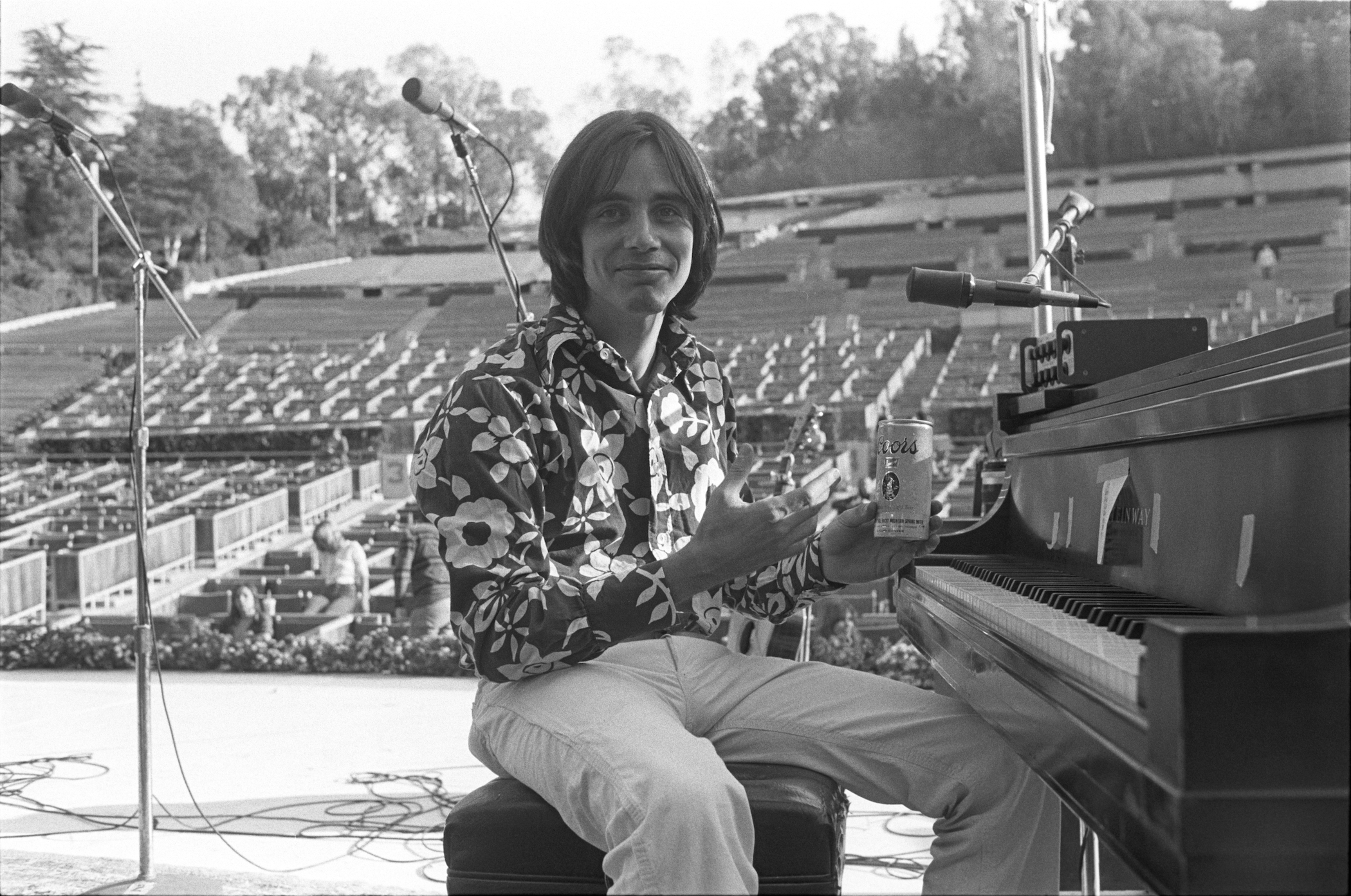
Jackson Browne at the Hollywood Bowl, Aug. 1973 (Photo © Henry Diltz; used with permission)
“Running on Empty.” “Doctor My Eyes.” “Somebody‘s Baby.” “Take It Easy.” They are often the songs most closely associated with Jackson Browne. They‘ve been in regular rotation on the radio and on his concert setlists in the decades since they were released.
Work through his albums though, and a wider perspective emerges. Since he first emerged in the early ’70s as a fresh, new voice, Browne has recorded a string of releases that established him as one of our most distinctive—and popular—singer-songwriters. The 10 songs featured here, diggin in beyond the usual suspects, are drawn from that period. Though some were released as singles, others are memorable album cuts, many of which have long been established through live performance, sitting comfortably alongside his best-known songs.
“Jamaica Say You Will” (1972)
The first song off his self-titled debut album (aka Saturate Before Using). Browne says he called the song a “modern fable,” but the nautical imagery (Jamaica is the daughter of a sea captain) comes from a real woman he knew who was working in an organic orchard on Zuma Beach in California. (“It was about a certain relationship that I was in where I wanted to remain within the cocoons of the relationship and the other person had other intentions,” he explained.) A tone-setter for his early work.
“Rock Me on the Water” (1972)
His second single (following the successful “Doctor My Eyes”), it hit #48 on the Hot 100. It‘s constructed with a looser melody that makes it more commercially accessible. This was an FM radio staple of the day, and despite its modest chart success, it‘s one of his most recognizable early songs.
“Redneck Friend” (1973)
The lead-off track of side two of Browne’s second album, For Everyman, has a fuller orchestration that would eventually become an album staple. It’s notable for its dual-meaning lyrics, guest vocals by Glenn Frey and Elton John, and live band staple David Lindley‘s debut on a JB album. In its cover pick review as a “sleeper,” Record World called it a “cookin’ rock ’em sock ’em item,” though it peaked at just #85 on the Billboard Hot 100 chart.
“Ready or Not” (1973)
One of his funnier and more literal songs of that time, this is an album track that moves along at a steady mid-tempo pace, keeping with the road concept that the record is so closely tied to. It‘s a raw, semi-autobiographical story about his relationship with Phyllis Major (who‘d later become his wife) and their surprise pregnancy announcement.
“Walking Slow” (1974)
Quite a fun, upbeat rock tune about contentment and a return to a new sense of domestic bliss, rather than many of the darker, moodier songs on Browne’s third album, Late for the Sky. It was the first single to be released from the LP, but it never charted on the Hot 100. It offers a welcome deviation from the album‘s mood and ended up being incorporated into Browne’s live shows.
“Fountain of Sorrow” (1974)
The Late for the Sky album version was the longest Browne had recorded up until that point. It gradually develops around the vocal, including a trio of harmony vocalists: Dan Fogelberg, Don Henley and J.D. Souther. It is widely speculated to be based on Browne‘s relationship with Joni Mitchell in the early 1970s. It became a cornerstone cut for fans and though it was trimmed from 6:42 to 4:37 for the 7-inch, the beautiful song failed to chart.
“Before the Deluge” (1974)
The final song from the third album grows from something minimal to something big and complex. One of Browne’s most frequently debated album cuts, he’s referred to it as an “apocalyptic song” with a warning of global warming, with such lyrics as “the earth was abused by the men who learned how to forge her beauty into power,” as we are teetering at the edge of an abyss.
“The Pretender” (1976)
The title track and the epic closing masterpiece from the Jon Landau-produced album, this was usually considered Browne‘s summation of the passing of the ’60s idealism and the acceptance of the rat race of adulthood. As Sam Sutherland notes in his Album Rewind for Best Classic Bands, “Three weeks after he began working on [it], a truly jolting darkness descended when his wife was found dead from an overdose, leaving him a widower with a two-year-old son. Whether Browne’s embattled dreams of community and faith in family could survive such a waking nightmare seemed far from certain.” The song is long considered one of his signature tunes, although Top 40 turned a deaf ear to it: it peaked at a rather pedestrian #58 on the Hot 100 in 1977. A stunning performance.
“The Load-Out” (1977)
An ode to his road crew and the often unglamorous truth of life on the road. It combines with a cover of Maurice Williams and the Zodiacs’ hit “Stay” as the last tracks on his 1977 mega-hit, Running on Empty, and together the songs peaked at #20 on the Hot 100. The pair of songs have almost always been played on the radio as if they are one long song.
“For a Rocker”(1983)
A high-energy number that features his band in a stripped-down sound. The third single from his seventh album, Lawyers in Love, it reached #45 on the Hot 100 and #8 on the Mainstream Rock Tracks chart. It’s in tribute to James Honeyman-Scott, a co-founder/guitarist of the Pretenders, who died in 1982.
Browne’s extensive recorded legacy is available in the U.S. here, in Canada here and in the U.K. here.



2 Comments so far
Jump into a conversationI love LInda Ronstadt’s version of Rock Me on the Water!!!!!
Hi! Lifetime JB fan; from the first album in 1972. Article title fooled me… oh well. Before reading it, I decided to make my own list of deepness. I included all of his oeuvre, and I stopped at 20, then chose ten. This article contends “The 10 songs featured here, digging in beyond the usual suspects, are drawn from that period. Though some were released as singles, others are memorable album cuts, many of which have long been established through live performance, sitting comfortably alongside his best-known songs.” I would consider the article’s ten chosen songs are arguably “songs [also] most closely associated with Jackson Browne. They‘ve been in regular rotation on the radio and on his concert setlists in the decades since they were released.”
I was anticipating a list of deep album cuts that reflect Jackson’s incedible song writing talents. So for those of you who expected such a list, here’s mine. I apologize not including any links or complete info on what albums these precious deep songs are from. And if you’ve gotten this far, you are an authentic JB fan and don’t need any explanation…I hope you appreciate this list:
1. Our Lady of the Well. Jackson’s segue into this song from Take it Easy on his second album is transcendent. I’ve heard it happen live a couple of times…be still my heart.
2. My Opening Farewell. Bonnie does a nice version, right?
3. Looking Into You. I am still amazed JB could get all the way through this song in concert without being reduced to tears, like the audience.
4. Call It A Loan. Wait; it’s on one of his Greatest Hits CD’s
5. That Girl Could Sing.
6. From Silver Lake
7. The Fuse
8. Love Needs A Heart
9. Colors of the Sun
10. The Late Show.