
The Day the Music Didn’t Die—14 Rockin’ Tunes from 1959-64
by Jeff Tamarkin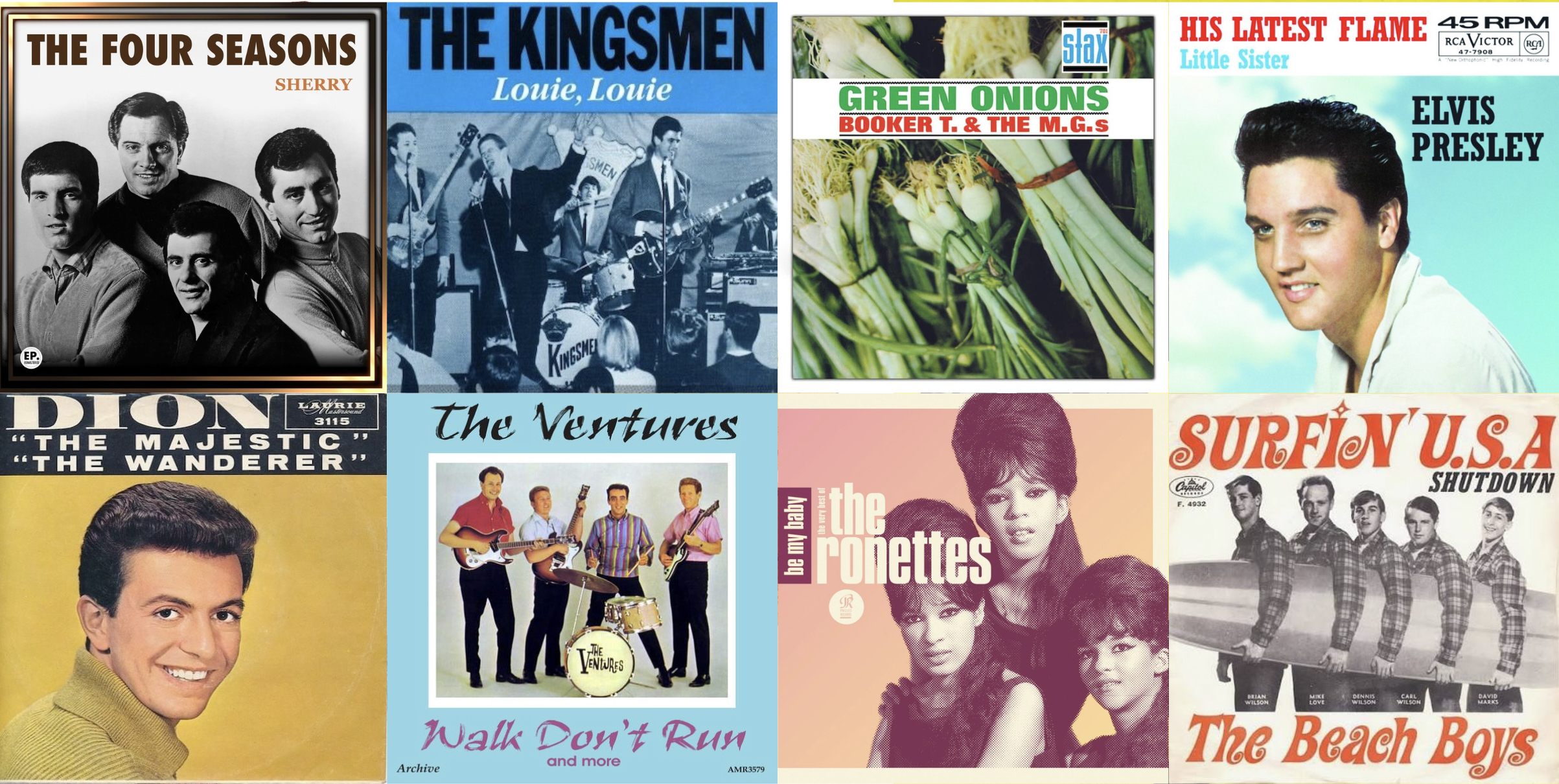
Some of the songs that demonstrate that rock and roll did not disappear for half a decade.
The conventional wisdom goes something like this: On Feb. 3, 1959, a small plane carrying rock and rollers Buddy Holly, Ritchie Valens and the Big Bopper crashed in an Iowa field, killing all three and the pilot. From that moment on, rock and roll lost its edge and, until the Beatles and the other British bands came along and saved it, it was dominated by well-scrubbed, clean-cut pinup boys who didn’t frighten parents or music business executives.
There is something to be said for that theory of 2-3-59 being “the day the music died,” as singer-songwriter Don McLean proposed in his early ’70s hit “American Pie.” One can wage an acceptable argument that rock and roll went into hibernation for a period of exactly five years after the tragedy, only to return stronger than ever with the creative bursts of the later ’60s.
Except it’s not true and never has been. Rock and roll did not disappear for half a decade. While several of its founding MVPs went into limbo—Elvis Presley served in the Army for a couple of years, Jerry Lee Lewis was blackballed for marrying his 13-year-old cousin, Chuck Berry was in prison, Little Richard was singing for the Lord—there was still plenty of creative activity going on in pop music. While some of those who would later comprise the first class of Rock & Roll Hall of Fame inductees sat it out, new trends developed and the music morphed in several new and different directions—as every genre does over time (look at jazz, which went from the big bands to small-group bebop to free/avant-garde in a relatively brief timespan).
While there were, undeniably, those pretty boys singing softly of “Puppy Love” and nice lads with names like “Johnny Angel” (or at least Frankie Avalon) smiling from the cover of 16 Magazine, there was still plenty of the real deal too.
Here, in relatively random order, are 14 songs that helped define the gap years between the death of Holly and the Beatles’ arrival in the United States in February 1964.
The Beach Boys—“Surfin’ USA”—The undisputed leaders of the surf music movement emerged in Southern California in 1962 with an original tune called—what else?—“Surfin’.” But it wasn’t until the spring of ’63 that they broke nationally with “Surfin’ U.S.A.,” a top 5 hit that sent them off on a remarkable career that found them becoming one of America’s most successful and lauded bands. Meanwhile, a parallel subgenre of instrumental surf music, led by guitarist Dick Dale, also enjoyed a solid but brief run.
The Ventures—“Walk—Don’t Run”—The guitar was also the vehicle that fueled the massive success of the Seattle-based Ventures, a quartet that knocked out one wordless earworm after another, starting with this 1960 #2 hit. Way before anyone in America had heard of the Beatles, the Ventures were responsible for pointing more wide-eyed kids toward music shops to purchase an electric guitar than anyone.
Barrett Strong—“Money”—When songwriter Berry Gordy Jr. launched Tamla Records in 1959, followed soon after by Motown, he could not have known that he was igniting one of the most significant cultural forces in the world, a company that would eventually give us Stevie Wonder, Marvin Gaye, the Four Tops, Smokey Robinson, the Supremes, the Temptations, Michael Jackson, Lionel Richie and many others. The first real hit was this one though, in early 1960. It made waves all the way over the sea in Liverpool, England, where a brand-new band called the Beatles made it a regular part of their show and later recorded their cover.
The Ronettes—“Be My Baby”—Record producer Phil Spector started his career in 1958 as part of a singing group called the Teddy Bears, who scored a #1 ballad with his “To Know Him is to Love Him.” Spector had higher aspirations though, and in 1961, partnering with Lester Sill, he founded Philles Records. Spector moved into production and by 1962, specializing in what became known as girl groups, he was churning out a string of hits powered by his trademark “Wall of Sound” production technique. Among the earliest were the chart-topping “He’s a Rebel” by the Crystals and the #2 ’63 landmark “Be My Baby” by the Ronettes, fronted by the inimitable vocalist Veronica Bennett, better known as Ronnie Spector.
Del Shannon—“Runaway”—Not all of the solo male singers of the day were tossing out wussy pimple cream music. The former Charles Westover, for example, now calling himself Del Shannon, was introduced to listeners via this brilliantly constructed tune that featured a mean falsetto and one Max Crook’s catchy solo on a keyboard he invented himself, the clavioline-based Musitron.
Related: Our review of a comprehensive Del Shannon boxed set
The Impressions—“It’s All Right”—Formed in 1958, this Chicago-rooted soul group took off when it added singers Jerry Butler and Curtis Mayfield to its lineup. Butler left for a high-profile solo career pretty quickly, making Mayfield the designated lead vocalist. The latter wrote this inspiring, gospel-infused number that advised, “Hum a little soul, make life your goal, and surely something’s gotta come to you.” Who could find fault with that? The recording became the Impressions’ biggest, reaching #4 on the Billboard Hot 100 in 1963.
Chubby Checker—“The Twist”—Never before had a single dance so dominated the culture. Chubby Checker, born Ernest Evans, took a song originally recorded in 1958 by Hank Ballard and the Midnighters and released as a B-side and—without changing the arrangement—took his cover to #1 not only in 1960 but again in 1962, the first single to accomplish that feat. Everyone—and we mean everyone, even high-society snobs—was doing the Twist, and there were countless variations and wannabe dances (the fly, the pony, the mashed potato, the hully gully). Checker himself scored several other huge dance hits, and although his mega-celebrity faded as the ’60s kicked in for real, he was one of the most recognizable faces and voices of the first part of the decade.
The Four Seasons—“Sherry”—Fronted by the distinctive voice of Frankie Valli, who punctuated his tenor with wild flights of falsetto, the New Jersey quartet, which began as the Four Lovers in the mid-’50s, persevered and became one of the premier American groups of the ’60s. Their run of hits began here, with this #1 gem released in the summer of 1962. From there, it was nonstop for more than a decade, as such memorable hits as “Big Girls Don’t Cry,” “Walk Like a Man,” “Rag Doll” and, in 1976, “December, 1963 (Oh, What a Night),” all topped the chart.
Ben E. King—“Spanish Harlem”—After a stint as lead singer with the R&B stalwarts the Drifters, singing such classics as “There Goes My Baby” and “Save the Last Dance for Me,” Ben E. King went solo and continued turning out hits. This 1960 beaut, written by Jerry Leiber and Phil Spector and produced by Leiber and Mike Stoller for Atlantic’s Atco spinoff, borrowed the Drifters’ penchant for string-drenched orchestral accompaniment and sounded absolutely majestic coming out of a transistor radio. The recording peaked at #2 in the U.S. and scored big in several European countries, far from the streets King and the song’s authors drew upon.
Dion—“The Wanderer”—Speaking of “the streets,” another solo male singer who didn’t fit the boy-next-door mold so often associated with the era, Dion DiMucci was a Bronx kid who would later be dubbed “The King of the New York Streets.” He first found fame in 1958 with “I Wonder Why,” a chaotic uptempo doo-wop featuring his fellow Bronxers the Belmonts on accompanying vocals. The mono-monikered Dion—who was on the tour that became the last for Holly and friends (Dion gave up his seat on the plane to Valens)—left the group behind in 1960 and that’s when his career truly began to take off. He scored a #1 in 1961 with “Runaround Sue,” which he cowrote with Bronx buddy Ernie Maresca, and then, later that same year, followed with this #2 hit, written solely by Maresca. As of this writing, the 87-year-old Dion still performs live, and sounds as great as ever.
The Marcels—“Blue Moon”—Doo-wop music wasn’t called doo-wop when it was thriving; it was simply called rock and roll. The other, more widely accepted term for the subgenre came later. The form took off initially in the ’50s, primarily among young Black urban vocal groups, fell out of favor for a bit, then in 1961 began to enjoy a resurgence wherein both new Black and white groups emerged and gave the vocal harmony group format a new life. The Marcels, from Pittsburgh, were a multi-tracial group that found success that year. Like many other vocal outfits, their ticket was an old song from the so-called Great American Songbook, the Rodgers and Hart ballad “Blue Moon,” written in 1934, which they sped up considerably and rocked up like nobody’s business. Any self-respecting teenager turned up the radio and sang along to its “bomp-baba-bomp-ba-bomp-ba-bomp-bomp vedanga-dang-dang-vadinga-dong-ding” intro as if the world depended on it (which it did).
Booker T. & the MG’s—“Green Onions”—As noted above (see the Ventures), instrumental recordings were all the rage in the early years of rock and roll, many of them—usually, but not always, powered by guitars—rising high in the charts. Booker T. & the MG’s were one of the best. Led by Hammond organist Booker T. Jones and the guitar of Steve Cropper, the musicians were the house band at Memphis’ Stax Records, backing up such greats as Otis Redding and Sam and Dave, but they began releasing their own music in 1962, making it to #3 in the Hot 100 with this, their very first single. The song became a standard, performed by countless bands throughout the years, and is still ubiquitous today.
The Kingsmen—”Louie Louie”—The original “Louie Louie,” an R&B sailing tune written and recorded by Richard Berry in 1956, didn’t make much of an impact—it didn’t even get into the Billboard top 100 list. But the song later gained traction among rock and roll bands, particularly in the Pacific Northwest, where an Oregon group called the Kingsmen took it into a recording studio in 1963 and recorded a version so shambolic and distorted that few listeners could understand what lead vocalist Jack Ely was really singing. Speculation mounted, leading to a theory that he’d injected some foul language into the lyrics. Scandal ensued, the record was banned in many locales, authority figures raved and ranted that the world was coming to an end thanks to “Louie Louie,” and all the fuss, rather than kill the song, boosted it all the way up to #2. The story doesn’t end there though: the Kingsmen’s “Louie Louie,” which was released just weeks before the Beatles invaded America, became one of the most covered, and recorded, rock songs in history, with many critics and historians pointing to it as the place where punk rock began. Who’s to say they’re wrong?
Related: More about the “Louie Louie” controversy
Elvis Presley—“(Marie’s the Name) His Latest Flame”—Oh, did we say that Elvis was one of those primal early rockers who went the way of the dodo at the end of the ’50s? Oops, we did. And we lied. Sorry. Sure, many believe that Elvis Presley’s career ended when he went into the Army in 1958. Even John Lennon, who readily acknowledged Presley as one of his greatest influences, allegedly said that the Army killed Elvis. The naysayers further swear that when he was discharged in 1960, the music world was a changed place and no one cared about Elvis anymore. He spent his time cynically making crappy movies and even worse soundtracks filled with mush, only finding his footing again when he launched a “comeback” in 1968. Nice story, but false. Presley never stopped rocking and never stopped enjoying King-sized hits, even when he was in the service: Singles like “Hard Headed Woman” and “A Big Hunk O’ Love” were released while he was out of the spotlight and hit #1, and although he did alternate those uptempo hits with ballads and midtempo songs, he never stopped rockin’. One of his best of the post-Army period was 1961’s “(Marie’s the Name) His Latest Flame,” written by the great New York City team of Doc Pomus and Mort Shuman, who also penned its equally potent B-side, “Little Sister.” It’s true that Elvis’ commercial power dimmed for a few years in the mid-’60s, but anyone who claims he was rendered obsolete when he traded in his blue suede shoes for Army drab just isn’t checking the facts very well.
Music from many of these recording artists is available in the U.S. here, in Canada here and in the U.K. here.






2 Comments so far
Jump into a conversationAttend any high school sporting event with a pep band and the odds are pretty good you will hear Louie Louie!
The Wrecking Crew play on many of those songs