
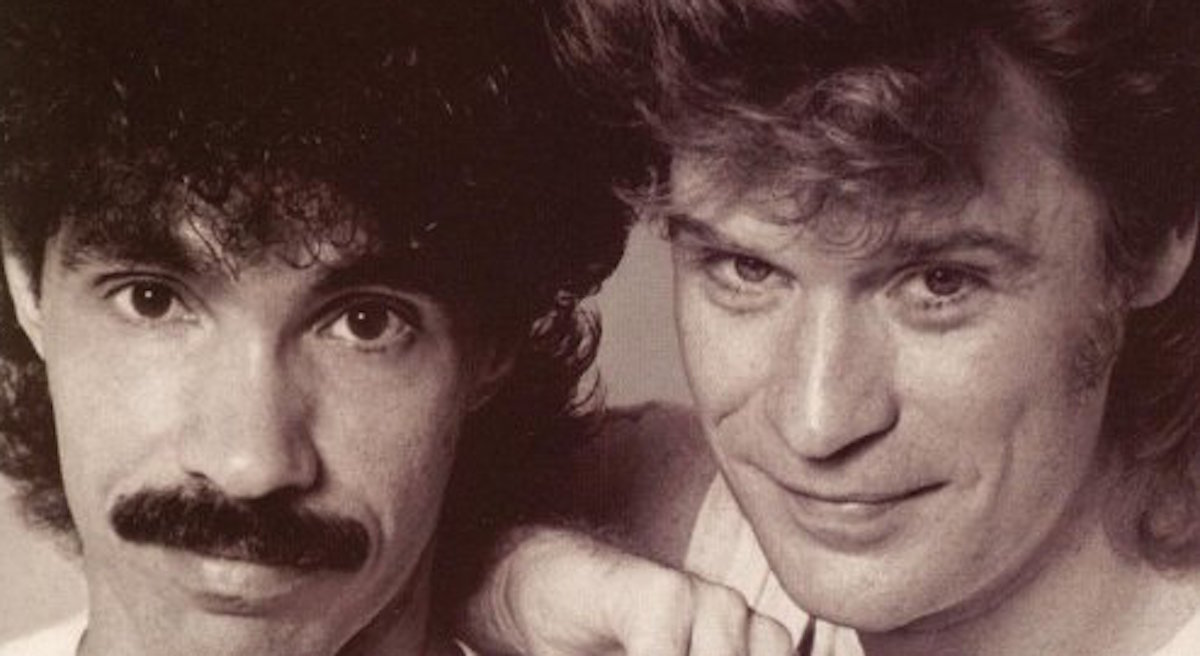
Daryl Hall and John Oates spent years trying to turn their musical chemistry into commercial success. Their early albums showcased an unusual meeting of Philadelphia soul, folk-rock and pop craftsmanship, but the big breakthrough took time. “Sara Smile” finally cracked the Top 10 in 1976, and “Rich Girl” reached #1 in 1977. By the early ’80s, the duo had become hitmaking giants, delivering one radio staple after another, including no less than six #1 singles. Hall and Oates‘ phenomenal success was the payoff for a long apprenticeship, not an overnight sensation.
There is plenty to discover beyond the familiar smashes. Their catalog includes overlooked singles, soulful album cuts, a composition that became a major hit for another singer and an entertaining Christmas detour. These 10 selections trace Hall & Oates‘ road from hungry young songwriters to pop superstars, revealing the craft, influences and occasional surprises behind the hits.
“When the Morning Comes” (Abandoned Luncheonette/Atlantic, 1973)
Released as a single in May 1974, this early highlight has a breezy, folk-rock warmth, with layered harmonies already hinting at the soulful sophistication to come. Producer Arif Mardin helped give the recording its polished yet organic feel. It emerged during the same creative period as “She’s Gone,” which needed a 1976 re-release before finding a much larger audience. Sometimes the seeds of success are planted long before the public notices.
“It’s a Laugh” (Along the Red Ledge/RCA, 1978)
This punchy lead single reached #20 on the Hot 100 in late 1978, helping bridge the gap between the duo’s earlier soul-pop sound and the streamlined approach that would soon dominate radio. David Foster’s production gives the arrangement a crisp, forward-driving quality without sanding away its edge. The album also marked the first time their touring band backed them in the studio on an LP, lending the performances a tighter, unified group dynamic.
“Wait for Me” (X-Static/RCA, 1979)
Peaking at #18 on the Hot 100 in January 1980, this track is a showcase for a vocalist who could make emotional uncertainty sound effortless. The arrangement builds patiently, allowing tension to gather instead of rushing toward an obvious payoff. Its combination of soulful phrasing and carefully layered pop production captures the duo refining the sound that would soon make them fixtures on American radio.
“How Does It Feel to Be Back” (Voices/RCA, 1980)
John Oates, born April. 7, 1948, wrote and handled lead vocals on this buoyant lead single, which reached #30 on the Hot 100 in the autumn of 1980. His delivery brings a distinct texture to the partnership, carrying the melody with an easygoing directness that contrasts with Hall’s more expansive vocal style. The self-produced parent album proved to be a turning point, later yielding their hit cover of “You’ve Lost That Lovin’ Feelin’,” the #1 “Kiss on My List” and Top 5 smash “You Make My Dreams.”
“Everytime You Go Away” (Voices/RCA, 1980)
This spacious, gospel-tinged ballad was written solely by Hall, born Oct. 11, 1946, and recorded as a key album track for Voices. The duo never issued their studio version as a single but British singer Paul Young later covered the song and took it to #1 on the Hot 100 in 1985. The Hall & Oates original remains an intimate fan favorite, built around an unhurried Memphis-soul groove and an expressive vocal performance.
Related: Our Album Rewind of Voices
“Some Things Are Better Left Unsaid” (Big Bam Boom/RCA, 1984)
By the mid-’80s, glossy production and electronic textures had become central to the duo’s sound. Released as the album’s third single, this track reached #18 on the Hot 100 in May 1985, wrapping its melody in layered synthesizers and a sleek rhythm track co-produced with Bob Clearmountain. The result is unmistakably of its era, yet the songwriting remains firmly at the center.
“Do What You Want, Be What You Are” (Bigger Than Both of Us/RCA, 1976)
Released in late 1976—the same year “Sara Smile” broke into the Top 10—this slow-burning Philly soul single reached #39 on the Hot 100. Its message of individuality sits comfortably alongside the duo’s classic R&B influences, giving the performance a conviction that extends far beyond its chart peak. Decades later, the title was chosen for the duo’s career-spanning 2009 boxed set, Do What You Want, Be What You Are: The Music of Daryl Hall & John Oates.
“I Don’t Wanna Lose You” (Along the Red Ledge/RCA, 1978)
Peaking at #42 on the Hot 100 in early 1979, this follow-up single offers a more restrained, romantic counterpart to “It’s a Laugh.” Emotional nuance takes precedence over tempo, supported by Gene Page’s lush string arrangements. It illustrates how the duo could explore different shades within a polished pop framework without repeating themselves.
“Jingle Bell Rock” (Non-Album Single/RCA, 1983)
The duo put a polished pop-soul spin on the holiday standard first popularized by Bobby Helms in 1957. Released as a standalone, two-sided holiday 7-inch single in 1983, one featuring Hall on lead vocals and the other featuring Oates. Their version(s) traded the original’s country twang for sleek rock and R&B energy. The pair of videos prominently feature lead guitarist G.E. Smith in drag disguised as an electric-guitar-playing grandmother.
“The Way You Do the Things You Do/My Girl” (Live at the Apollo/RCA, 1985)
Recorded live at Harlem’s Apollo Theater in May 1985 alongside former Temptations vocalists David Ruffin and Eddie Kendricks, this performance celebrated the Motown heritage that shaped Hall & Oates’ musical roots. While the album features a continuous 12-minute, four-song medley (also incorporating “Get Ready” and “Ain’t Too Proud to Beg”), the edited commercial single paired “The Way You Do the Things You Do” with “My Girl,” climbing to #20 on the Hot 100. Ruffin and Kendricks connect the tribute directly to the source, making it a fitting conclusion to the collection.
Their recordings are available in the U.S. here, in Canada here and in the U.K. here.





No Comments so far
Jump into a conversationNo Comments Yet!
You can be the one to start a conversation.