
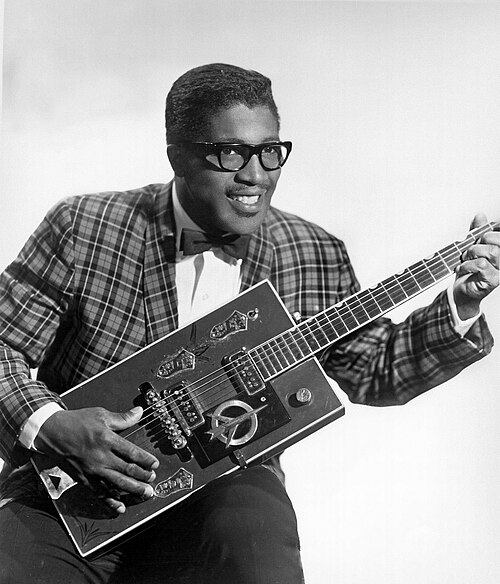
A Bo Diddley publicity photo from 1957 (from his Wikipedia page)
What’s become known as the Bo Diddley beat is rooted firmly in the rhythms of Africa and Latin America and its antecedents on the charts of America with hits like the Andrews Sisters’ “Rum and Coca Cola” in the 1940s and Red Saunders and the Hambone Kids’ “Hambone” in the early 1950s.
But there can be no question that once Bo Diddley (born Ellas Otha Bates) popularized it in his pioneering rock and roll hit, the self-mythologizing “Bo Diddley,” there was no turning back. It has set the pace on countless classic rock records ever since. Here are some prime examples of the Bo Diddley beat as employed throughout the history of rock music.
Bo Diddley—“Bo Diddley” (1955)—It seems only right to begin with the record that would influence all who followed on the trail that Bo Diddley blazed. A #1 rhythm and blues hit that failed to crossover to the pop charts, its historic significance far outweighs the success it achieved at the time of its release.
The Crickets—“Not Fade Away” (1957)—A dyed-in-the wool Bo Diddley fan (he recorded “Bo Diddley” in 1956), Buddy Holly and his band made this original song the B-side of their Top 10 hit “Oh Boy!” and it would later achieve still greater renown as the first Rolling Stones single to crack the American charts—after it went to #3 in the U.K.
Related: The Stones’ cover of “Not Fade Away” is among the best of their early recordings
The Johnny Otis Show—“Willie and the Hand Jive” (1958)—A bandleader who was a regular presence on the rhythm and blues charts of the early 1950s but achieved his greatest pop success with this oft-recorded number, which hit the top 10 later that decade and would also become a hit for Eric Clapton in 1974.
Dee Clark—“Hey Little Girl” (1959)—He’s little remembered today but Dee Clark, a Chicago-based veteran of Red Saunders’ Hambone Kids and the Kool Gents, a doo-wop group, had a string of five pop and rhythm and blues hits very much in the style of Clyde McPhatter in the late 1950s and early 1960s, of which this Otis Blackwell-penned song was one.
Elvis Presley—“(Marie’s the Name) His Latest Flame” (1961)—With “Little Sister,” one-half of one of the all-time greatest two-sided hit singles, both sides written by Doc Pomus and Mort Shuman and each song a top 5 hit for the King.
The Foto-Fi Four—“Stand Up and Holler (All for the Beatles)” (1964)—With the U.S. breakthrough of the Beatles there was no shortage of singles released stateside looking to ride the wave of Beatlemania. This one, an early effort by none other than Harry Nilsson, failed to trouble the charts.
The Strangeloves—“I Want Candy” (1965)—Much to the surprise of Jerry Goldstein, Richard Gottehrer and Bob Feldman, this song, written and produced by them in collaboration with Bert Berns, and credited to a fictional Australian band, became a hit single and they were expected to perform it live. And then it became a hit again, in the U.K., for Bow Wow Wow in 1982.
The Who—“Magic Bus” (1968)—The last in a long line of U.K. hit singles—they had far fewer in the U.S.—by the band prior to the release of their rock opera Tommy, it was written by Pete Townshend in 1965 but only became the titular track of the album Magic Bus: The Who on Tour, a misleadingly named compilation of studio recordings released three years later.
The Stooges—“1969” (1969)—The first song on, and a highlight of, the punk progenitors’ debut album The Stooges, it was written by Iggy Pop and his bandmates and produced by John Cale, who had only recently departed the Velvet Underground. Disparaged upon its release, this song and the album it’s taken from are now celebrated for their enduring influence.
Bruce Springsteen—“She’s the One” (1975)—A standout track on an album, Born To Run, chock full of standout tracks, in concert The Boss and his E Street Band have been known to precede playing it live with a Bo Diddley song. Can’t imagine why.
Related: A deeper look at Bruce’s Born to Run album
REO Speedwagon—“Don’t Let Him Go” (1981)—On their multi-platinum album Hi Infidelity, the Midwestern rockers expanded their repertoire to include the power ballad “Keep on Loving You,” a #1 hit single, but that didn’t mean they had forsaken rock and roll, as the inclusion of this song amply demonstrates. It too became a hit.
Elvis Costello and the Attractions—“Lovers Walk” (1981)—His fifth studio album, Trust, found Elvis and the group adopting a more elaborately produced sound without necessarily sacrificing, in songs like this one, the hard-edged attitude of their earlier recordings.
George Michael—“Faith” (1987)—Side one, track one of the singer’s debut solo album after leaving Wham!, both single and its namesake album hit #1 on the American charts, as did the album in Great Britain, though the single crested at a mere #2.
U2—“Desire” (1988)—From Rattle and Hum, the Irish band’s eighth album, the soundtrack to a documentary about their then-recent tour of the United States, and released as its first single, their first to top the U.K. charts while peaking at #3 in the U.S.
KT Tunstall—“Black Horse and the Cherry Tree” (2004)—The first single from the Scottish singer-songwriter’s first album, Eye to the Telescope, and a hit in the U.S. after a performance of the song by Katherine McPhee on American Idol. It would chart in the U.K., Canada and New Zealand as well.
Bo Diddley recordings are available here.





No Comments so far
Jump into a conversationNo Comments Yet!
You can be the one to start a conversation.