
The early rock and roll pioneers are typically thought of as hitmakers responsible for jumpstarting a kind of music that’d be more artfully made by others. These artists whose heyday was the 1950s produced the goods that served for decades as the raison d’être of oldies stations. They were meant to take a listener down “memory lane,” rather than off for a heady peregrination on Penny Lane, or else hook a kid on what had been Dad or Grandma’s music.
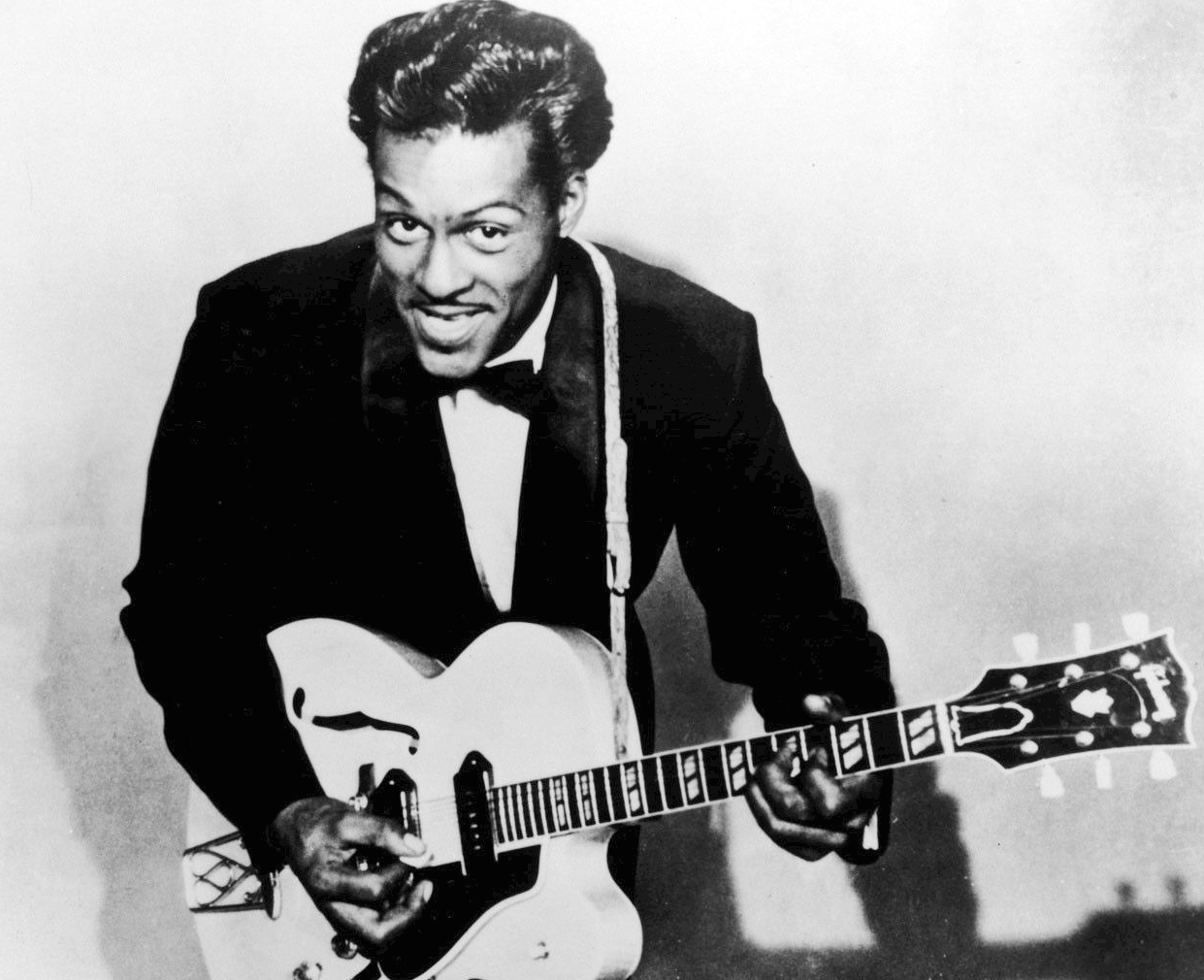
But if we take the time to listen properly, divorced from associations, it’s startling how bold, experimental, avant-garde and futuristic the output of the likes of Elvis Presley, Buddy Holly and Jerry Lee Lewis was and remains. Then we have Chuck Berry, born in St. Louis on October 18, 1926, who just happened to create some of his finest work in the late 1950s, material essential to the identity of that period while transcending it.
Were one apprised by a visiting alien from Neptune who lived in a year that was happening both before and after our current one that “Johnny B. Goode” was all the rockin’ rage there, that would track. Berry is timeless like Walt Whitman, otherworldly and front-and-center. And insofar as the United States has a definitive musical voice that also excels at telling stories, that voice may well be Chuck Berry’s.
“Johnny B. Goode,” “Maybellene,” “Let It Rock,” and so many others, are built with quintessential Berry guitar riffs that are the very foundation of rock and roll. We know a Berry riff instantly, and yet never tire of them. They manage to be both familiar and fresh while serving as rip-roarin’ prefaces that send us headlong into a fast-paced tale with themes as deep and hard-hitting as one would find in Faulkner.
Watch Berry perfom “Maybellene” live in 1958
Berry wrote story songs. They’re fun, engrossing, stirring, loaded with wit, thick with unforgettable, highly detailed images economically expressed. One reads a description in Shakespeare that doubles as crucial insight into a life and thinks, “Yep, he nailed it.” Same goes with listening to Berry sing, “He used to carry his guitar in a gunny sack/Go sit beneath the tree by the railroad track” in “Johnny B. Goode.” Berry isn’t merely one of our finest songwriters; he’s one of the great storytellers.
A case can be made for the 1982 compilation The Great Twenty-Eight as the single disc most illustrative of what rock and roll is. It’s composed largely of singles. These early rockers, we’re often told, didn’t think in terms of albums anyway. That would be the purview of Bob Dylan, the Beatles, the Who, the Rolling Stones, Jimi Hendrix and on and on in the 1960s. There could be top-shelf LPs from rock and roll’s formative years, but it was as though they happened by accident rather than design, and thus weren’t treated as “proper” artistic statements.
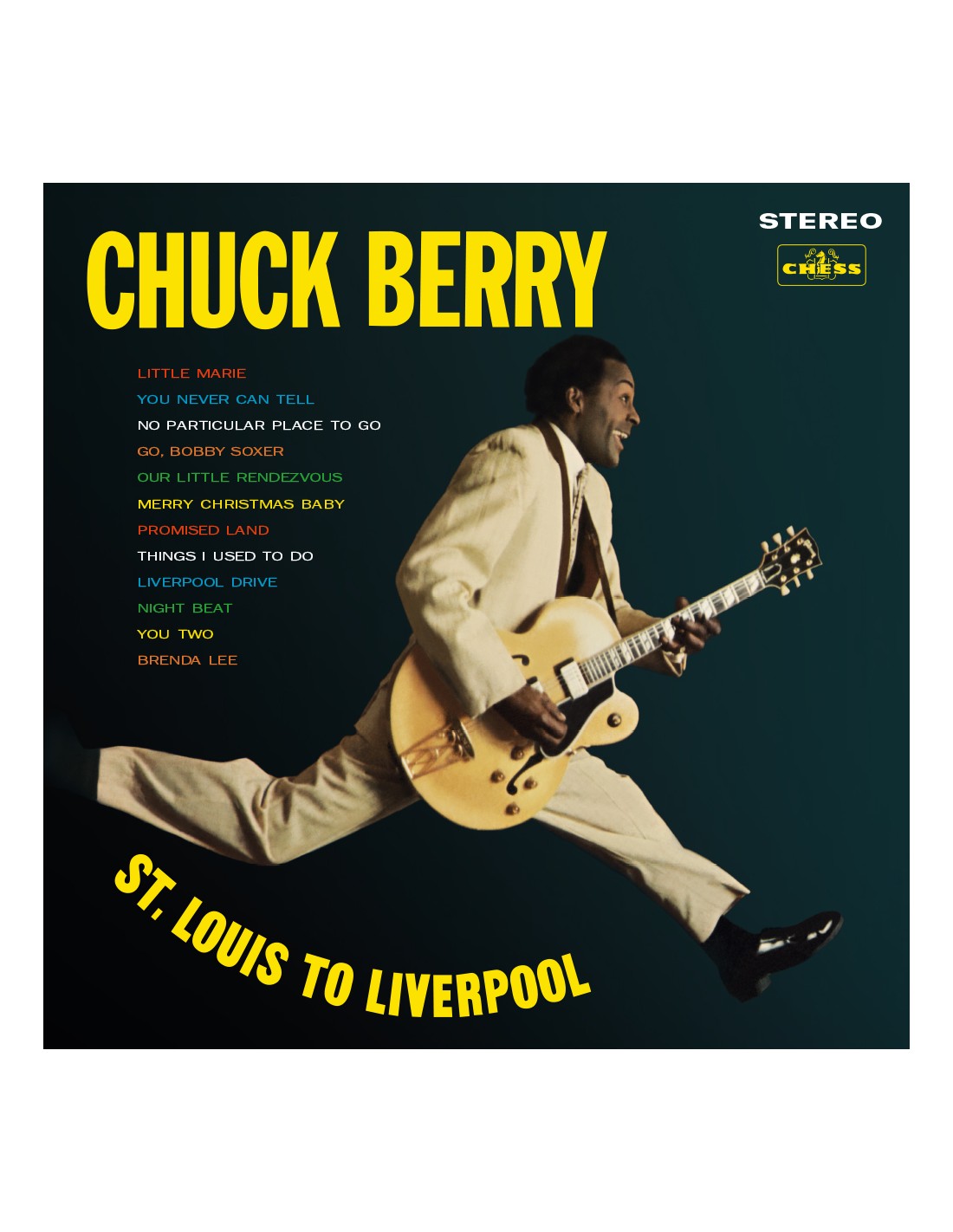 This is silly. Holly’s The “Chirping” Crickets, Presley’s RCA debut, The Dance Album of Carl Perkins and The Coasters hold their own with the likes of a Highway 61 Revisited or Are You Experienced. Then there’s the hidden-in-plain-view wonder of an album that is Chuck Berry’s St. Louis to Liverpool. The record was released in November 1964 when Berry was thought of as passé, save as the guy that the Beatles, Rolling Stones and Animals were hugely into, which the album title’s nod to the Fab’s hometown clearly tried to cash in on.
Berry had been in prison for violation of the Mann Act for 20 months, gaining release in October 1963. The following year would be the last in which he was a consistent force in the charts. St. Louis to Liverpool features four of that annum’s five top-twenty Berry hits, each of which is a masterpiece of song-based storytelling: “You Never Can Tell,” “No Particular Place to Go,” “Little Marie” and “Promised Land,” the last a number that may or may not be the finest song ever written in the United States, but at worse is damn close.
These songs were sufficiently sterling that no less a diehard Berry believer than John Lennon opined they had to have been written before the man went to prison, as if his genius was confined to the previous decade. It scarcely matters. The album is the album and it’s a document one needs to experience in life or else one isn’t getting from life what one easily can. If we’re only here the once, you want to make sure you read Moby-Dick and watch Citizen Kane. Same goes with listening to From St. Louis to Liverpool.
Watch Uma Thurman and John Travolta dance for their lives to “You Never Can Tell” in Pulp Fiction
The album begins with “Little Marie,” a sequel to 1959’s “Memphis, Tennessee.” The earlier number told the story of a man whom we learn is separated from his little girl, Marie. It packs a similar wallop to F. Scott Fitzgerald’s 1931 story, “Babylon Revisited.” Berry is such a gifted writer that the story features a twist that also isn’t really a twist. That is, there’s no novelty, no “gimmick.” It’s authentic, unfakeable life, with a guitar riff different from any in the Berry catalog; a riff that we may not be conscious of until it’s pointed out to us.
In “Little Marie,” the singer receives a phone call from the mother of his daughter, accepting the charges. A lot of phone calls are made in Berry’s music because people are trying to communicate and connect with each other. They’re sharing disappointments, triumphs, desires.
We don’t get the particulars of this backstory. Why father and daughter are separated. Why dad had to leave. Was it the law? Something race-related? Is he on the lam? Has he had to go elsewhere to make enough money for this family.
The narrator is self-conscious, senses that there’s nothing he can say that will rise to level of the situation or express his feelings accurately. He promises to do everything in his power to help his little girl and hangs up. The song is two minutes and thirty-three seconds long.
This is what Berry did and does throughout St. Louis to Liverpool. In “No Particular Place to Go,” cruising is paradise, regardless of whether the singer knows it in that moment, as with the characters in George Lucas’ American Graffiti (1973). “Ridin’ along in my automobile,” Berry sings, “My baby beside me at the wheel/I stole a kiss at the turn of a mile/My curiosity runnin’ wild.”
Those two words—“My curiosity”—contain a mountain of meaning and possibility. Berry uses implication to foster clarity. He doesn’t tell us what to think, but he positions us so that we know what to think on our own. Later, the singer dukes it out with a recalcitrant seat belt, which we also realize is a pun on his date’s belt around her pants. “All the way home I held a grudge/But the safety belt it wouldn’t budge.” Good luck finding a superior display of wit in the whole of rock and roll.
Berry cooled things down with two instrumentals in “Liverpool Drive” and “Night Beat,” leading to a rendition of “Merry Christmas Baby” that hits hard all year. Pianist Johnnie Johnson—conceivably the most unsung foundational instrumentalist in American music—uncorks a hook on “You Never Can Tell” attesting that in the Land of Berry a piano can be just as important as a guitar. This is a major piece of pianism: tricky and simple. Think Sonny Clark in a rock and roll setting.
Two teenagers get married in the song and begin their lives together, the older folks looking on, thinking what they do, sharing those thoughts with each other, evincing a knowledge about the world that includes leaving room for what you don’t know and maybe never will, but might with an attitude like this. Berry throws in some French, easy as you please. Listening to the song you feel as if there was little that Berry didn’t know.
Related: 17 classic Chuck Berry covers
Then we have “Promised Land,” a song-story about a Black man who’s embarked on a journey from Norfolk, Virginia, to Los Angeles, for reasons which we’re again not told. To see the world? To make it big? He wanders, we wonder, and everyone is better for it.
Berry’s verbs possess atomic energy. A Greyhound bus is “straddled” and rode into Raleigh; the singer is taking the reins of his fate. The quotidian becomes the epic. “We had motor trouble, it turned into a struggle/Halfway across Alabam’/And that ’hound broke down and left us all stranded/In downtown Birmingham.”
We’re talking rarefied writing, the words and music. The latter has a unique pulse; it sounds like a cross-country journey, the rhythm of the road, the peaks and valleys of one’s concomitant thoughts, the dips, the next marker up ahead, the rushing wind, the roll of tire tread. The singer needs and gets help. He’s effectively on an overland Underground Railroad. Berry’s protagonist could look across the aisle and see that dreamer from Sam Cooke’s “A Change is Gonna Come” grabbing some shuteye.
Bus gives way to train which gives way to plane. Descending from the sky, the singer makes references to the spiritual, “Swing Low, Sweet Chariot,” before the verbs propel us to the finish line of a new start: “…come down easy/Taxi to the terminal zone/Cut your engines and cool your wings,” and the narrator dashes for the telephone to announce to his people back home that, yes, indeed, he’s made it. Triumph.
The same can be said for St. Louis to Liverpool itself. This is triumphant art. Rock and roll as literature and literature as rock and roll. Accept its call, because there’s genius on the other end of the line.
Watch Chuck Berry perform “Promised Land” live in 1972
Berry’s recordings are available in the U.S. here, in Canada here and in the U.K. here.





No Comments so far
Jump into a conversationNo Comments Yet!
You can be the one to start a conversation.