
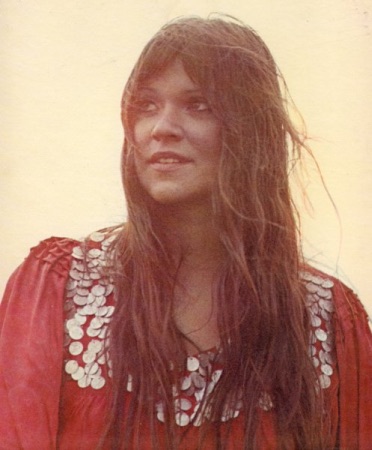
Melanie (from from her website)
When Melanie Safka arrived at the site of the Woodstock Music and Art Fair in August 1969, she was, she admitted in the following interview, “terrified out of my mind.” So much so that when the rain came falling down, she breathed a sigh of relief, hoping that the crowd would turn around and go home and that she wouldn’t have to perform.
The singer-songwriter, then only 22, did perform though, and her appearance at the festival (although not included in the documentary of the event) made the relatively unknown artist an instant star. More than a half-century later, the singer, whose biggest hits include 1970’s Woodstock-inspired “Lay Down (Candles in the Rain)” and the following year’s chart-topping “Brand New Key,” was still writing songs, performing live and making new music. Her fascinating life story was made into a musical, 2012’s Melanie and the Record Man, which detailed Melanie’s experiences with her producer, manager and late husband, Peter Schekeryk.
Melanie—she always recorded and performed under the single name, although she used her last name in songwriting credits—spoke at length with Best Classic Bands’ editor in 2018 about the highlights of her career. In this first half, we trace her evolution from shy New Jersey teen through her first appearances at Greenwich Village clubs and on to Yasgur’s Farm.
In part two (link below), Melanie, born Feb. 3, 1947, filled us in on the aftermath of Woodstock and her first big hit, the smash song she once hated and came to love, and what she’s been up to for the past four decades. Melanie died on January 23, 2024, at age 76.
Listen to Melanie sing “Mr. Tambourine Man” at Woodstock
Let’s start at the beginning. You’re originally from Queens, New York, but at some point in your youth you moved to New Jersey.
Melanie Safka: My family moved to New Jersey when I went to junior high school. It was a really bad time to make this transition from a savvy New York kid…well, not that savvy; I was still playing with dolls. I was not precocious or advanced in certain aspects of development; I was kind of an introvert. But in New York, I had friends and people who knew me, and when I moved to Long Branch, New Jersey, it was much more provincial. I thought I actually invented the ’60s because I was the only person in Long Branch who looked anything like me. I was a little different: oddball and beatnik were terms that I would hear applied to me. So I grew up with those restrictions and all that shunning of who I was.
At what point did you open your mouth and notice that a very powerful voice came out?
I always sang. No matter what, I would sing. So even though I was an introvert, when there was a hootenanny contest, I put myself in. My dad drove me down to the hoot and I won this huge trophy. I was in Red Bank High School and they actually announced it on the loudspeaker: “The winner of last night’s hootenanny contest was Melanie.” My mom was a jazz singer. She would go to the Village on weekends and sing with different jazz groups, and I would sometimes sing on the street and go to different folk clubs with my guitar. The Village was more like home to me than where I was living; that was some kind of altered reality. It was two different worlds.
Did you play some of the famous folk clubs in the Village, like the Bitter End?
Well, the Bitter End was for the big deals. I did play the Bitter End later on, but when I first started out it was places called the Fat Black Pussycat or Cafe Wha? No self-respecting person in the Village had a guitar case; you put it over your shoulder on the strap. And I wore these little thongs made of buffalo hide, and of course going home in that getup to New Jersey was a whole other thing. Anyway, I grew up despite all of it. You work with your limitations.
Why did you decide not to use your last name professionally?
I didn’t set out to do that. The record company put Melanie on the first album and it stuck. My last name is Safka and they thought it was too ethnic. So it was Melanie for a long time and then as a writer, I just felt it lacked legitimacy for a song to be written by Melanie, so I fought for my last name. I would put Melanie Safka as the writer. I finally got to use my last name but now I’m thinking I want to be [just] Melanie again. I’m Melanie. I fought hard for that one-name status.
You signed with Buddah Records, which was known mostly as a bubblegum label. How did that come about?
My husband Peter made a deal with Buddah Records. I didn’t know anything. I just sang songs and I wrote songs. This is who I am. I wasn’t worried about what genre they put me in. I wasn’t worried that I would be called a folk singer or I’d be called pop singer. In fact, at Montreux [Jazz Festival], I won jazz singer of the year because of “Lay Down.” I was singing with black people [the Edwin Hawkins Singers] so I must be jazz. I was always highly suspect of genres. They’ve got it pinpointed to exactly who is going to be interested in what, and you can’t pin me down. I’m everywhere, style-wise.
The first song most of us heard by you was “Beautiful People.” What was the inspiration behind that song?
There were two events that inspired that, and one was the [1965] blackout in New York. I lived in New York in an apartment building, way up on the 16th floor. When that blackout happened there was a feeling of taking care of one another, that feeling that we’re all in this together, that we need to come together. My friend and I went and got utility candles and were passing them out to old people—you know, probably people in their 30s. We were helping people who were nervous about it. We were kids, nothing can happen—so we’re in the dark, big deal. But we were all part of this helping one another and that feeling, that kindred spirit feeling of we’re all in this together, came alive, and I just looked at people and I thought, oh, beautiful people. That morning I got on the bus and nobody was talking, nobody was looking, and then there’s this lunatic and he starts yelling things out and people started to laugh and look at him and look at one another. That brought people together in a funny kind of way and from that sentiment—you ride on the same bus, you ride the same subway, as I do—the song was born.
Watch Melanie perform “Beautiful People”
When did you first hear about this upcoming event called Woodstock?
My husband’s office was in the same building as the people who were putting it together—Michael Lang and Artie Kornfeld. They were friends with people at Buddah Records. They were all buddies and they were putting it together and Peter and I were in the same office building and somehow I was just involved. I had no clue that it was going to be what it was. No one did, but I had even less. I was working on this film score in England and the Rolling Stones were in the studio next to me and I decided last minute to do it. It was a faraway concept of something that was gonna happen. It was the Aquarian Exposition; it wasn’t even called Woodstock yet. I thought it would be families with picnic blankets and a pastoral scene on a hillside somewhere. There’d be things for sale and I could go shopping for arts and crafts. I flew home and my mother got me and we drove to Woodstock.
Wait, your mom was at Woodstock?
Yeah! I never really asked her how she spent the day. I know how I spent the day. It was in a little tent. I didn’t even think about it; it didn’t even faze me. I was an unknown folkie. I was sitting across from Tim Hardin. He had written “If I Were a Carpenter.” He was certainly more well-known than I was.
So it’s fair to say most people there did not know who you were yet when you stepped out on that stage?
“Beautiful People” was what they call a turntable hit on radio stations. After Rosko on WNEW-FM played it, it was picked up on different underground radio stations, and then they had something called pirate radio stations in Europe and they played that record on pirate radio. I was kind of a maverick and a renegade and a beatnik and a rebel. I didn’t have an agenda. It was just where I got placed. Somehow Rosko got a hold of “Beautiful People.” It came out on CBS Records [Note: Melanie was signed briefly to Columbia before switching to Buddah], and the record label wasn’t promoting it because the new guy in charge was Clive Davis, who did not get it at all. He kind of shelved my records—totally did not see it at all. The radio stations weren’t being serviced. It was just a freak that it was being played on all these radio stations.
Related: Where are all of the Woodstock performers today?
You were 22 years old when you played Woodstock. What was that like to stand up on that stage and see all those people?
I was terrified out of my mind from the minute we hit traffic! I got to the hotel and it wasn’t even the original place where I was supposed to go, and then they ushered me to a helicopter and that is where I was separated from my mother for the rest of the day.

Melanie (left) with Judy Collins and Richie Havens (photo from Melanie’s website)
Did the audience accept you?
That’s the amazing thing. By the time I went on, I was so scared, because every once in a while, someone would come and say, “You’re next,” and then it would be a false alarm and I’d be waiting and waiting. Then it was night and Ravi Shankar went on and it started to rain and I thought, that’s it, I’ll be saved because people are gonna go home now because it’s raining. Of course, they’re going to go home! I mean, they’re not gonna sit there in the rain. I’m in this revelry of thinking that’s what’s gonna happen and they called me and right as I’m waiting I hear Wavy Gravy making an announcement about his collective passing out candles, and something inspirational happened: the crowd started lighting the candles. So when I got on the stage, the candles were being lit. So forever after, I was associated with the lighting of things at concerts. But this is what happened at Woodstock: I left my body. I actually had an out-of-body experience, having no alteration with any kind of drug. I was a purist—I didn’t hang out and smoke a lot of grass with people and so I was completely alone, and so terrified. I was certain this was my doom and I left my body. I came back to myself singing “Beautiful People,” but I did have this experience of separating from my body. I went exterior. That experience was never reported. I’ve done radio interviews and they’ve always left that out, because they don’t want people to think they’re spirit and not bodies. You can control bodies but you can’t control spirits.
Watch another clip of Melanie performing at Woodstock
When did you realize that Woodstock was a big deal, that it wasn’t just a concert that happened to be really crowded?
As I was leaving, I was in this euphoric high of, oh my God, I just resonated with 500,000 people, and that in itself is a mind- and life-changing experience. It wasn’t just, oh, I did a gig at Woodstock. I went on that stage an unknown person and I left a celebrity. That’s a phenomenon. Even the organizers didn’t think much of me. They stuck me in a little tent with a dirt floor and I didn’t even have an artist’s backstage pass. If I wandered too far from my tent they would try to usher me into the crowd, so I didn’t wander too much. I just sat in sheer terror. My one Woodstock moment was Joan Baez sending over tea because she heard me coughing. I had developed this deep bronchial cough. It was just coming louder and louder—my voice box must be a bigger than normal one because I have a very loud voice. She heard this coughing and she sends over her assistant with tea and that was my warm. cuddly Woodstock moment. She was my idol.
Related: Another perspective on Woodstock, from Mountain’s Leslie West
Do you think you would have become more famous if you’d been in the Woodstock movie?
Not really. I think that probably would have been edited. And I’m barely visible in the Woodstock museum [at Bethel Woods]. There was a book about Atlantic Records. I was on Atlantic Records and I’m the only artist on Atlantic Records that isn’t in the book.
Has Michael Lang or anybody else contacted you about a 50th anniversary Woodstock event?
I have talked to Michael Lang. But, he’s a little slippery. I mean, he made a life out of this. I don’t know, that might not happen. We’ll see.
Related: Part two of our interview with Melanie where she talked about her hits
Watch Melanie perform on The Ed Sullivan Show
Melanie’s recordings are available for purchase here.


4 Comments so far
Jump into a conversationMelanie was cool til she gave her heart to Scientology. She says she is Catholic but that’s a half truth.
Melanie came out as a Scientologist on Twitter this week. It only took her 38 years to admit publicly that she has been held captive by this evil cult.
that’s all? a lovely woman, and talented writer.. and all you have to say is she’s in a cult?!? what small people you are!
Melanie gave a great interview about writing BRAND NEW PAIR OF ROLLER SKATES after fasting for 27 days on water at Bernard Jensen’s ranch in Escondido Ca, flying back to New Jersey, and eating a burger, fries and thick shake in her car. Her hubby asked what Melanie had written. He suggested they go to the studio the next day to record the song. BRAND NEW PAIR OF ROLLER SKATES.
It was MELANIE’S biggest hit.
You can listen to the entire interview on
Here’s To Your Health with Joshua Lane
https://herestoyourhealthwithjoshlane.com
DARRELL WAYNE, ex Program Director KROQ LOS ANGELES joins in the fun