
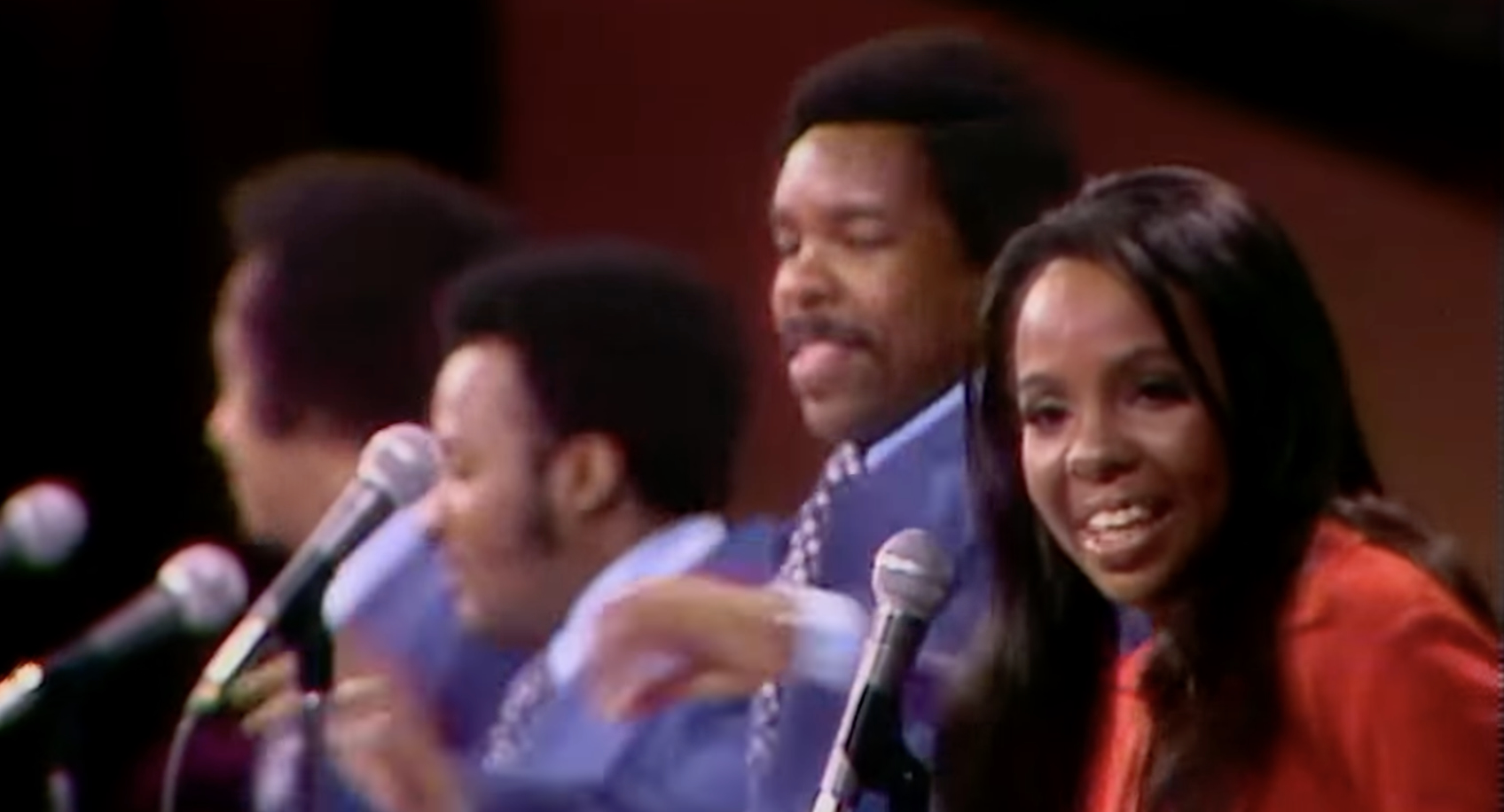
Gladys Knight & the Pips performing on The Midnight Special in 1974.
Motown relocated its operations from Detroit to Los Angeles between 1969 and 1972, and the move coincided with a shift toward artist autonomy. Marvin Gaye demanded and got full creative control for What’s Going On in 1971; Stevie Wonder followed with a renegotiated contract that let him write, produce and play nearly every instrument on his own albums, starting with Music of My Mind in 1972.
At the same time, Kenny Gamble and Leon Huff founded Philadelphia International Records in 1971, building a house sound around MFSB’s rhythm section that would carry into disco by mid-decade. Isaac Hayes won the Academy Award for Best Original Song for “Theme from Shaft” in March 1972, the first Black composer to win in that category. Al Green, working with producer Willie Mitchell at Hi Records in Memphis, released four gold or platinum albums between 1971 and 1973.
The 15 records below sit within that period of consolidation and change—some the product of new label deals, others of artists pushing past what their labels expected.
Smokey Robinson & the Miracles—“The Tears of a Clown” (Make It Happen/Tamla)
Recorded in 1967, this took a while to make its mark. Stevie Wonder and Henry Cosby supplied the distinctive music, while Smokey Robinson provided the aching words, drawing on the tragicomic theme of the opera Pagliacci. The wait paid off when a U.K. release generated massive demand, prompting a U.S. single that became the group’s first #1 hit on the Hot 100.
Edwin Starr—“War” (War & Peace/Gordy)
Norman Whitfield and Barrett Strong originally gave the composition to the Temptations, whose version appeared on Psychedelic Shack. Fearing the controversial protest song might alienate the group’s conservative fans, Whitfield re-recorded it with Edwin Starr. The later recording was considerably more aggressive, with Starr’s explosive vocals turning the antiwar message into an anthem impossible to ignore, and it spent three weeks at #1 on the Hot 100.
The Moments—“Love on a Two-Way Street” (A Moment with the Moments/Stang)
Sylvia Robinson co-wrote this tale of romantic betrayal with Bert Keyes, drawing on an experience from co-writer Lezli Valentine’s own life. The Moments’ rendition connected strongly with listeners, featuring a lush arrangement and heartfelt lead vocal that spent five weeks atop the Billboard R&B chart and reached #3 on the pop chart.
The Jackson 5—“ABC” (ABC/Motown)
At just 11 years old, Michael Jackson was already fronting one of Motown’s biggest acts. Written and produced by “The Corporation” (Berry Gordy, Freddie Perren, Alphonso Mizell and Deke Richards), the recording followed the group’s initial breakout run with “I Want You Back.” It showed just how quickly the young vocalist had become the focal point of the family band, famously knocking the Beatles’ “Let It Be” off the top of the Hot 100.
Marvin Gaye—“What’s Going On” (What’s Going On/Tamla)
The idea came from Renaldo “Obie” Benson of the Four Tops after he witnessed the social unrest surrounding a protest at Berkeley’s People’s Park. Gaye transformed that inspiration into something far more expansive, overcoming label executives’ initial reluctance to release it. The track reached #2 on the Hot 100, beginning a new chapter in his career and ultimately becoming the title track of one of soul’s landmark albums.
Bill Withers—“Ain’t No Sunshine” (Just As I Am/Sussex)
Before his recording career took off, Withers had worked as an aircraft mechanic and served in the U.S. Navy. His first album arrived when he was already 32, making the understated success of this spare, emotionally direct performance all the more remarkable. Produced by Booker T. Jones, the song reached #3 on the Hot 100 and earned Withers a Grammy Award for Best R&B Song.
The Temptations—“Just My Imagination (Running Away With Me)” (Sky’s the Limit/Gordy)
Eddie Kendricks took the lead on this dreamy meditation about imagining a life that may never happen, backed by Norman Whitfield’s orchestral production. It was Kendricks’ final major lead performance with the group before his departure for a solo career in 1971, giving the recording—which became the group’s third #1 pop hit—an added emotional significance in the Motown story.
Related: What were the big radio hits of 1971?
Al Green—“Let’s Stay Together” (Let’s Stay Together/Hi)
The singer recorded his lead vocal in virtually one take after producer Willie Mitchell and the Hi Records rhythm section helped shape the unhurried groove. The combination of Green’s intimate delivery, subtle falsetto shifts and a timeless horn arrangement produced his breakthrough pop success, taking him all the way to #1 on the Billboard Hot 100 in early 1972.
Sly & the Family Stone—“Family Affair” (There’s a Riot Goin’ On/Epic)
Much of the track was constructed by Sly Stone himself, using an early rhythm box drum machine, with Billy Preston contributing electric piano. Compared with the band’s earlier, celebratory psychedelic funk, the atmosphere here is noticeably darker, more stripped-down, and introspective—a reflection of the changing mood surrounding the group that nevertheless topped the Hot 100.
The Staple Singers—“I’ll Take You There” (Be Altitude: Respect Yourself/Stax)
The groove came courtesy of the Muscle Shoals Rhythm Section, whose earthy playing gave the recording its reggae-influenced feel. Mavis Staples then took command of the vocal, infusing gospel passion into a message of hope. Her commanding performance brought the family group a landmark #1 success across both pop and R&B charts.
The Chi-Lites—“Oh Girl” (A Lonely Man/Brunswick)
The lead vocal came from Eugene Record, who also co-wrote and produced the song. Its pleading arrangement—anchored by a simple, evocative harmonica line—was deceptively restrained, allowing the vulnerability in Record’s voice to build without excessive ornamentation. It ultimately became the Chicago soul group’s biggest crossover hit, hitting #1 on the Hot 100.
Stevie Wonder—“Superstition” (Talking Book/Tamla)
The famous funky clavinet line is only part of the genius: Wonder played most of the instruments himself, including the drums and synthesizer bass. Guitarist Jeff Beck had originally been slated to record the composition first, but Berry Gordy recognized its potential and insisted Wonder release his own version, sending it to #1 on the Hot 100 in early 1973.
The O’Jays—“Love Train” (Back Stabbers/Philadelphia International)
Kenneth Gamble and Leon Huff wrote this buoyant celebration of unity specifically with the O’Jays in mind. The Philadelphia International production, complete with driving disco-precursor rhythms and sweeping strings, became the trio’s signature recording and helped establish the Philly soul sound as a dominant force in ’70s music.
Billy Paul—“Me and Mrs. Jones” (360 Degrees of Billy Paul/Philadelphia International)
The storyline about an extramarital affair was inspired by a real-life daily encounter noticed by songwriters Gamble, Huff and Cary Gilbert at a local cafe. Billy Paul’s sophisticated, jazz-tinged delivery kept the material empathetic rather than melodramatic, earning him a Grammy Award and his sole #1 pop hit.
Gladys Knight & the Pips—“Midnight Train to Georgia” (Imagination/Buddah)
Songwriter Jim Weatherly originally recorded the composition as “Midnight Plane to Houston” before it was re-imagined as a train-themed masterpiece. The contrast between Gladys Knight’s soulful lead vocal and the Pips’ tight, call-and-response answering harmonies defines its enduring character, resulting in a #1 hit and a timeless soul standard.
Many soul collections are available in the U.S. here, in Canada here and in the U.K. here.




No Comments so far
Jump into a conversationNo Comments Yet!
You can be the one to start a conversation.