
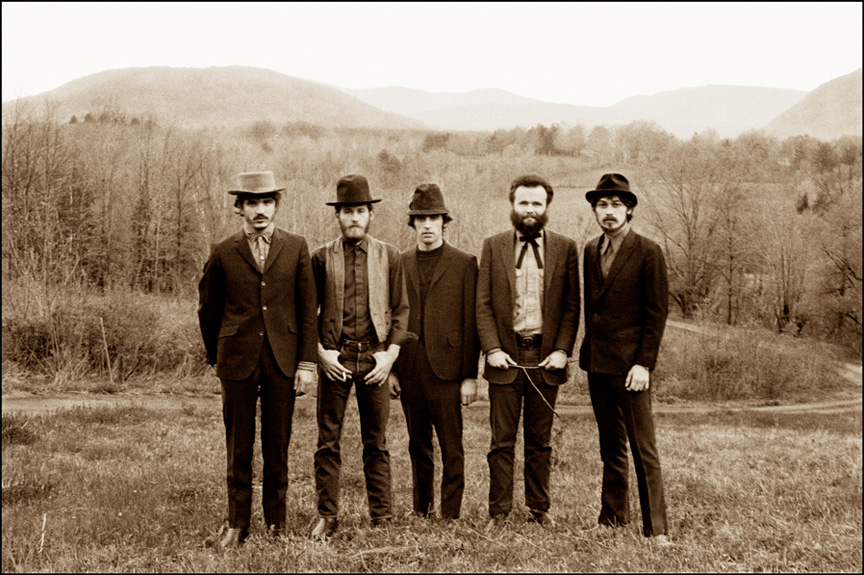
The Band, Music From Big Pink album photograph, Woodstock NY, 1968 (L-R: Rick Danko, Levon Helm, Richard Manuel, Garth Hudson, Robbie Robertson) (Photo © Elliott Landy; used with permission)
Of the many great catalogs available from artists within the American roots music genre, there are only a handful that reach the level of The Band. Formed originally as Ronnie Hawkins’ backup group, and then serving in the same role for Bob Dylan, this celebrated unit of four Canadians and one American—Robbie Robertson, Levon Helm, Rick Danko, Richard Manuel and Garth Hudson—created back-to-the-basics music that has been described as “rustic” and “country soul,” going against the prevailing grain of rock that was increasingly more complex in nature.
After backing Dylan in the mid-‘60s as he moved into electric rock, the quintet stepped out on its own with Music from Big Pink, the 1968 album that introduced them to many of us. They followed it up with a self-titled sophomore album (like the debut, produced by John Simon), that seemed to evoke an earlier time in American history—even its cover looked like it might have been shot during the Civil War. As they continued, the Band diversified and became somewhat more mainstream, but they always delivered quality music and never lost sight of their roots.
Despite their considerable acclaim, they were never Top 40 radio darlings during an era when the format embraced rock bands, and thus only three of their tracks reached the upper half of the Hot 100. Sadly, they’re all gone now. Nonetheless, these 12 songs are the building blocks of their enduring recorded legacy.
1. “The Weight” (1968)
Very few songs have the cultural resonance of this one. Composed by Robertson and sung by Helm and Danko, it features a narrative that describes a series of characters (“Fanny” and “Crazy Chester,” for starters) and biblical references (“Judgment Day”) that have become well known to listeners. The memorable “Take a load off, Fanny” chorus has been shared across generations and makes the song instantly recognizable, though it didn’t help at the time: the song peaked at just #63 on the Hot 100.
2. “Tears of Rage” (1968)
An opening statement on a rock album has never come with a sense of so much foreboding. Co-authored by Dylan and Manuel, the track boasts the latter’s empathic lead voice. Originally from their 1967 Basement Tapes sessions with Dylan, it laid down the marker for Music from Big Pink. (Such changes were fairly common across the various Basement Tapes recordings.)
3. “Chest Fever” (1968)
Hudson‘s intro on the organ from the outset lays down a huge sense of scale. The song is recorded at a laid-back, relaxed pace, though Manuel‘s voice provides a certain energy. Hudson‘s intro offered a standout element in live performances; they opened their set at the 1969 Woodstock festival with it.
4. “I Shall Be Released” (1968)
Music from Big Pink ends effectively on a lift with this Dylan song released well before his own recorded version. Manuel handles the delicate lead vocal, the harmonious arrangement adds a gospel echo. Another classic from the Basement Tapes sessions.
Related: Our Album Rewind of Music from Big Pink
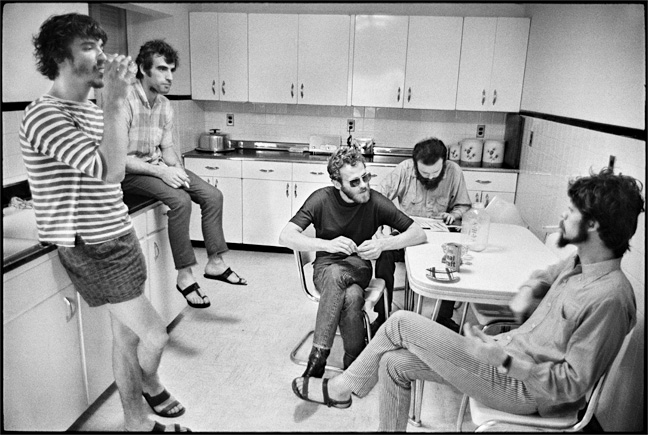
The Band in the kitchen of “Big Pink,” Easter Sunday, West Saugerties, NY, 1968. L-R: Rick Danko, Richard Manuel, Levon Helm, Garth Hudson, Robbie Robertson. (Photo © Elliott Landy; used with permission.)
5. “Across the Great Divide” (1969)
The buoyant opening track on their second album, with a lead vocal from Manuel, sets an air of confident, rootsy attitude. The Robertson-penned song emphasizes the strength of the group’s relatively stripped-back musicianship.
6. “Up on Cripple Creek” (1969)
A groove-driven, clavinet- and wah-wah-laced highlight from their self-titled second album. The signature song, with an outstanding lead vocal from Helm, combines great storytelling about a truck driver in the American South. “Cripple Creek” reached #25 on the Hot 100, representing the highest-charting single of their career. It’s a true showcase for The Band’s trailblazing talent.
7. “The Night They Drove Old Dixie Down” (1969)
Another example of a great storytelling track. Robertson wrote the song, and then Helm delivered the story of a participant in the American Civil War. Two years after its release, Joan Baez recorded it, earning the biggest pop hit of her career, reaching #3 on the Hot 100 (and #1 on Record World). The song continues to be one of the group‘s most memorable story-based recordings.
8. “Rag Mama Rag” (1969)
The album‘s New Orleans-oriented number, with a nod to ragtime, is carried up front by the drums. Based heavily on the traditional jazz-band style, the song was released as a single, peaking at #57 on the Hot 100. We’ve included an alternate version that accentuates the masterful syncopation of the rhythm section and exhibits the excellent tight and intuitive playing so familiar in the band.
9. “King Harvest (Has Surely Come)” (1969)
The second album’s closing track is a song about working class battles and redemption. Another voiced by Manuel, it has a slow progression in terms of both arrangement and story. It touches on the issues faced by a union man who has been marginalized in modern society but whose “hard times are about to end.”
Related: Our Album Rewind of The Band’s ‘rustic masterpiece’
10. “Stage Fright” (1970)
This title song from their third album that marked a change in direction for the band at the start of a new decade. The arrangement was sparse, highlighted by Hudson’s swirling organ. Music critic Ralph J. Gleason called it “the best song ever written about performing.” Written by Robertson and sung earnestly by Danko, it offered an image of the pressure that musicians face when they appear before an audience. An absolute delight.
11. “The Shape I’m In” (1970)
This one shoots out of the starting blocks from the first bar and opening lyrics, “Go out yonder, peace in the valley, come downtown, have to rumble in the alley.” The joyous song, composed by Robertson and sung by Richard Manuel, is driven by a strident rhythm section and straightforward vocals. The song’s direct, driving feel made it a staple in their live sets.
12. “Life Is a Carnival” (1971)
The brass arrangements add a whole new element to this highlight from Cahoots, their fourth album. Composed by Robertson, Helm and Danko, with Helm providing lead vocals, the funky song is fronted by horns arranged by Allen Toussaint.
The Band’s recordings, including many expanded editions, are available in the U.S. here, in Canada here and in the U.K. here.
Elliott Landy has collected a second volume of photos that he took of The Band. Ten years after the first edition that had long since sold out, the legendary photographer has published The Band Photographs: 1968 – 1969 Two-Volume Set. The hardcover title, 12×12 inches, joins the two editions, with a combined 352 pages and nearly 400 photos. The book, via publisher Weldon Owen, is available in the U.S./worldwide here, in Canada here and in the U.K. here.



3 Comments so far
Jump into a conversationIt makes no difference
Solid selections, but I would have expanded it to include It Makes No Difference and Acadian Driftwood
The later songs sung by Richard Manuel are beautiful: Right As Rain, Hobo Jungle, Rags and Bones. and of course, the wonderful cover of Georgia on My Mind.
Definitely worth a listen!