
11 Great Bob Seger Songs Beyond the Hits: Deep Cuts Worth Revisiting
by Shrinivas Kodape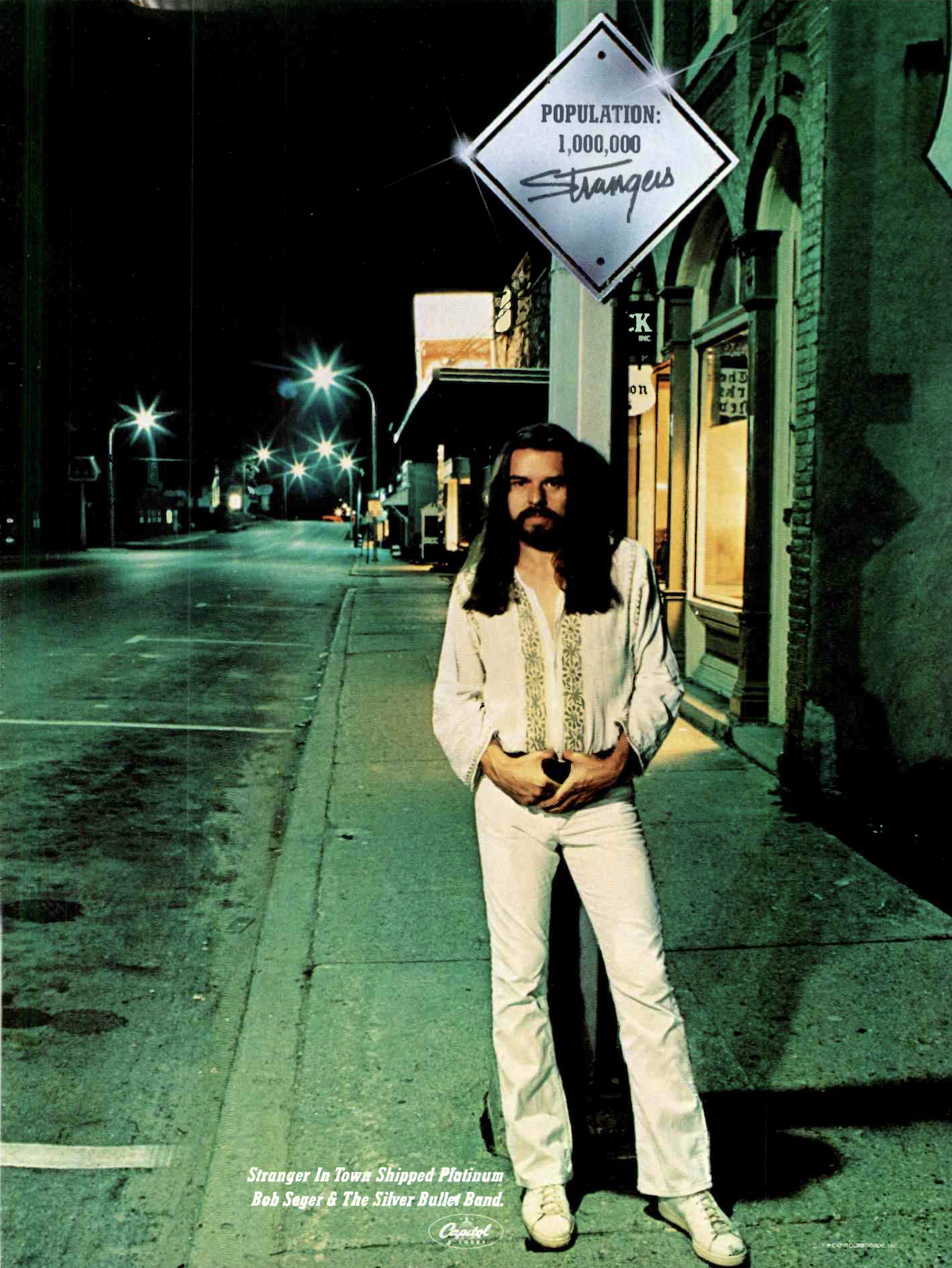
This ad for a classic Bob Seger album appeared in the June 17, 1978, issue of Record World. “It’s almost like a greatest hits release.”
The more you dig through an impressive catalog, the more it rewards you, and that‘s certainly the case with Bob Seger. And beyond such chart hits and signature tunes as “Night Moves,” “Against the Wind,” “Hollywood Nights” and “Old Time Rock and Roll,” are some great deep cuts from his vast catalog that are often overlooked.
Beginning with his late ‘60s Detroit sessions and through to the Silver Bullet Band era, Seger, born May 6, 1945, honed a songwriting craft across a whole album beyond those radio hits. Dig through those albums, and some songs start to stand out. Here are 11 that do just that.
“Till It Shines”—Stranger In Town (1978)
His 1978 album is almost like a greatest hits release, with no less than four significant singles. Right in between some of those is track four. It builds slowly, starting with an acoustic guitar and quickly fills out the arrangement. That’s Detroit pal Glenn Frey on the guitar solo. (The two would remain good friends and occasional co-writers, and Frey would sing on such Seger recordings as “Fire Lake” and “Against the Wind.”)
“The Fire Down Below”—Night Moves (1976)
This track is vital for the arc of the album, following the thrilling one-two punch of the opening numbers, “Rock and Roll Never Forgets” and “Night Moves.” All feature the great musicianship of the Silver Bullet Band.
“Sunspot Baby”—Night Moves (1976)
The album was a breakout success, thanks to three singles, most notably the title track and “Mainstreet.” This one is about a woman the narrator knew “who did me so wrong” by walking off with his Amex card and a mountain of debt. Its rhythm section, courtesy of the Muscle Shoals session players, is the lead on this catchy, overlooked track that leads off side two.
“Shame on the Moon”—The Distance (1982)
This Rodney Crowell-penned number, which hit #2 on the Hot 100, was one of Seger‘s signature hits in the early ‘80s, with a melodic groove and timeless arrangement. The song also reached #15 on the country chart, becoming Seger‘s only top 40 entry in that radio format.
“Her Strut”—Against the Wind (1980)
The classic rock song was actually the B-side to “The Horizontal Bop,” the fourth (and final) single from the humongous album. The track, which gave the album a groovy spin, has drawn criticism for the way its lyrics depict women (“once she starts in walking, the lady will be all they ever dreamed”). But Seger himself has said that its inspiration was Jane Fonda as a very ’80s woman. “I wanted to write a song about how women have become so confident,” he’s been quoted as saying. Years later, Fonda, herself, noted, “I am flattered, to say the least and you’ll know why when you hear the lyrics.”
“Get Out Of Denver”—Seven (1974)
This straightforward rocker offers punchy drumming and a dead-on lead vocal. The very tight song—just 2:44 on the album—makes it one of Seger‘s most focused records of the early 70s. It‘s a standout track from Seven, which critics call a “lost classic.” This live version, recorded in Detroit a year later, is a highlight from his first concert album, which has sold more than five million copies.
“Lucifer”—Mongrel (1970)
The closing track of side A of the third album from the Bob Seger System opens as a piano-based structure that grows into the full band. The driving rocker reached #84 on the Hot 100 and is considered to be among the best of his early era by Seger fans.
”Heavy Music (Part 1 and Part 2)” (1967)
A local hit in Detroit, this two-sided single, complete with finger snaps, was representative of the music coming out of the Motor City. The track focused on repetition and groove, establishing Seger well before he broke through nationwide. Live Bullet contains an 8-plus-minute performance.
“Ramblin’ Gamblin’ Man”—Ramblin’ Gamblin’ Man (1969)
His first Top 20 pop hit thanks to its catchy hook, at the heart of his earliest identity as a recording artist, and his arrival to a national audience. However, after this initial taste of success, it would be another eight years before he scaled such heights on the pop singles chart.
“Katmandu”—Beautiful Loser (1975)
An absolute crowd-pleaser for Seger that was often featured in his live shows. It‘s an unabashed, all-American power-pop rock and roll blast—in its review, Cash Box noted its “down-home, rockin’ piano”—even though the rest of the album explores much more languid territory.
“Feel Like a Number”—Nine Tonight (1981)
Originally released as the final song of side one of 1978’s Stranger in Town, the uptempo song took on new life as a concert favorite and was also prominently featured in the steamy 1981 thriller Body Heat, starring William Hurt and Kathleen Turner, making her film debut.
Seger’s enormous catalog is available in the U.S. here, in Canada here and in the U.K. here.




28 Comments so far
Jump into a conversationSo many songs was just thinking today. The song “It’s You.” And many many more.
I once read a critique of Bob Seger on Spotify. The short expose labeled Seger as a singer/songwriter in the mold, but not quite in the caliber of Bruce Springsteen (I’m paraphrasing, as it was many years ago that I saw this). I remember thinking, “what an incredibly asinine statement” (in my opinion). Musically, Springsteen doesn’t hold a candle to Bob when it comes to both melody and lyrics in the songwriting department. I would put the song “Night Moves, ” by itself, up against the whole entire catalog of Springsteen songs, and never second guess my choice as to who was the better musician.
“Some people think Bob [Seger] is a poor man’s Bruce Springsteen, but personally I always thought Bruce was the rich man’s Bob Seger”
– Bob Dylan
Bob is the GREATEST!!! SBB!!!!
Why do you take this moment to insult Springsteen simply because you like Segers music better?
Both are great rock artists and it’s unnecessary to prop one up and denigrate the other. Other than that I agree Seger was great far beyond the hits. I loved everything from the Night Moves LP and I would have added Ship Of Fools to the list.
what about “School Teacher?”
Absolutely! A thunderous track from Bob’s best and most dynamic LP
I only discovered Ramblin’ Gamblin’ Man a few years ago. Great great song from when Seger was still hungry for success. The Glenn Frey vocal is a hoot, I imagine Bob glared at him and he piped down in subsequent choruses.
You forgot Turn the Page, song that tells the real story of rock ‘n’ roll road worker.
I used to sing that to my oldest to get him to go to sleep. Some nights, is sing it ten times in a row, because if I switched to another song or stopped singing, he’d get restless. Still one of my go-tos at karaoke.
Turn the Page is a classic that I came across on a juke box as although I have been a fan since the sixties I somehow missed this track. My reaction was – holy f***, which album is this on. Thought I had listened to all of his albums by that time. I think it was the very early 1970’s. One of my favourites for sure and that says a lot.
haven’t heard anything bad from Bob. love his music!
All great — but should have been expanded to 12 so you could include 2+2=?
We used “Ramblin’ Gamblin’ Man” to warm up for our intramural basketball games at Siena College in 1969-1970. Awesome psych-up song!
Bob Seger’s 2+2=? was one of the best anti-war songs written and should be included. Released in 1968 it was one of his finest early releases.
What about “Main Street”?!?! That song & that guitar riff should be in the top 2!
Another one to add–Even Now from the mid 80s.
What about anything off of Back In 72. Great songs
In my mind Bob Seger is a national treasure.
A one in a million. Plus, Pure Class.
Turn The Page?????
The Famous Final Scene !!!
To me like a rock was one of his best lyrics song of any young singer starting out with nothing but passion for life and music wow he said it straight on
“No Man’s Land” on the Against the Wind album is gold !
Seger never put out a bad song. He never gets the appreciation he deserves. Although, I’m not quite sure he wants the attention.
Roll Me Away……”next time we’ll get it right!”
It’s Deep Cuts folks, Main Street and Turn the Page are not deep cuts
Not only do I agree with Scottr, but I’ll take that a few steps further. I clicked onto this article because the headline reads: 11 Great Bob Seger songs beyond the hits. And what do I end up reading? A list that includes at least seven songs that have been either staples or close to staples of rock radio for decades. And, damn, “Shame on the Moon” was his 2nd biggest hit!
Back in ’72. absolute classic for Detroiters (…we got homesick for Lincoln Park…)