
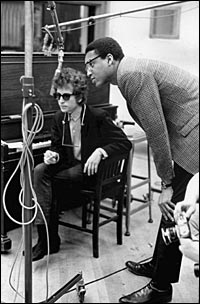
Record producer Tom Wilson (right) with Bob Dylan during the session for “Like a Rolling Stone.” (Photo by Don Hunstein, from Wilson’s Wikipedia page, used with permission)
When listing the top pop record producers of the 1960s, the names George Martin and Phil Spector spring immediately to mind and any such list would surely have to include at least some of the following: Jerry Wexler, Mickie Most, Bob Crewe, Smokey Robinson, Bert Berns, Shel Talmy, Jimmy Miller, Allen Toussaint, Curtis Mayfield, Brian Wilson and the team of Holland-Dozier-Holland. But what about Tom Wilson, who died of a heart attack at 47 on Sept. 6, 1978 and tends to get overlooked today? He was extremely successful and influential when he was active in the music business. This is his story in 13 records.
Sun Ra & His Arkestra—“Swing A Little Taste” (1956)—Wilson founded Transition Records right after graduating from Harvard in the mid-1950s and focused on jazz during the short-lived label’s lifespan, cutting important artists of the future like Cecil Taylor, Donald Byrd and Herman Blount, better known as Sun Ra. The pianist and bandleader’s down-to-earth “Swing a Little Taste” first appeared on a Transition sampler and was later added to his first album, Jazz by Sun Ra, Vol. 1, when it was reissued as Sun Song.
The Golden Chords—“Wake Me, Shake Me” (1963)—Wilson moved on to United Artists and Savoy Records after Transition folded, continuing to concentrate on jazz, but when he joined Columbia Records in the early 1960s he began to branch out. Among his first projects was a live album, Introducing the Sweet Chariot: The Sensational New Pop Gospel Night Club with “Soul,” which included this track featuring Lorraine Ellison, later famous for the soul music tour-de-force “Stay With Me.”
Simon & Garfunkel—“The Sound of Silence” (1964, 1965)—Wednesday Morning, 3 A.M., was the debut album by a young folk duo from Queens, New York. Initially unsuccessful, the duo went their separate ways, Simon to London, Garfunkel back to school. In their absence and without their knowledge, producer Wilson overdubbed electric guitar and percussion on the track, then known as “The Sounds of Silence,” and a seminal folk-rock record (and #1 pop single) was launched.
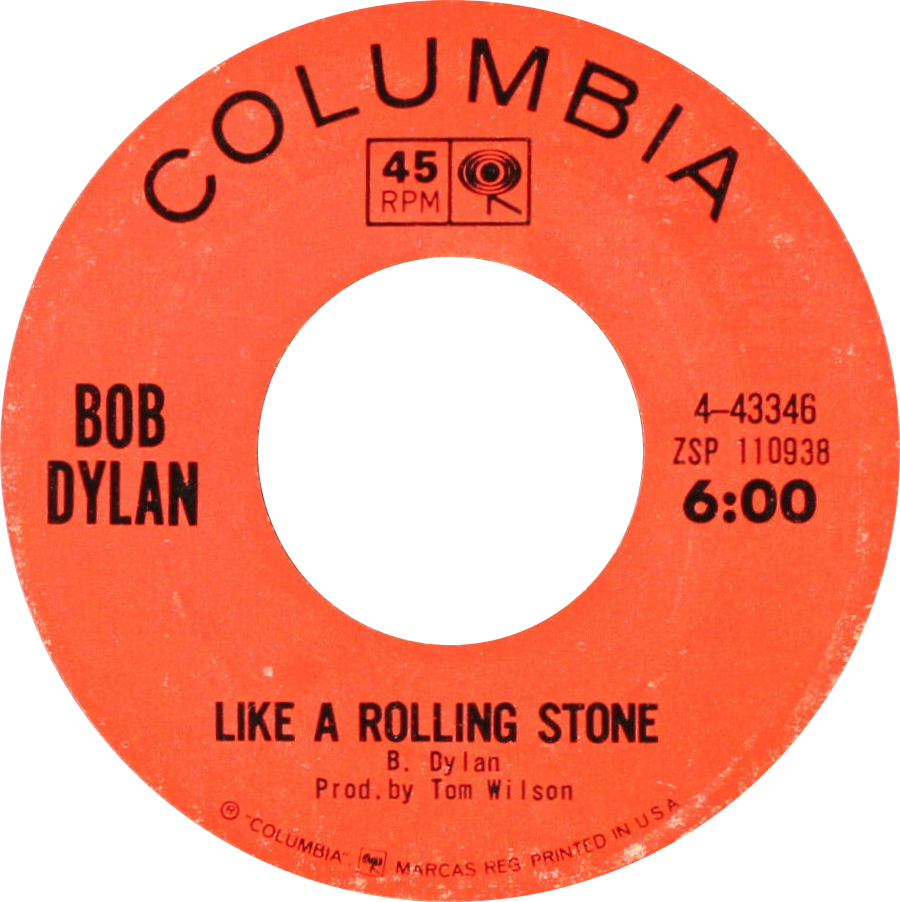
Bob Dylan—“Like a Rolling Stone” (1965)—Though uncredited, Wilson had taken the reins midway through the recording of Dylan’s second album, The Freewheelin’ Bob Dylan, then oversaw his evolution from folk to rock, producing the next three, The Times They Are A-Changin’, Another Side of Bob Dylan and Bringing It All Back Home. He was only responsible for one song on the next, Highway 61 Revisited, but it was this one, and it made history.
Related: More on the classic Dylan song’s recording session
Dion—“Baby I’m In the Mood for You” (1965)—Dion was the first bona fide consistently successful rock ’n’ roll artist signed to Columbia but by the mid-1960s the hits had stopped coming. Exposed to and inspired by Robert Johnson and Bob Dylan by the legendary A&R man John Hammond, he went into the studio with Wilson, with whom he recorded songs by the delta bluesman and this heretofore unreleased Dylan rocker.
The Blues Project—“Wake Me, Shake Me” (1966)—By 1966, Wilson had left Columbia and joined M-G-M/Verve, where he produced Projections, the sophomore release by this Al Kooper-led, New York-based aggregation featuring the electrifying Danny Kalb on guitar. A staple on early progressive-rock FM radio, have you ever wondered how they came to record this gospel (see the Golden Chords, above) song? Was it at Tom Wilson’s suggestion?
The Velvet Underground—“Sunday Morning” (1966)—This was the one track Wilson was credited with producing on The Velvet Underground & Nico (Andy Warhol, who designed the album cover, received credit for the rest). The album was a wrap when Wilson decided it needed a fifth Nico vocal, perhaps in the hope of coming up with a single. Lou Reed wrote this song and, surprisingly, when the band emerged from the studio with a finished recording, it sported a lead vocal by Reed himself.
The Mothers of Invention— “Trouble Every Day” (1966)—Despite sharing space in rock’s avant-garde, a record label (Verve), a producer (Wilson) and stages on an early West Coast tour (or, more likely, due to sharing those things), the leaders of the Mothers of Invention and the Velvet Underground, Frank Zappa and Lou Reed, famously did not get along. This song, written in response to the Watts riots of the previous year, was from the Mothers’ debut album, a two-record (for the price of one) set named Freak Out!
The Animals—“Don’t Bring Me Down” (1966)—Mickie Most had produced all the group’s first hits but when the Animals negotiated a new contract with their U.S. label M-G-M, production duties fell to Wilson. When their first Wilson-produced single failed to catch fire, they turned once again to Brill Building writers (one of their biggest hits, “We Gotta Get Out of This Place,” had been written by Barry Mann and Cynthia Weil) for one by Gerry Goffin and Carole King and scored with this, the first of a string of hits under Wilson’s direction.
Van Dyke Parks—“Come to the Sunshine” (1966)—A co-production with Tim Alvarado, this quintessential sunshine-pop single was recorded in the midst of lyricist Parks’ collaboration with Brian Wilson on the ill-fated Beach Boys album Smile. It was unsuccessful but the song subsequently became Harpers Bizarre’s follow-up (with Parks on piano) to their hit version of Paul Simon’s “The 59th Street Bridge Song (Feelin’ Groovy).”
Nico—“These Days” (1967)—With three-quarters (Lou Reed, John Cale, Sterling Morrison) of the Velvet Underground in tow, Wilson reunited with the German chanteuse for her first solo album, Chelsea Girl. It featured several songs written by the Velvets in various combinations and her take on the obscure Bob Dylan song “I’ll Keep It with Mine,” as well as three songs by the then 19-year-old Jackson Browne, including this one, the first recording of the now oft-covered classic.
The Fraternity of Man—“Don’t Bogart Me” (1968)—This group, an offshoot of the Mothers of Invention and Lowell George’s pre-Little Feat band the Factory, provided Wilson with his final significant commercial success when their song, aka “Don’t Bogart That Joint,” was featured in the soundtrack of Dennis Hopper, Peter Fonda and Terry Southern’s iconic late-1960s road movie Easy Rider.
Fear Itself—“Born Under a Bad Sign” (1968)—In the late 1960s, Wilson went independent and proceeded to produce a host of acts, some known (Soft Machine, Country Joe and the Fish, John Mayall, Professor Longhair) with little success and many little known, if at all, to this day. Most noteworthy among them was a psychedelic blues band named Fear Itself, featuring the singer and guitarist Ellen McIlwaine, who went on to record several well-regarded solo albums in the next decade. Here they tackle the then-recent Albert King hit, written by Booker T. Jones and William Bell.
For more about the 1960s New York City rock scene in which Tom Wilson played such a prominent role you may be interested in reading: Wake Me, Shake Me, by Mitchell Cohen.
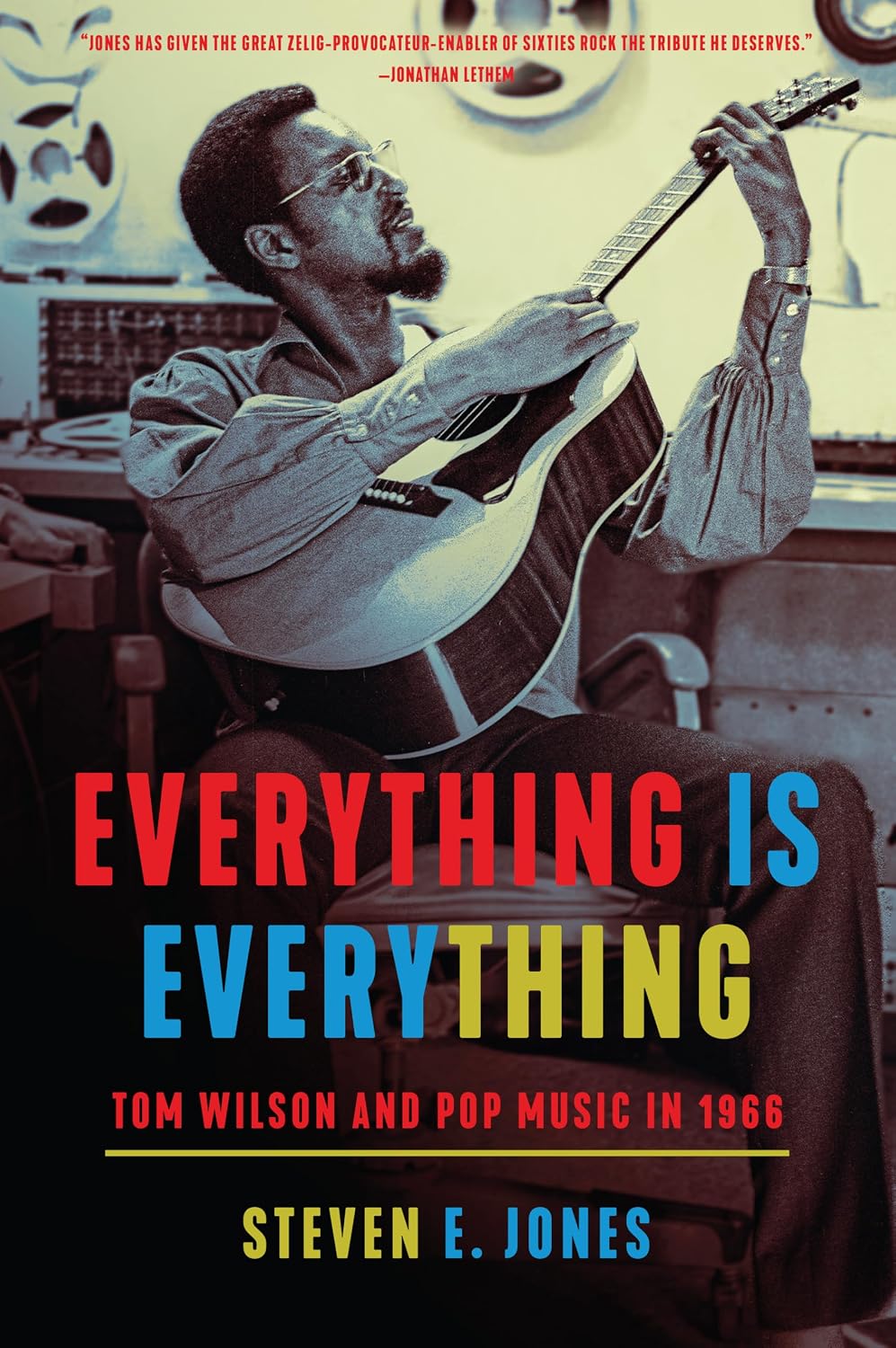
2026’s Everything Is Everything: Tom Wilson and Pop Music in 1966 book, by Steven E. Jones.
For more about Wilson specifically: Everybody’s Head Is Open to Sound: Writings on Tom Wilson, edited by Anaïs Ngbanzo, and available here; and Everything Is Everything: Tom Wilson and Pop Music in 1966, by Steven E. Jones (to be published on September 29, 2026; available in the U.S. here and in the U.K. here).




2 Comments so far
Jump into a conversationYou are forgetting the Grateful Dead, who were making Aoxomoxoa with Tom’s help, until Bob told Tom he wanted the sound of “heavy air”. Tom left the studio, never to return. That album was extremely ambitious and avant-garde, combining live and studio tracks seamlessly.
You may be referring to “Anthem of the Sun,” the second album, which is the one that combined live and studio recordings. “Aoxomoxoa” was strictly studio tracks. Never heard that Wilson was involved with the Dead but it would make sense. I have heard about the “heavy air” request though.