
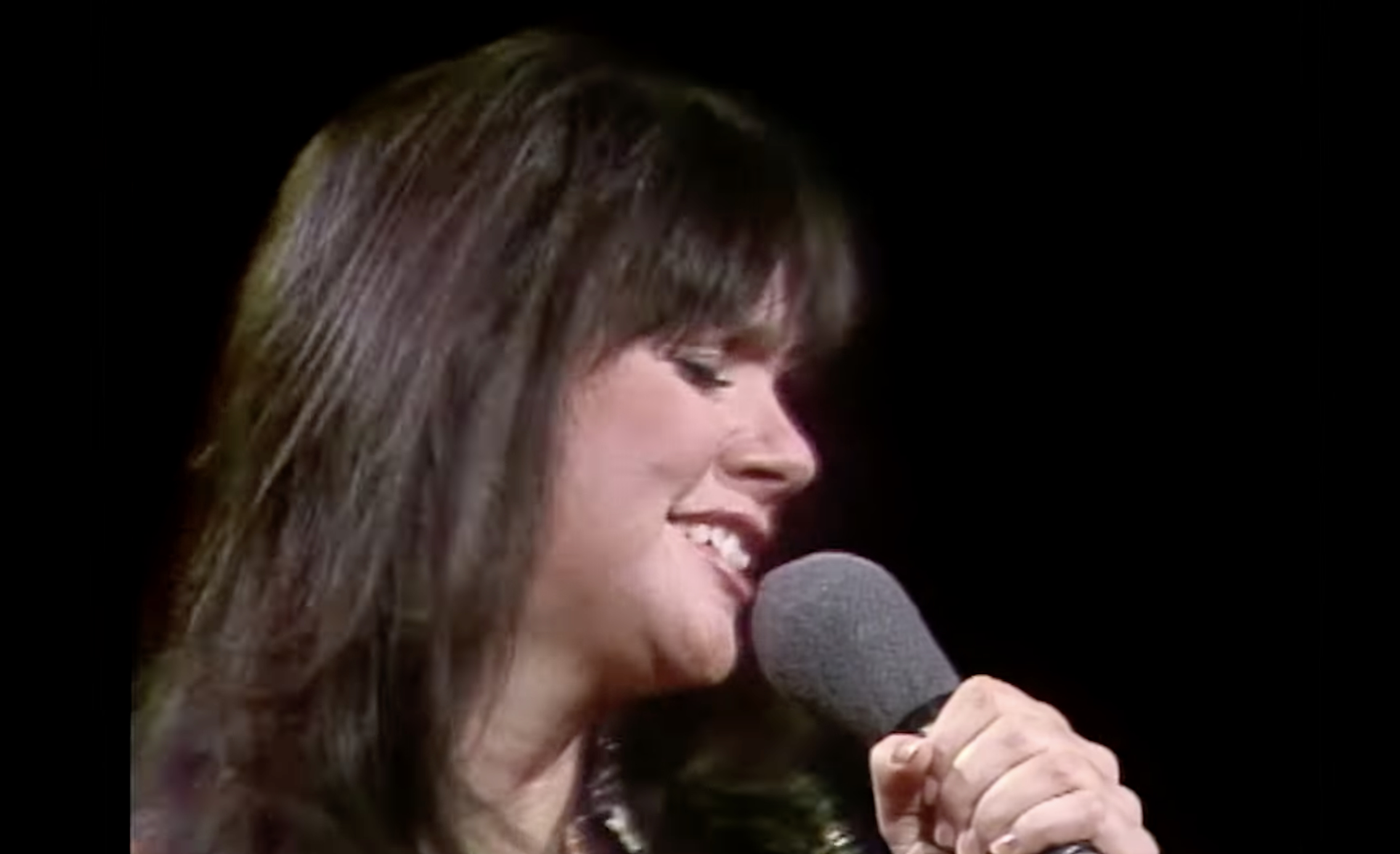
Linda Ronstadt belting one out on The Midnight Special in 1973.
Linda Ronstadt has one of music’s most wide-ranging recorded catalogs, with significant success in country, folk, pop, rock and beyond, including traditional Mexican mariachi, Broadway and even operetta. Thanks to canny song selections that she and her manager-producer Peter Asher made, she scored strong hits in a variety of chart formats that spanned decades.
Though many of her numerous signature tunes originated with others, she put her unique stamp on them. While maintaining the structural integrity of the pieces, she infused the vocal arrangements with a tighter sense of phrasing and command. As her success in the ’70s blossomed, she attracted more and more musicians into her sphere in the studio and on stage, from early appearances by future Eagles members Don Henley, Glenn Frey, Randy Meisner and Bernie Leadon, to J.D. Souther, Andrew Gold and Waddy Wachtel, among dozens of others.
Here are 12 Ronstadt gems that only begin to scratch the surface of her significant contributions.
“Different Drum” (1967)
We were introduced to the then-21-year-old singer via this single from the Stone Poneys, written by Michael Nesmith prior to his joining the Monkees. The track reached #13 on the Hot 100 and we instantly fell in love with her.
“Silver Threads and Golden Needles” (1969)
It was first made a hit by Wanda Jackson and has been covered many times by a diverse group that includes the Cowsills and the Grateful Dead. Ronstadt cut it early in her career earning her first entry on the country chart at #20. She revisited the song four years later with a country-rock version (that reached a pedestrian #67 on the Hot 100) for her 1973 album Don‘t Cry Now.
“Desperado” (1973)
Eagles first cut the Henley-Frey composition and Ronstadt, in an effort to champion the band, recorded it as an album track for her Don’t Cry Now album, her first to go gold. It ultimately became one of her standard live numbers. A grateful Henley gave Ronstadt the credit for popularizing the song and called her interpretation “poignant, and beautiful.” Which it is. It is still identified closely with her.
“You’re No Good” (1974)
Written by Clint Ballard Jr. and initially recorded by Dee Dee Warwick in 1963. In ’73, Ronstadt began performing it in her live sets and ultimately recorded it for her massive Heart Like a Wheel album. Her otherworldly powerful vocal and Gold’s memorable guitar solo resulted in her first—and only—#1 pop single.
“When Will I Be Loved” (1975)
Written by Phil Everly and originally recorded by the Everly Brothers, this was the second consecutive smash single from Heart Like a Wheel, peaking at #2 on the Hot 100 and #1 on the country chart. Joyous.
Related: Our Album Rewind of Heart Like a Wheel
“That‘ll Be the Day” (1976)
Ronstadt was just hitting her stride when she recorded this Buddy Holly song for her Hasten Down the Wind album. She had us from its very first note: an extended, other-worldly “Wellllll…” The #11 single helped her earn a third straight platinum-selling album—the first female solo artist to accomplish that feat—and garnered her a Grammy for Best Pop Vocal Performance, Female.
“It‘s So Easy” (1977)
Another Buddy Holly song, this one co-written with Norman Petty, reached #5 on the Hot 100, from her album Simple Dreams. Wachtel layered the song with an intricate, potent guitar riff that also made it an FM radio standard.
“Blue Bayou” (1977)
It‘s a song first recorded by Roy Orbison, which he co-wrote, and her version became a top hit (#3 Hot 100 and #2 country). Her recording featured Don Henley on backup vocals and was nominated for a pair of Grammy Awards, including the highly coveted Record of the Year (losing, ironically to “Hotel California”).
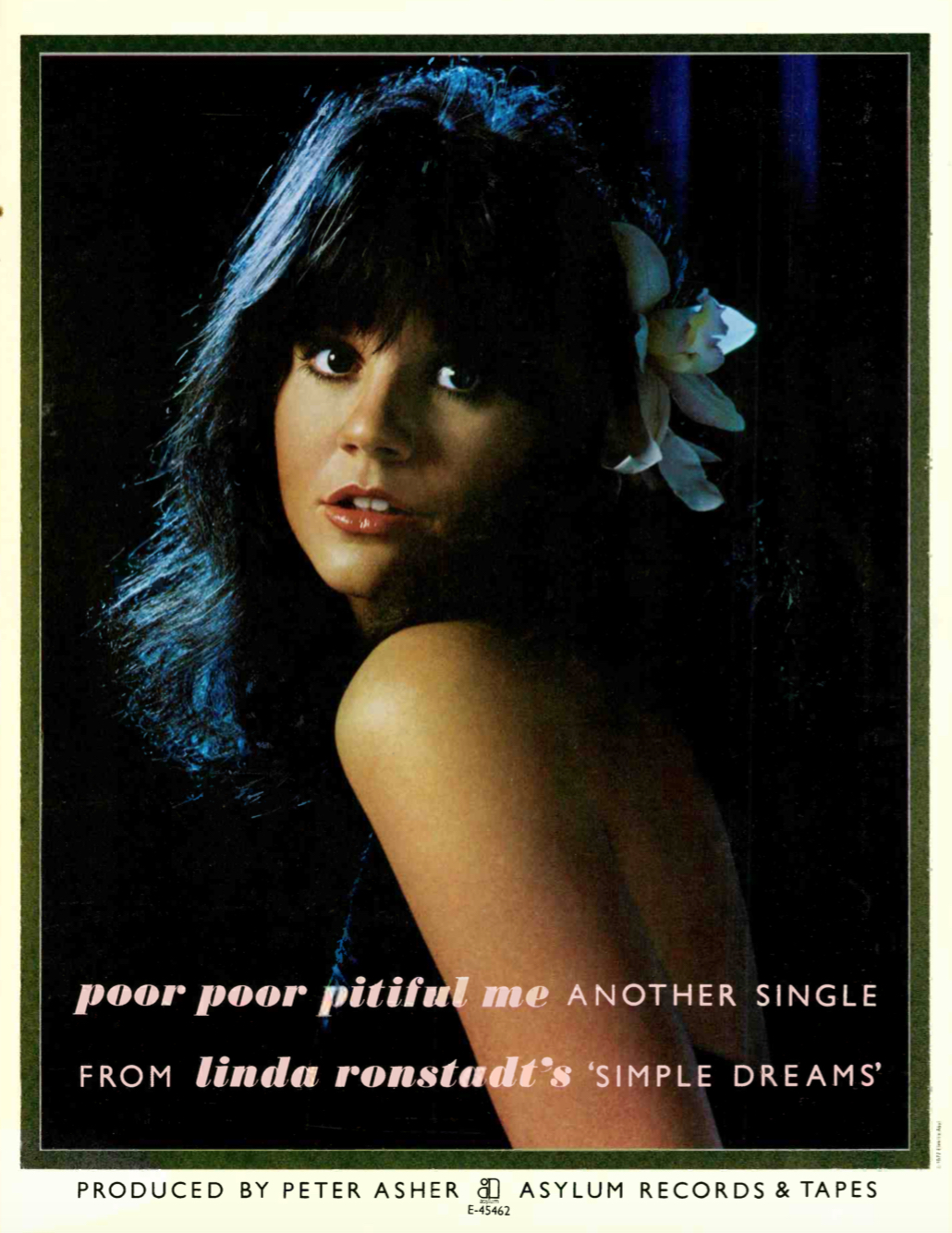
This ad appeared in the Feb. 4, 1978 issue of Record World magazine.
“Poor Poor Pitiful Me” (1977)
Her recording of the Warren Zevon composition was somehow a relative flop on the radio, peaking at just #31 on the Hot 100, as the third single from her Simple Dreams album. She made a few lyrical changes for her recorded version and it proved to be one of her more popular live numbers and a perfect track for her confident, belt-it-out style.
“Just One Look” (1978)
Originally recorded by Doris Troy in 1963, the song also marked the first single by the Hollies to chart in the U.S. Years later, Ronstadt covered it on her Living in the USA album. Though she offers a remarkable vocal that could not fit any better in her commercial sweet spot, her version somehow peaked at just #44 on the Hot 100.
“Back in the USA” (1978)
A rock ‘n’ roll standard by Chuck Berry, whose 1959 single only reached #37. Ronstadt‘s cover roughly two decades later as the title cut on her ’78 album should’ve reached higher than #16. The crackerjack band includes Wachtel, bassist Kenny Edwards, drummer Russ Kunkel and pianist Don Grolnick. With the structure largely intact, Ronstadt‘s performance is rendered in signature late ’70s studio polish.
“I Can’t Let Go” (1980)
Evie Sands and the Hollies had both recorded the Al Gorgoni and Chip Taylor composition. Ronstadt recorded her version for the album Mad Love. This is one of those songs that one keeps on humming throughout the day. Asher’s production expertly melds her phenomenal lead and backup vocals. (And a tip of the cap to Mark Goldenberg’s great guitar solo.) It’s absolutely criminal that the song peaked at a pedestrian #31 on the Hot 100.
Related: Our interview with Peter Asher about producing Ronstadt
Ronstadt’s recordings, including a 2026 release, The Early Years, are available in the U.S. here, in Canada here and in the U.K. here.
So, where to next? Check out Part 2 for more of her sensational recordings.




9 Comments so far
Jump into a conversationI think that Lose Again and some of her other Karla Bonoff songs deserve inclusion. Many of the above are jaunty rock tunes, but as with Desperado, few could nail an emotional ballad as well as Linda. I also think her trilogy of Great American Songbook albums with Nelson Riddle was among the best of the genre. An incredibly gifted singer and interpreter of great songs.
My late mom’s favourite song for just laying back and listening…after she died i called her phone and played the song on the phone messaging machine…one of the ways i still honour her!
Great songs. It was amazing how many she took songs that may have been written and/or recorded by someone else but made the song her own.
Linda Ronstadt could sing! She is my favorite female rock vocalist. Her version of Tumblin’ Dice by the Stones kicks ass! Poor, Poor, Pitiful Me, Its so Easy, Love is a Rose are just a few of her classics. Her 70s music rocked and she is so gorgeous.
Just about everything Linda does is excellent. Mostly covers, of course, but for the most part, she “owns” them. Many of us would not have a clue that “You’re No Good” and “It’s So Easy” are not originals.
At least “Tumbling Dice” didn’t make the list, thankfully. Not for the fact that she sings it off-key, or have any bum notes…..but just the “feeling”….seems that all of the “good time vibe” the Stones original had, got sucked out of it. Yes, it’s in the same category as Phil Collins’ version “You Can’t Hurry Love”–technically proficient, but lacking in something.
How can you omit “Long Long Time” (1970)? If I had to choose one song to represent her essence, that would be the one.
Batchman… waiting for Part 2…
Sadly left off the list are 2 of Karla Bonoff best songs that Linda sang so beautifully. Someone To Lay Down Bedside Me & Lose Again. Both off of Hasten Down The Wind.
Check out Part 2, Mykel.