
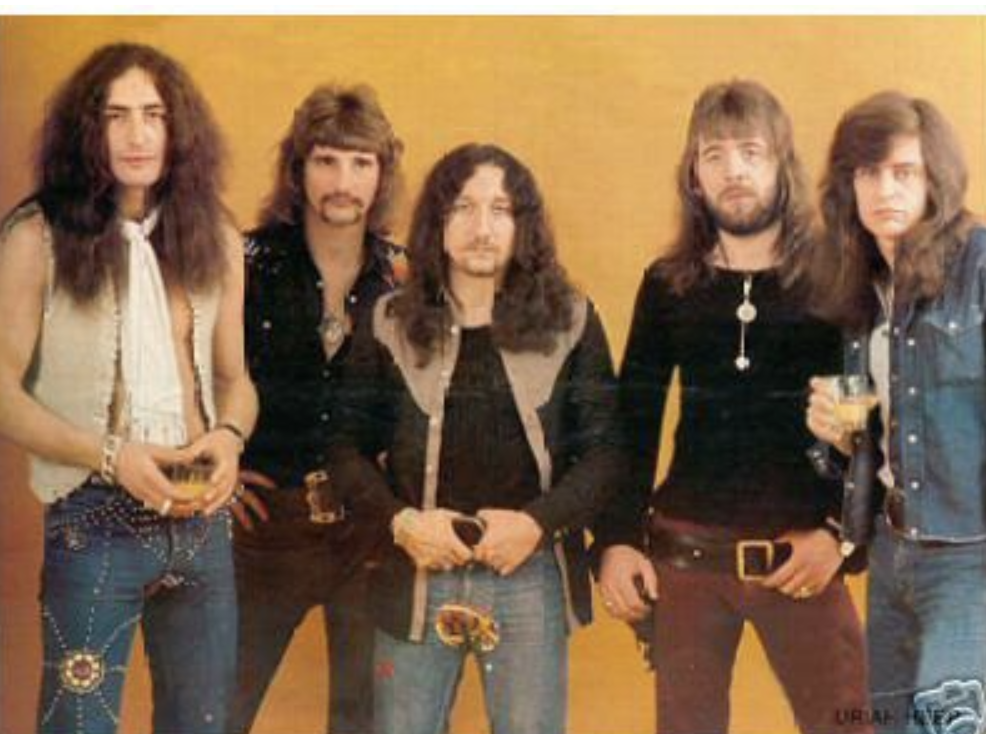
Uriah Heep 1973 classic lineup: Ken Hensley, David Byron, Mick Box, Lee Kerslake, Gary Thain (Uncredited publicity photo from the band’s website)
Though Uriah Heep never reached the commercial heights of fellow British bands Led Zeppelin, Black Sabbath or Deep Purple, few U.K. rock groups from the early ’70s built a catalog quite like theirs. Formed in London in 1969, “Heep” blended heavy riffs, soaring harmonies and progressive ambition into a sound all its own.
While their early records featured shifting rhythm sections, the defining “classic” lineup—vocalist David Byron, guitarist Mick Box, keyboardist Ken Hensley, bassist Gary Thain and drummer Lee Kerslake (whom Box called “one of the kindest men on earth” when he died in 2020)—remained intact through 1974 and powered a remarkable run of albums in the first half of the ’70s, representing the core of the band’s reputation. “Easy Livin'” remains their only U.S. Top 40 hit, but the albums surrounding it reward closer attention.
These 12 songs explain why Uriah Heep remains one of hard rock’s most enduring cult favorites.
“Gypsy” (…Very ‘Eavy …Very ‘Umble)
The opening track on the band’s debut album announced their arrival with thunderous organ, heavy guitar and stacked vocal harmonies. Written by Box and Byron, it remains one of the defining songs from the band’s earliest period. The album received some famously harsh reviews upon release, but its reputation grew considerably in the decades that followed.
“Bird of Prey” (…Very ‘Eavy …Very ‘Umble/Salisbury)
Appearing in different versions on the U.S. debut album and Salisbury, it quickly became one of the songs most closely associated with the band’s early years. Its driving riff and dramatic arrangement helped establish the heavier side of the band’s sound and confirmed that Uriah Heep’s approach was here to stay.
“Lady in Black” (Salisbury)
Written by Ken Hensley, it showed they could be just as compelling acoustically as they were at full volume. The song became one of the band’s biggest international successes, particularly in Germany, where it enjoyed enormous popularity. More than five decades later, it remains one of Uriah Heep’s signature songs.
“July Morning” (Look at Yourself)
At more than 10 minutes long (album version), it became one of the most celebrated songs in the catalog. Written by Hensley and Byron, the track features a memorable Minimoog synthesizer contribution from Manfred Mann that helped give the song its unmistakable atmosphere.
“Look at Yourself” (Look at Yourself)
The title track from the band’s third studio album became one of their concert staples. The recording featured percussion from members of Osibisa, adding an unusual rhythmic texture to one of the band’s hardest-driving songs. Its powerful riff and energetic performance helped establish Uriah Heep as a major force in early-’70s hard rock.
Related: Our obituary of Heep’s Ken Hensley
“The Wizard” (Demons and Wizards)
Opening with acoustic guitar and a memorable melody, the song demonstrated a more restrained side of the band. It helped establish the fantasy-tinged atmosphere that ran throughout the album, one of tthose most closely associated with the band’s classic era.
“Easy Livin'” (Demons and Wizards)
Lasting barely two minutes and 37 seconds, the song became Uriah Heep’s only U.S. Top 40 hit, reaching #9 on the Hot 100 in 1972. It performed even better internationally and remains the song most American rock fans know best. Its short running time made it one of the most direct and accessible recordings in the group’s catalog.
“Circle of Hands” (Demons and Wizards)
The track paired Hensley’s piano with one of Byron’s strongest vocal performances. It revealed a more reflective side of the band than many listeners expected.
“The Magician’s Birthday” (The Magician’s Birthday)
The title track of the band’s fifth studio album combined fantasy storytelling with the progressive ambitions that frequently set them apart from many of their peers. Its extended arrangement remains one of the best examples of how far Uriah Heep was willing to push beyond straightforward hard rock.
“Sweet Lorraine” (The Magician’s Birthday)
Driven by one of Hensley’s most recognizable Moog lines, it became a regular feature of the band’s live shows. Decades later, it remains a favorite among longtime fans and a perfect example of the band’s ability to combine melody and muscle.
“Sunrise” (The Magician’s Birthday)
Powered by one of Byron’s strongest vocals, the song helped launch an album that became one of their most successful releases in the United States. It is considered one of the band’s classics.
“Stealin'” (Sweet Freedom)
Released as the lead single, it paired a memorable chorus with one of the band’s most accessible performances. The song became one of their best-known recordings and remains a fan favorite more than five decades after its release.
Mick Box remains the only founding-era member still carrying the Uriah Heep name forward today. More than five decades later, these recordings still offer the clearest picture of what made Uriah Heep one of hard rock’s most distinctive bands. Their catalog is available in the U.S. here, in Canada here and in the U.K. here.




11 Comments so far
Jump into a conversationUriah Heep was very popular band in Finland in early seventies and today we still think that band was more important to popular rock in that period. David Byron´s voice and the way how he use it was very personal.
I wonder why Innocent Victim features nowhere….
Should have had Rainbow Demon in there.
I love that song as well. The keyboard intro and Mick Box’s short but killer solo are the highlights.
Thanks to BCB for this article on Uriah Heep, and bringing back fond memories.
While most classmates were into Led Zeppelin, Black Sabbath, and Deep Purple (all of whom I listened to fervently as well), during the early 1970s, I always had a leaning towards the early/mid 1970s Heep output, including the highly underrated (IMO) live album “Uriah Heep Live January 1973” (which I wore out the tape on my 8-Track players; home, car, and portable ), which showed that their complex studio output could be replicated in a live setting.
I still have my original “Look At Yourself”, “Demons and Wizards”, “The Magician’s Birthday”, “Live”, and “Sweet Freedom” albums in the LP format, as well as now a compilation CD, “Travellers in Time: Anthology”
I guess I personally considered Uriah Heep’s releases, of this time period, to be of the eclecticism of Yes, combined with the muscle of Black Sabbath/Deep Purple.
Good times.
Absolutely right about the live album it’s classic.
“Sweet Freedom” is probably my favorite album of theirs. “Stealin'”, “Seven Stars”, and my favorite Heep song, “If I Had the Time”.
Except for Mick Box they’re all dead now. Gary Thain died electrocuted, David Byron OD’d, and Hensley and Kerslake were killed by cancer.
A damn good band i grow up with,
Won’t forget them.
Salisbury’s title track is my pick. The atmosphere and band’s playing skill, especially Mick Box’s phenomenal solo still hit me. Very underrated track.
There is a live version of “Blind Eye” from a later Heep line up on YouTube with Ian Anderson on flute. Thijs van Leer of Focus guests on “Tales” on which he plays flute and yodels.