
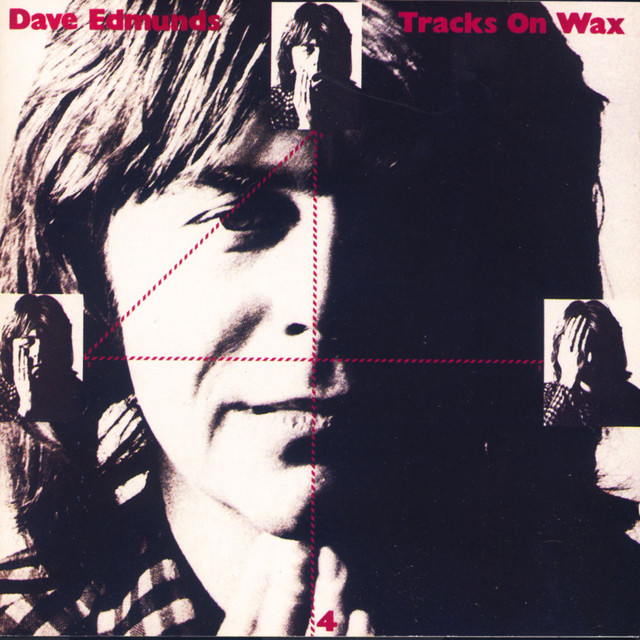
 After finding some chart success with the band Love Sculpture, the Welsh singer-guitarist Dave Edmunds struck out on his own with his version of Smiley Lewis’ 1955 New Orleans raver “I Hear You Knocking,” and got himself a British #1 single in 1970. Edmunds was a multi-instrumentalist who rarely composed his own material, preferring to plunder his beloved American rock and roll and R&B, reimagined with modern equipment.
“I think the nitty-gritty, the spirit of rock and roll, is timeless; it’s only the styles that go in and out of fashion,” he once told New Musical Express. “The productions of some of those records, the spirit that’s there on the classic ‘Whole Lotta Shakin’’s and what-have-you’s…that spirit is just immaculate. It’ll never die.”
In the late ’60s and early ’70s, Edmunds could be found nearly every day at Rockfield Studios in a tiny town in the Wye Valley of Wales, meticulously recording layers of tracks like an introverted one-man version of Phil Spector’s Wall of Sound.
“I don’t mind when people compare my work to Spector,” he told journalist Alan Betrock in 1976. “It was a conscious thing I did, that sound, except I wanted to do it just with four instruments as opposed to the whole setup he used. Just do it with piano, guitar, bass and drums.” He didn’t make many live appearances, content in his isolation doing his art. “Someone says, ‘You got fans in America,’ and that always freaks me out.”
Edmunds jumped between record labels for Rockpile (Deram, 1972) and Subtle As a Flying Mallet (RCA, 1975) before finding a more permanent home at Led Zeppelin’s new label Swan Song for 1977’s Get It. Working mostly at Rockfield, for these recording sessions he also ventured to London’s Pathway studios, employing a few other musicians drawn from the London pub-rock scene, including Nick Lowe (bass) and Terry Williams (drums). Still doing oldies written by Hank Williams, Arthur Crudup, Otis Blackwell, a Rodgers and Hart, Edmunds also cut newer material by Graham Parker, Bob Seger and Lowe, with whom he began to collaborate on songwriting.
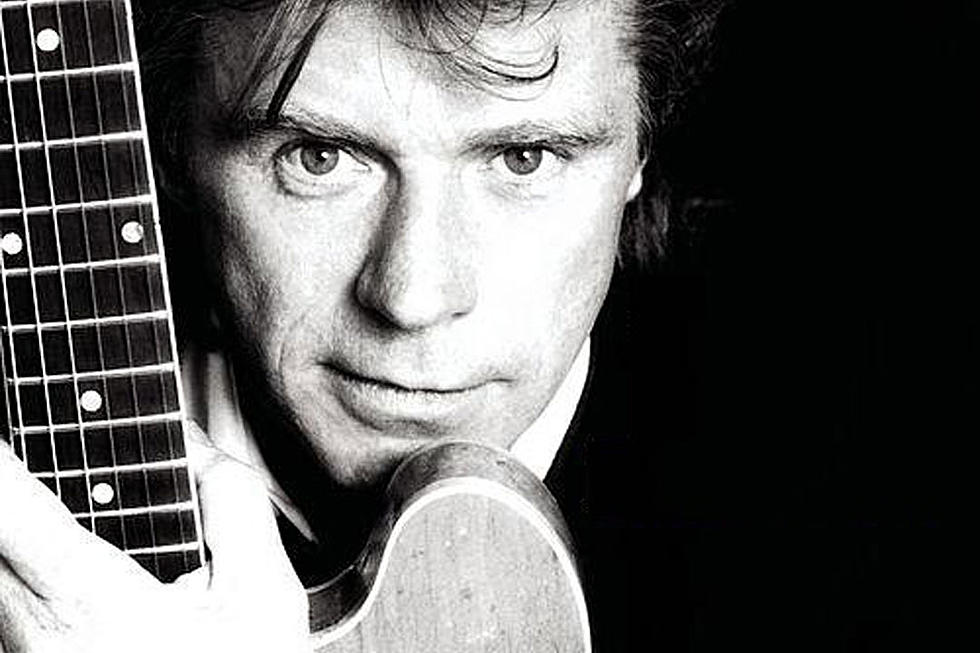
Dave Edmunds
By the time he was ready to record his next album, eventually dubbed Wax on Trax 4, he’d become part of a bona fide band, dubbed Rockpile after his LP. He, Lowe and Williams added a second supremely talented guitarist-vocalist-songwriter, Billy Bremner, a Scotsman who’d worked with Lulu, Neil Innes and others.
Aside from a healthy touring schedule, Rockpile began recording multiple albums at the same time, which for contractual reasons came out under individual names, Labour of Lust (Lowe) and several credited to Edmunds. 1980’s Seconds of Pleasure became the only LP credited to Rockpile itself, just as they were breaking up.
Edmunds told NME the mid-’50s were his template: “The kind of songs that were written during that period, three-minute singles with a bit of feeling and class, were what we based Rockpile on. Look at almost any Everly Brothers song—great singing, great words and an amazing guitar solo in the middle.”
Wax on Trax 4 was recorded in a mere 13 days in March 1978 at the small Eden Studios in London, where Lowe had already been given the nickname “Basher” for how quickly he tended to record any act he was assigned to produce. A pessimist in many of his lyrics and an optimist in the studio (“I don’t think there’s any point going into a recording studio thinking you’re not going to make a hit record”), Lowe made sure Edmunds’ perfectionism was tempered by the “one and done” approach he liked.
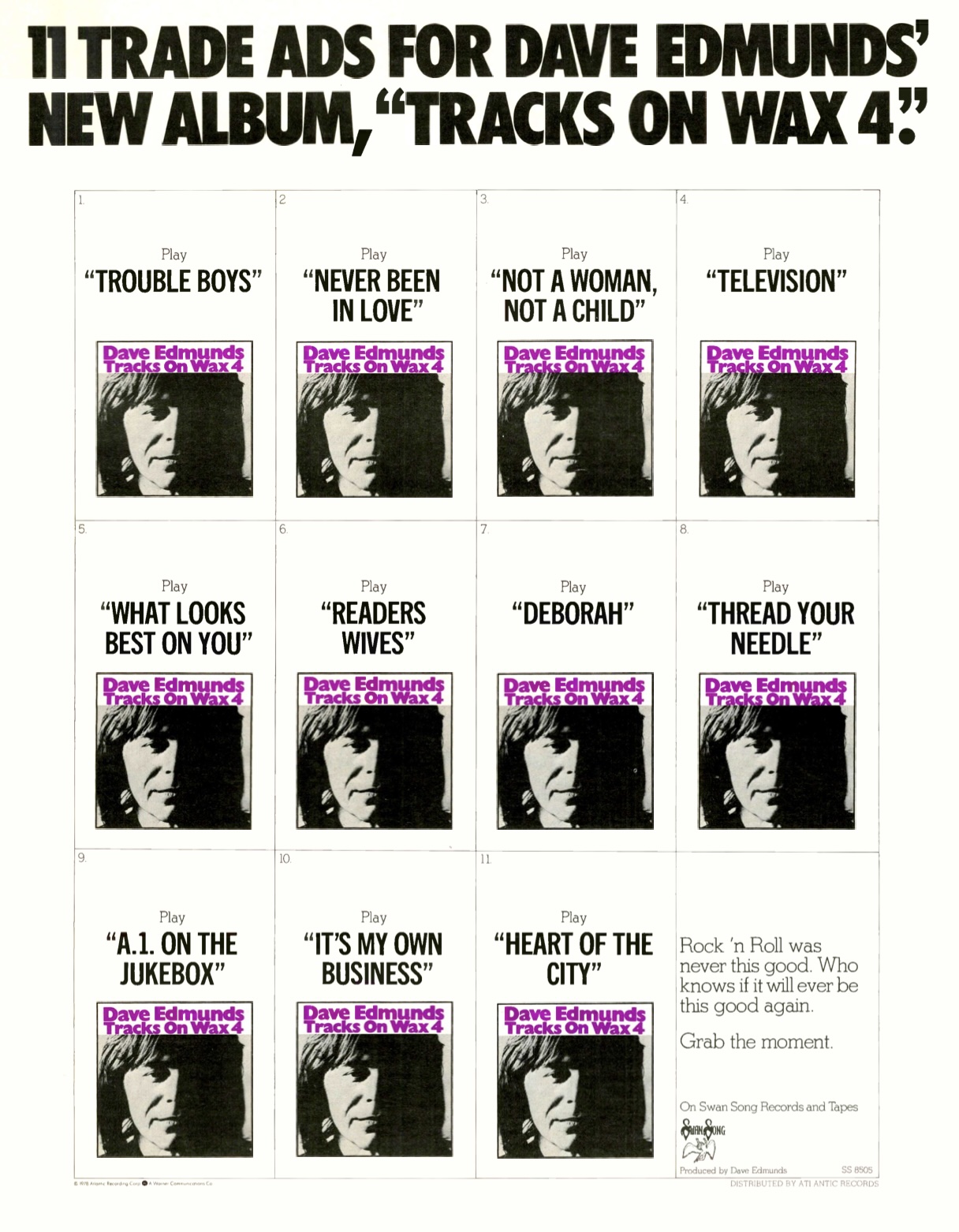
This ad for the album appeared in the Sept. 23, 1978, issue of Record World.
The album opens with the magnificent “Trouble Boys,” written by Bremner under his songwriting moniker B. Murray. The intro is an homage to Eddie Cochran’s “Summertime Blues,” but the skeleton of the track is a propulsive Chuck Berry-ish chug, over which Edmunds expertly serves some tongue-twisting lyrics in his clear tenor voice. The plot involves an altercation between some rough guys at a dance and the singer’s crew: “The trouble boys came in/I guessed they’d been out fightin’ and ravin’/It wasn’t long before they moved in and picked up/The girls we brought to the dance at the night spot.” The expert guitar solo lasts all of 20 seconds, before Bremner throws in a lyrical reference to Elvis Presley’s “All Shook Up” (“I was shaking like a leaf on an autumn tree”), and no blood is shed after all.
The whole group composed the music to Lowe’s lyrics for “Never Been In Love,” which features Edmunds harmonizing with himself and Bremner, a tune that Ricky Nelson would have been proud to cut. Edmunds told the writer Dave Schulps that the guesting player Gerry Hogan was “trying to recapture that rock ’n’ roll pedal steel sound pioneered by Johnny Day on such Everly Brothers tracks as ‘Lucille.’”
“Not a Woman, Not a Child” (by Bremner) starts with Edmunds in a low register, croaking like he’s Joe Jones or John Lee Hooker. “It was weird,” he told Schulps, “We put the track down about a week before I did the vocal. When it came time to do the vocal. I walked up to the mike and didn’t know how to approach it at all. I just started singing in this blues voice with John Lee Hooker’s delivery. It started out as a joke, but we couldn’t see any other way to do it.” Again, the initial extremely short guitar solo is perfection in miniature, but the longer solo at 2:20, which shows Edmunds’ devotion to the chicken-scratch style of Jerry Reed, is just short of a miracle. Pete Kelly contributes some nice tack piano too.
Lowe’s “Television” (first recorded by the Kursaal Flyers on their 1976 album The Great Artiste) is powered by Bremner and Edmunds’ twin guitars, and the Lowe/Williams rhythm section swings like hell. Edmunds’ typically tongue-in-cheek delivery brings out the humor of the lyrics, which portray a lovelorn sad sack who finds the boob tube can fulfill his every need, once he downs a few beers: “Let me tell you I don’t care what’s on, if it’s happy or sad/Don’t give a damn if it’s good or bad/I’ll sit and watch it till it drives me mad/Just so long as it’s on I’m glad.” And another full-of-surprises guitar solo in the middle? Yes, please!
“What Looks Best on You, is a Lowe-Edmunds co-write, as close to the Everlys as they ever got. On live Rockpile shows, the duo sometimes used to sing it together, with perfect Phil and Don harmonies, as a prelude to the rest of the band coming on stage, and it never failed to wow an audience. A randy admirer tries to charm his intended with flattery just this side of offense: “I can tell you’ve an eye for fashion/By those gowns all from Paris and Rome/You can look like a queen in diamonds or jeans/But what would look the best on you is me.” The moaning pedal steel is just the right touch to add.
Side one of the original LP concludes with “Reader’s Wives,” written by Noel Brown from an obscure London band called the Tooting Fruities. American audiences could be forgiven for not understanding what the song title was all about: “There’s a [British] magazine called Fiesta, a stroke mag, where the readers send in photos of their wives, usually in awful, grotesque poses,” Edmunds explained. “Terrible. Noel sent in a demo of it to Jake [Riviera, Lowe’s manager] and Jake, with his outrageous mind, gave it to me.”
Brought in by Williams’s snare rolls, the Berry-ish momentum is relentless, and Edmunds shouts to the point his voice cracks. Hogan and Edmunds, working at a breakneck tempo, take the solos, but the real stars of the track are the salacious, ridiculous words: “Some girls look like they’re just plain gifted/Others look like they’re trained weightlifters/Little one stands at four foot three/While the big ones start at 44D/Quick, give me some coffee before the police arrive/I only came out to look at Reader’s Wives.”
The second side begins with “Deborah,” with some chords pilfered by Edmunds and Lowe from the Kinks’ “Victoria.” “I usually get Nick’s cast-offs,” Edmunds confessed to Schulps, “”hough not by design. He’ll play me something—some half-done song—and forget about it. Six months later I’ll say, ‘What about that one you played me?’ and he’ll go, ‘Oh, yeah.’ Then I sit down with him, sort it out and make it work. That’s how ‘Deborah’ came about.” The band looks to Buddy Holly and Tommy Roe for the arrangement, with acoustic guitars moving to the front, and an electric 12-string for soloing. It’s truly delightful, and with “What Looks Best on You” the most seriously “retro” performance.
“Thread Your Needle,” originally the B-side to Dean and Jean’s “I Wanna Be Loved” on the obscure Rust label, differs from the first version in several ways, mostly in the orientation toward country blues rather than R&B. “This was a chance for Billy to play some more guitar,” Edmunds explained in a 1976 interview. “He’s incredible. You can’t really appreciate him on stage with Rockpile, but he could walk into this room and do some things on guitar you wouldn’t believe.” Jerry Reed is again the heavy influence here.
“A-1 on the Jukebox” was penned by Will Birch of the aforementioned Kursaal Flyers, with some modifications from Edmunds. An energetic country shuffle, complete with a pedal steel that could fill the dancefloor of any Texas honky-tonk, this is another song written by a wiseass who thinks lyrics in rock and roll matter. Evoking sympathy for a comical loser who seeks fame and fortune, the words go into the details of the music business as it used to be: “A-1 on the jukebox, played in every bar/A-1 on the jukebox, big Wurlitzer star/I’m nowhere on the hit parade ’cause no one likes my art/I’m A-1 on the jukebox, nowhere on the charts.” The guitar solo that begins at 1:30 is especially wacky.
On a disc full of tributes to Chuck Berry’s style, why not have the longest track (3:53) be a version of a real Berry song, and give it a twist? “When I’ve done a Chuck Berry song in the past, I’ve basically tried to keep it close to the original feel,” explained Edmunds, “but this one I do like Little Richard would: a real screamer.” All the players are on high alert, especially Terry Williams, who’s got superhuman strength throughout. Even Pete Kelly and his pumping piano joins in. Edmunds pulls out all the stops vocally, and cannot refrain from yelling encouragement to his bandmates. Somehow, engineer Roger Bechirian keeps the proceedings clear, as they threaten to go off the rails.
“It’s My Own Business” was cut for Berry’s 1965 LP Fresh Berry’s, and reflects his ire over the time he spent in prison for violating the Mann Act: “I am tired of you telling me what I ought to do/Stickin’ your nose in my business and it don’t concern you/It’s my own business/Seems like the ones that want to tell you/They don’t ever know as much as you.”
An oddity ends the album. Riviera prevailed upon Edmunds to perform Nick Lowe’s “Heart of the City” to a live Rockpile performance, previously released on Lowe’s Jesus of Cool LP, erasing Lowe’s lead vocal and substituting a new one. It’s not filler—it’s killer!
Trax On Wax 4, released on Sept. 8, 1978, didn’t achieve much in the way of chart action, but it’s a solid, cohesive album that has gained fans over the decades. Edmunds’ subsequent Swan Song albums are also marvels of committed rock and roll, as are the half-dozen releases he’s slowly squeezed out between 1982 and today, but because of his aversion to playing live and otherwise promoting his work, he’s unfortunately never risen above cult hero.
Dave Edmunds had been retired from the music business for a decade when, in 2025, he suffered a nearly fatal heart attack. When he returned home from the hospital, his wife Ceci’s social media post read, “It looks positive. He’s cracking jokes and walking short distances. Very short. But one has to start somewhere. He’s doing great! Hopefully he’ll be Rocking and Rolling in no time. Sending you all much love and light your way always.”
Edmunds’ recordings are available in the U.S. here, in Canada here and in the U.K. here.
Watch Edmunds and Nick Lowe tear into “Heart of the City” live




No Comments so far
Jump into a conversationNo Comments Yet!
You can be the one to start a conversation.