
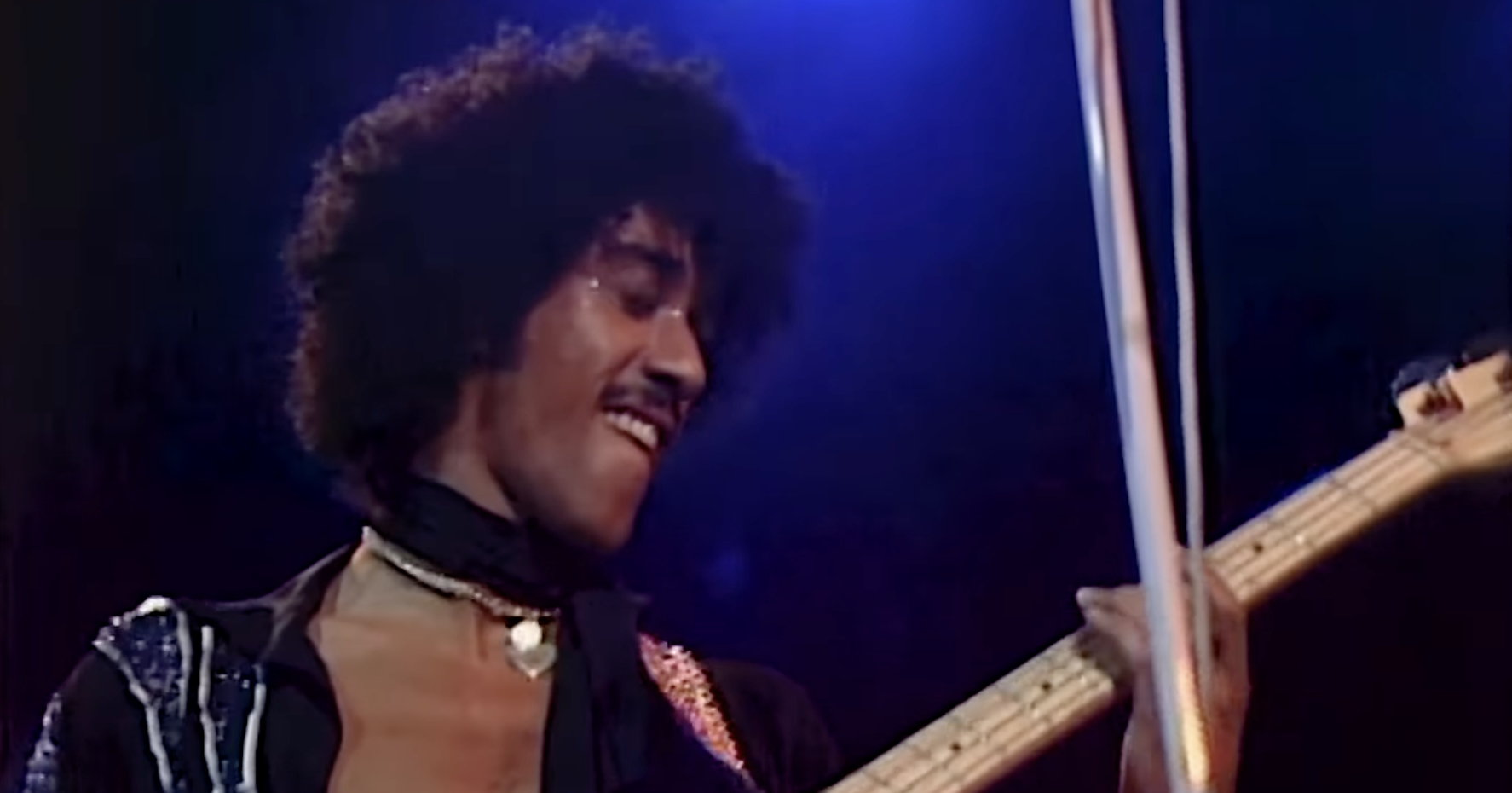
Phil Lynott performing with Thin Lizzy in 1977.
Thin Lizzy built their legacy one album at a time, blending twin-lead guitar harmonies with songs rooted in Dublin streets, Celtic tradition and rock ‘n’ roll swagger. Phil Lynott remained the creative force throughout, joined at various times by standout guitarists Scott Gorham, Brian Robertson, Gary Moore and John Sykes.
The commercial breakthrough came with Jailbreak, but the music that followed proved the success was no fluke. These 12 Thin Lizzy songs capture the band at its finest, from timeless radio staples to ambitious epics and overlooked gems that have only grown in stature.
“The Boys Are Back in Town” (Jailbreak, 1976)
The breakthrough hit reached #12 on the Billboard Hot 100 and #8 in the U.K., helping the LP—their sixth—become their first to chart in the U.S., peaking at #18 on the Billboard 200, their sole gold album in America. Its instantly recognizable riff and singalong chorus have made it one of classic rock’s defining anthems.
Related: Why is “The Boys Are Back in Town” a perfect rock song?
“Jailbreak” (Jailbreak, 1976)
Opening the album with a tale of a daring prison escape, this hard-driving rocker remains one of the catalog’s signature tracks. While it failed to reach the U.K. Singles Chart top 40 upon release, it later peaked at #31 on the U.S. Mainstream Rock chart, became an iconic concert staple and remains an FM radio favorite.
“Cowboy Song” (Jailbreak, 1976)
Beginning as a reflective ballad before erupting into soaring guitar harmonies, this fan favorite showcases the group’s remarkable dynamic range. Their second and final song to chart on the Hot 100, at #77, it has long been a staple of classic rock radio, where it is frequently paired back-to-back with fellow album hit “The Boys Are Back in Town.”
“Emerald” (Jailbreak, 1976)
Drawing on Irish history and mythology, this ambitious epic features the celebrated guitar partnership of Scott Gorham and Brian Robertson at its peak. A foundational text for the New Wave of British Heavy Metal, its dual-guitar attack heavily influenced Iron Maiden and has since been covered by bands ranging from Overkill to Mastodon
“Don’t Believe a Word” (Johnny the Fox, 1976)
Barely two minutes long, this compact rocker wastes no time delivering one of the band’s sharpest hooks. It became a concert favorite and was later embraced by Gary Moore, who regularly performed a slower, bluesier version of it during his solo career.
“Dancing in the Moonlight (It’s Caught Me in Its Spotlight)” (Bad Reputation, 1977)
A relaxed groove, saxophone flourishes and one of the catalog’s most memorable melodies helped this single reach #4 in the band’s native Ireland and #14 in the U.K. It remains one of the band’s most enduring and accessible recordings.
“Still in Love With You” (Live and Dangerous, 1978) (originally from Nightlife, 1974)
Although first recorded in 1974, the live version is widely regarded as definitive. The emotional vocal performance and extended guitar passages helped establish the album—#2 in the U.K.—as one of rock’s greatest live recordings.
Related: Our Album Rewind of Live and Dangerous
“Waiting for an Alibi” (Black Rose: A Rock Legend, 1979)
Gary Moore’s return to the lineup produced an immediate success, with this rocker reaching #9 on the U.K. Singles Chart. Its crisp arrangement and memorable chorus made it one of the band’s biggest late-’70s hits.
“Do Anything You Want To” (Black Rose: A Rock Legend, 1979)
Built around an uplifting message and an irresistible hook, the single climbed to #14 in the U.K. It remains one of the most accessible entries in the catalog without sacrificing its hard-rock edge.
“Sarah” (Black Rose: A Rock Legend, 1979)
Written for Lynott’s newborn daughter, this heartfelt ballad reached #24 on the U.K. Singles Chart. Its warmth and simplicity provide a striking contrast to the album’s heavier moments.
“Black Rose” (Black Rose: A Rock Legend, 1979)
Stretching beyond seven minutes, this sweeping suite blends traditional Irish melodies with expansive hard-rock. Often cited among the band’s greatest achievements, it also ranks among Moore’s finest recorded performances.
“Cold Sweat” (Thunder and Lightning, 1983)
John Sykes brought a heavier, more metallic edge to the final studio album, and this single reached #27 in the U.K. Its blistering riff and aggressive attack pointed toward the sound that would dominate hard rock through the rest of the decade, later prompting a notable cover by thrash metal legends Megadeth on their 2013 album Super Collider.
Thin Lizzy’s recordings are available in the U.S. here, in Canada here and in the U.K. here.



2 Comments so far
Jump into a conversationa local group i knew named Forest covered a few of their songs it was great dancing to them..Thin Lizzy were great! the band Forest was great also! the catty witches with the band may have snickered but i ignored them and had a great time! Phil Lynott was a great talent..sadly gone too soon…the place O.B.I West and the band may be gone but the memories live on..
No mention of Eric Bell or Early Albums ..