

KISS performing on The Midnight Special on July 11, 1975.
Gene Simmons, Paul Stanley, Peter Criss and Ace Frehley formed KISS in New York in January 1973 and released their self-titled debut in February 1974. Within three years, the band went from club dates to headlining arenas, backed by a stage show built on fire, blood and pyrotechnics—and a catalog of hooks sturdy enough to survive the spectacle.
As the decade turned, the original lineup fractured. Criss departed in 1980, replaced behind the kit by Eric Carr (the “Fox”), whose heavy-hitting style redefined their rhythm section until his death in 1991. Frehley officially exited in 1982, opening the door for lead guitarist Vinnie Vincent (the “Ankh Warrior”), who co-wrote key material and helped steer the group through its unmasking. Later eras brought stability through longtime guitarist Bruce Kulick during KISS‘ non-makeup MTV years, and eventually Eric Singer (drums) and Tommy Thayer (lead guitar), both of whom stepped into the Catman and Spaceman personas for the band’s final decades.
The 15 songs below trace that evolution chronologically, beginning with the debut’s raw templates, moving through the Bob Ezrin-produced Destroyer and Eddie Kramer-produced Rock and Roll Over, and culminating in 1983’s unmasked pivot, Lick It Up.
“Deuce”—(KISS, 1974)
Gene Simmons wrote the song and the driving bass riff that opens it, establishing one of the debut’s defining signatures. It quickly became a fixture of early concert sets and remains one of the band’s most frequently performed numbers.
“Nothin’ to Lose”—(KISS, 1974)
Simmons, Peter Criss and Paul Stanley trade lead vocals over studio musician Bruce Foster’s barrelhouse-style piano. The debut’s first single failed to chart, but it secured early national exposure when the band performed it on ABC’s In Concert, which aired in March 1974.
“Firehouse”—(KISS, 1974)
Written before KISS had even formed, this stomping track quickly transformed into a centerpiece of the band’s live spectacle. Sirens, flashing red lights and Simmons’ signature fire-breathing act turned it into an enduring stage fixture.
“Black Diamond”—(KISS, 1974)
The debut album closes with its most dramatic arrangement. Stanley delivers the tender acoustic intro before handing lead vocal duties over to Criss, whose raspy delivery drives the heavy, slowing riff to the finish.
“Let Me Go, Rock ’n’ Roll”—(Hotter Than Hell, 1974)
Simmons and Stanley co-wrote this fast-paced rocker for the band’s murkier, heavier sophomore LP. Released as a single in late 1974, it missed the charts entirely but held a dependable slot in concert setlists for years.
“Rock and Roll All Nite”—(Dressed to Kill, 1975)
Designed explicitly as an arena anthem with a chorus swelled by roadies and studio guests, the original studio cut stalled at #68. The breakthrough came via the raucous live recording on Alive!, which surged to #12 on the Hot 100 to deliver the band’s first Top 20 single.
“Detroit Rock City”—(Destroyer, 1976)
Inspired by the death of a KISS fan traveling to a concert, this high-velocity opener captures Bob Ezrin’s cinematic production style, complete with sound-effects storytelling and dual-guitar harmonies. Though it failed to chart on the U.S. Hot 100, its B-side launched the band’s biggest American hit.
“Beth”—(Destroyer, 1976)
A lush ballad featuring piano and strings from an otherwise high-volume shock-rock act, this song became the quartet’s highest-charting U.S. single. Criss sings lead on the ballad, which was credited to Criss, Stan Penridge and Bob Ezrin, and it reached #7 on the Hot 100.
Related: Our Album Rewind of Destroyer
“Shout It Out Loud”—(Destroyer, 1976)
Crafted with Ezrin to deliver an immediate, arena-wide sing-along, this call-and-response anthem features Stanley and Simmons trading vocal lines. Released as the album’s lead single in 1976, it reached #31 on the Hot 100.
“God of Thunder”—(Destroyer, 1976)
Originally written by Stanley as an up-tempo rocker, Ezrin slowed the tempo down and reassigned the lead vocal to Simmons. The menacing, heavy stomp permanently defined Simmons’ onstage “Demon” persona.
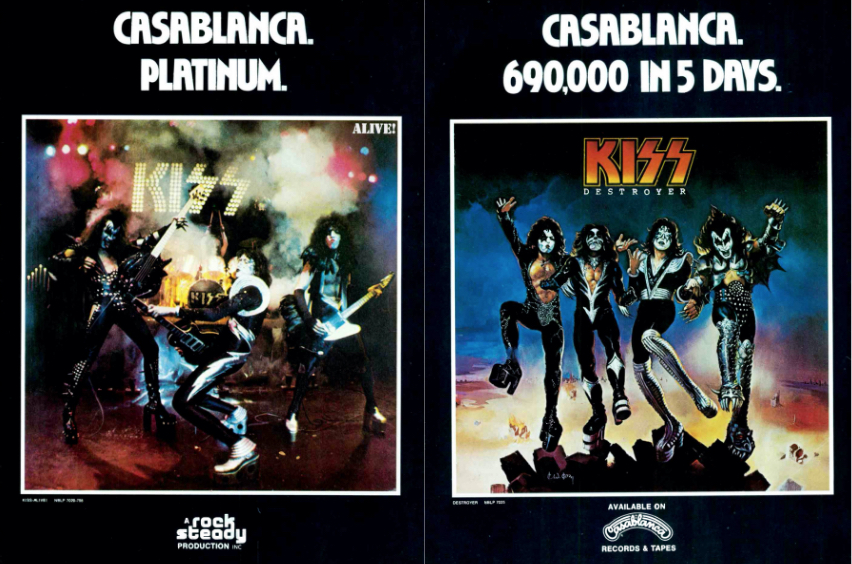
This 2-page celebratory ad for Destroyer appeared in the March 27, 1976 issue of Record World.
“Calling Dr. Love”—(Rock and Roll Over, 1976)
Simmons’ swagger and hook-first instincts carry this hard-edged track, produced by Eddie Kramer. Released as a single in early 1977, it peaked at #16 on the Hot 100 and remained an essential live regular.
“Love Gun”—(Love Gun, 1977)
Stanley wrote, sang lead and played rhythm guitar as well as bass on the title track. While the single peaked modestly at #61 on the Hot 100, the song became one of Stanley’s signature concert showpieces.
“Rocket Ride”—(Alive II, 1977)
Ace Frehley stepped into the spotlight with lead vocals, scorching guitar leads and bass duties on a track he co-wrote with Sean Delaney. As one of five new studio tracks on Side 4 of Alive II, it peaked at #39 on the Hot 100 in early 1978.
“I Was Made for Lovin’ You”—(Dynasty, 1979)
Teaming with songwriter Desmond Child and producer Vini Poncia, Stanley fused four-on-the-floor disco rhythms with arena-rock power chords. Anton Fig played drums on the recording, while Peter Criss did not perform on the track. The single reached #11 on the Hot 100 and became a massive worldwide hit.
“Lick It Up”—(Lick It Up, 1983)
The greasepaint came off, and this title track kicked off the unmasked era. Co-written by Stanley and lead guitarist Vinnie Vincent, the song’s promotional clip became an MTV staple, giving fans their first look at the band performing without makeup and helping reestablish KISS as a major rock attraction.
Kiss’ extensive recording catalog is available in the U.S. here, in Canada here and in the U.K. here.




5 Comments so far
Jump into a conversationi’m enjoying this feature, especially for my favorite band who’s covered here occasionally. this is a great list! ….another case for KISS’ success and longevity being based on great songs/records. just add the greatest live show on earth! …not bad for 4 knuckleheads from NYC!
‘Calling Doctor Love’ and ‘Christine Sixteen’. Doesn’t get any more Rock & Roll than that.
Imagine Elvis doing ‘Christine Sixteen’ in 1956.
Actually, “Hard Luck Woman” is probably my favorite song by Kiss, though I have to admit, the reason for that is because it really doesn’t sound like Kiss.
Rocket Ride is fun, but I’d replace it with the track that actually debuted Ace on vocals – 1977’s Shock Me off Love Gun, or if we want what’s probably Ace’s most popular Kiss track, New York Groove off his solo record (any time I do a best of KISS list, I include one song from each of the 4 original solo LPs)