
Stevie Wonder: “Fulfillingness’ First Finale” Was Beyond Category
by Mark Leviton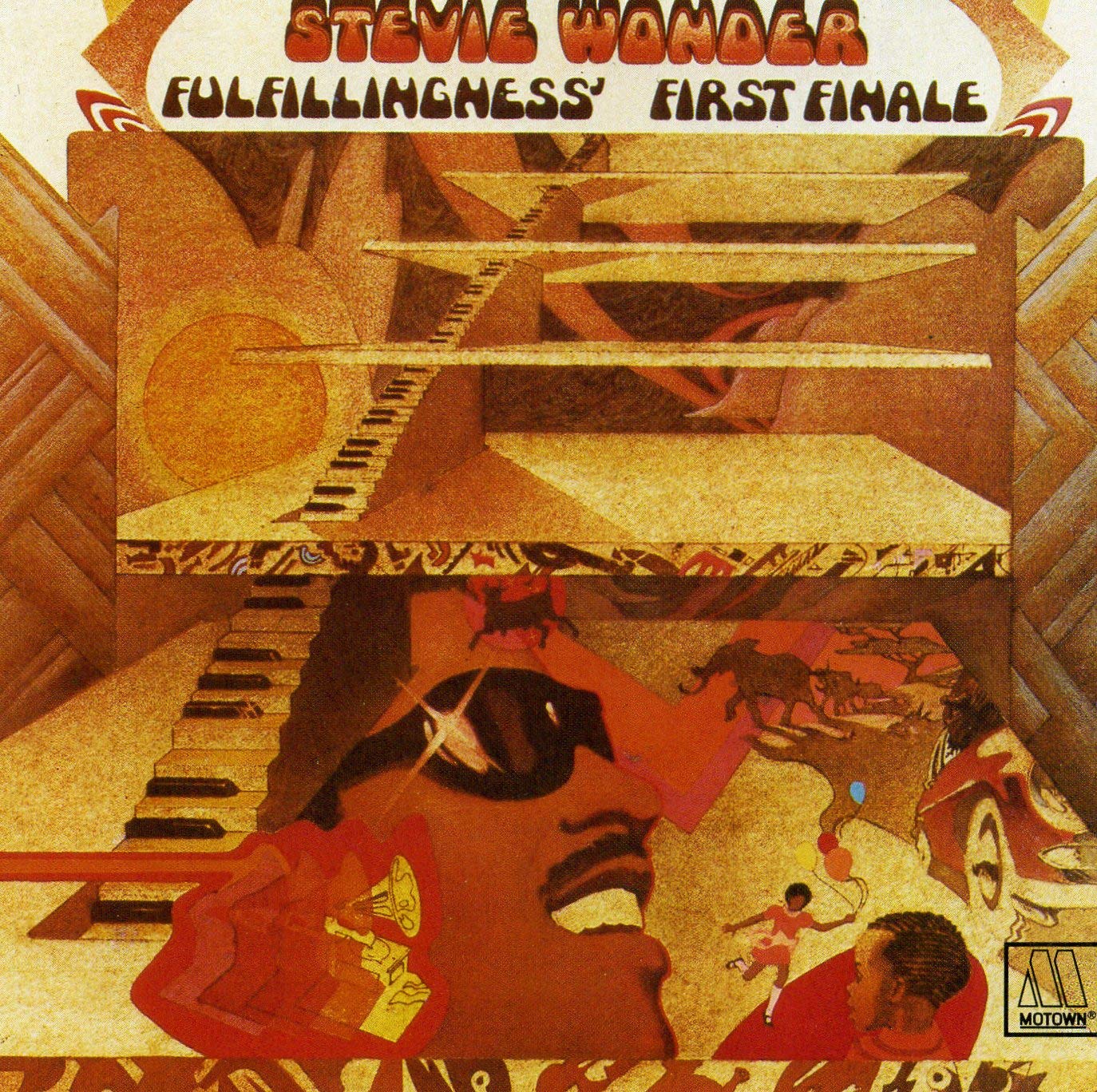
Stevie Wonder’s Fulfillingness’ First Finale, released on July 22, 1974.
“It seems after we get to a certain age,” the 24-year-old Stevie Wonder told Melody Maker in 1974, “your excitement, your desire, your fire leaves the body. It’s the psychological thing about getting old, and my belief is that you’re only as old as you let yourself get. You’re only as old as your ideas about things that are not positive.”
Wonder had just released his 17th studio album, the tongue-twistingly titled Fulfillingness’ First Finale, which followed three innovative, influential and big-selling LPs: Music of My Mind, Talking Book and Innervisions, all released between March 1972 and August 1973. Believing his new work would signal the “finale” of a phase in his creative development, Wonder once again worked with electronic music pioneers Malcolm Cecil and Bob Margouleff, whose synthesizer system had enthralled him when he heard their album Tonto’s Expanding Headband in 1971 and sought them out.
“I know everyone was expecting another Innervisions,” he says in the same interview, “and I hate that categorization. People categorize because they can’t get used to change.” He continued this theme talking to the journalist Robin Katz that same year: “At the time I did Music of My Mind, people were saying I shouldn’t mess around, and I should stick to my own style. They said I was getting into heavy stuff and that I should come back home, so to speak.” But for young people of all races, his “heavy” stuff was very much in line with where America was during the era of Richard Nixon.
Another subject weighing on Wonder’s mind was his own health and longevity. In August 1973, Wonder was being driven to a benefit show in Durham, North Carolina, when a log detached itself from a truck on the road and smashed through the windshield of the vehicle in which he was riding. He was hit in the head and was in a coma for a week. Looking back years later, he told writer Barney Hoskyns, “The only thing I know is that I was unconscious and that for a few days I was definitely in a much better spiritual place that made me aware of a lot of things that concern my life and my future and what I have to do to reach another higher ground.”
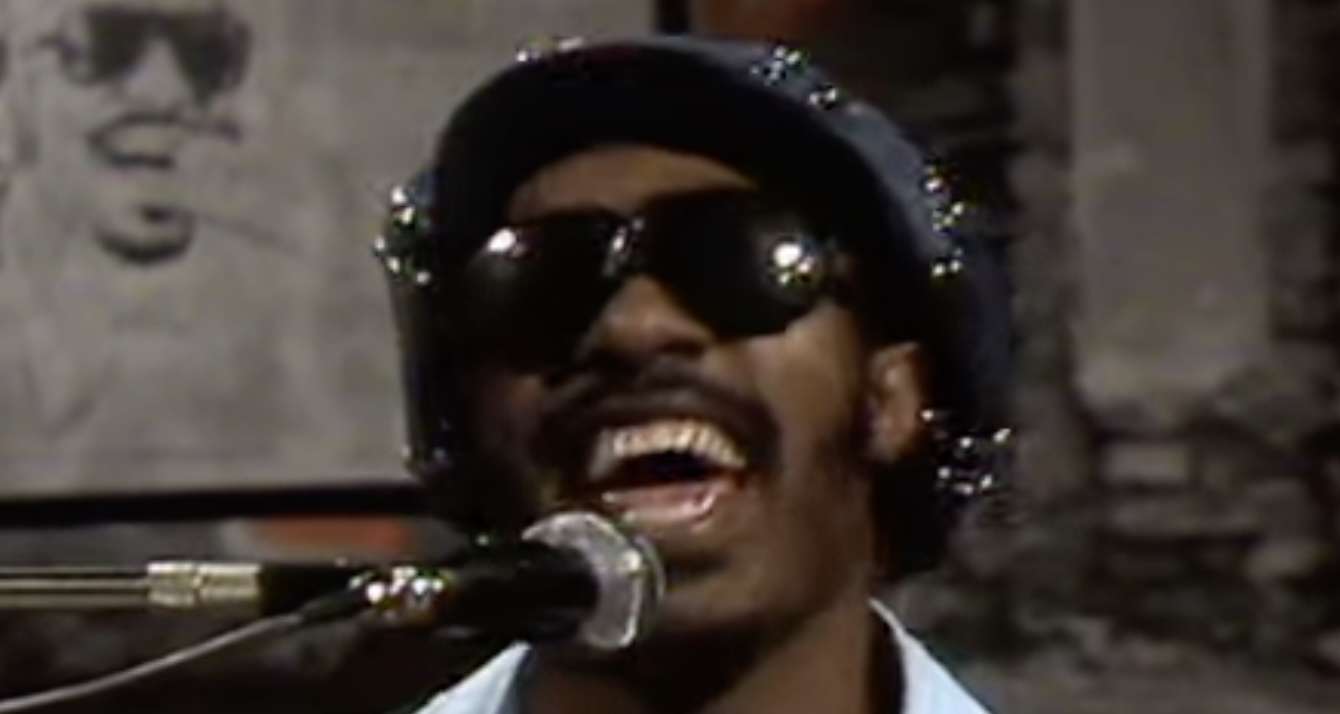
Stevie Wonder performing in 1974.
In fact, even as Fulfillingness’ First Finale came out on July 22, 1974, Wonder was anxious to release more music right away, part of a cache of over 180 songs he’d stockpiled, but his label Motown convinced him to wait, given that his previous three albums were still selling strongly. Wonder’s next release, Songs in the Key of Life, a double-LP with an extra EP inserted, hit the racks in 1976, and turned out to be the “Fulfillingness Part Two” Wonder envisioned and much more.
Related: Our Album Rewind of Talking Book
The complexities of Wonder’s compositions are sometimes daunting, as he can draw from multiple musical traditions and restlessly find new territory to explore. “I’ve always been a lover of jazz,” he told Hoskyns. “Using chords that are considered abstract: raised ninths, flatted fifths, major sevenths, all those different chord structures. I learned to play [Coltrane’s] ‘Giant Steps’ but for a long time I just couldn’t get it. Finally, I got it and I thought, ‘I’m one o’ the cats now, baby!’ I always had that spirit of wanting to know and discover.”
“Smile Please” is the first track on Fulfillingness’ First Finale, and exudes optimism in a Latin groove that’s cousin to “You Are the Sunshine of My Life”: “Love’s not competing/It’s on your side/You’re in life’s picture/So why must you cry?” Several of the elements of the album are already in place, with Bobbye Hall’s congas and bongos, the background vocals of Jim Gilstrap and Deniece Williams, and Michael Sembello’s mellow Wes Montgomery-like electric guitar laid in with Wonder’s Fender Rhodes piano. Wonder, who often likes to build tracks from the percussion track up, is the drummer throughout the LP.
The atmosphere of “Heaven is 10 Zillion Light Years Away” is shimmering from the start, as Wonder’s Moog bass, Hohner clavinet and confident, intimate lead vocal suffuse the track with gospel warmth. Of the four background vocalists, Shirley Brewer and Larry Latimer are given extra latitude to weave their funky call-and-response with Wonder (Paul Anka and Stevie’s ex-wife Syreeta Wright are also singing). The emotional elevation at 1:50 as Wonder asks, “Why must my color Black make me a lesser man?” is breathtaking, and the vocal calisthenics for “Let God’s love shine within to save our evil souls/For those that don’t believe will never see the light” show his unabashed commitment to spirituality and “His spirit.”
The instrumentation for “Too Shy to Say” is minimal: Wonder’s acoustic piano, upright bass from his longtime Motown colleague James Jamerson, and “Sneaky Pete” Kleinow’s ghostly pedal steel guitar. The melody is slow, sensuous and classically American: you can almost imagine Richard Rodgers and Lorenz Hart writing it for a Broadway love scene.
The next track, future Grammy winner and hit single “Boogie on Reggae Woman,” is an exciting genre hybrid that has surprises around every corner. Rocky Dzidzomu plays congas while Wonder handles everything else, including drums, harmonica, Fender Rhodes, Moog bass and synthesizer.
The lyrics are especially playful and randy (“I like to reggae/But you dance too fast for me/I’d like to make love to you/So you can make me scream”), but it’s the pumping rhythm that grabs attention from the start and fills dancefloors to this day. The interplay of synth and harmonica solos in the last minute is truly unique even in a catalog as rich as Wonder’s. For over 50 years, jazz and jam-band artists—everyone from Stanley Turrentine to Phish—have covered the song with fresh variations.
The outstanding, slow-groove “Creepin’,” featuring the same instrumental line-up as “Boogie on Reggae Woman,” follows, adding only Minnie Riperton’s backing vocal. Closing out the original vinyl side, it’s yet another affirmation of love, lust and fantasy, when the potential lover is told, “You always creep into my dreams.” The harmonica solo at 2:30 is another sweetener for the lyrics.
The overtly political rant about Richard Nixon, “You Haven’t Done Nothin’,” leads off side two with a bang. Released as a single on August 7, 1974, it quickly hit #1. As a protest song meant to influence events, the timing was just a bit off, as Nixon resigned the presidency on August 8: “We are amazed but not amused/By all the things you say that you’ll do…We are sick and tired of hearing your song.”
A waterfall of synths, and then a clavinet channeling “Superstition,” lead into one of Wonder’s strongest vocals. Margouleff and Cecil handle synthesizers [perhaps also imitating an uncredited horn section], Reggie McBride plays electric bass, and the Jackson 5 are brought in for some terrific “doo-wop” vocal support.
“It Ain’t No Use” is a beautiful love song of the type Wonder can seemingly produce at will. It benefits from a trio of female backup singers, Lani Groves joining Williams and Riperton, and the instrumental work is once again impeccable.
The nearly six-minute “They Won’t Go When I Go” begins like Chopin, and unspools as a somewhat opaque lament where “the bleeding hearts with sorrows to impart/Were right here from the start/And they won’t go when I go.” Most likely it’s Wonder’s anticipation of his “destiny” in an afterlife where there won’t be the suffering and negative energy of life on Earth, with “People sinning just for fun.” Is this the “fulfillingness” of the album’s title? It’s not as big-hearted as other Wonder lyrics, but whether it’s overly judgmental and off-putting is up to the listener.
The Brazilian friction drum called a cuica, played by Bobbye Hall, is prominent in “Bird of Beauty,” which features more brilliant keyboard and percussion work from Wonder, and kicking Brewer/Groves/Williams vocals recalling the work of Sergio Mendes, who not coincidentally supplied some Portuguese lyrics for the track.
“Please Don’t Go” threatens to break into a “classic” Wonder ’60s Motown-bred tune like “My Cherie Amour” or “Yester-Me, Yester-You, Yesterday,” but could easily fit on Innervisions or Talking Book. It’s a truly joyous ending to the album, with a wonderfully exuberant lead vocal, the addition of the fabulous Persuasions in the backing choir, and excellent piano and harmonica work from the master of ceremonies.
At the 17th Annual Grammy Awards, Fulfillingness… was named Album of the Year (just as Innervisions had been), won the Best Male Pop Vocal category, and found additional recognition for “Boogie on Reggae Woman” as Best Male R&B and Blues Vocal Performance.
“I think it was a good record,” the ever-modest Wonder told Hoskyns in 2000. “I don’t know if it was equal to Innervisions, to be honest with you. It was just different.”
Wonder long ago cemented his status as one of the music world’s true geniuses. He has no plans to retire, and his live performances are still top-flight, but we’re still waiting for his first full studio album in over 20 years, now rumored for 2026 release, possibly called Through the Eyes of Wonder (or Ten Billion Hearts or When The World Began, depending on who’s reporting). Wonder’s last single, “Can We Fix Our Nation’s Broken Heart,” came out in 2024, just before the national election.
Wonder’s enormous catalog, including Fulfillingness…, is available in the U.S. here, in Canada here and in the U.K. here.
Watch Stevie Wonder perform “Boogie on Reggae Woman” live in 2007





No Comments so far
Jump into a conversationNo Comments Yet!
You can be the one to start a conversation.