
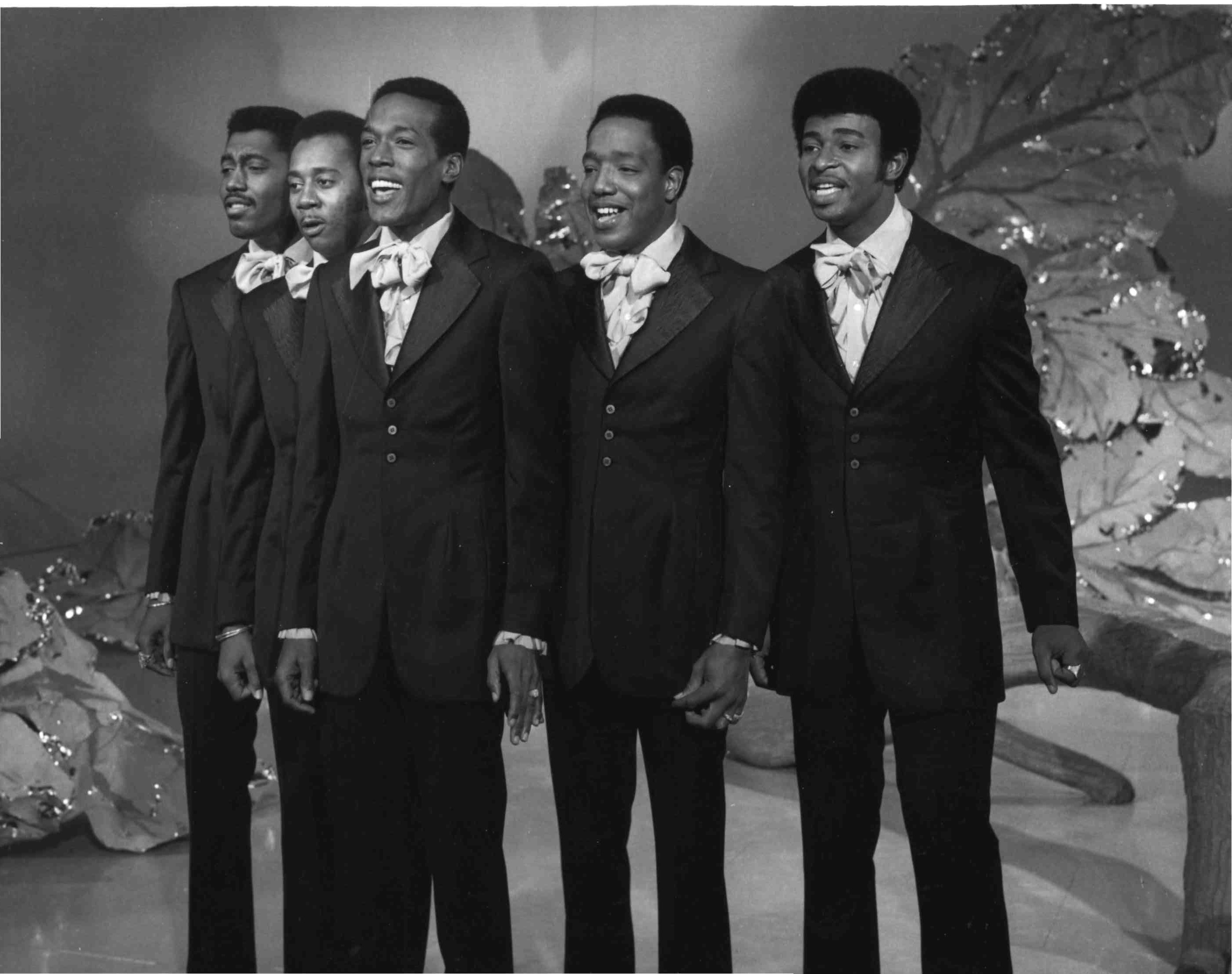
The Temptations performing “I Can’t Get Next to You” on The Ed Sullivan Show, Sept. 28, 1969 (Photo: SOFA Entertainment/UMe; used with permission)
Despite—or perhaps because of?—some shifts in their lineup, varied production approaches and oscillating cultural moods, The Temptations somehow stayed true to their form and, for a span of roughly a decade, remained truly excellent, tight with group/solo harmony, while still pushing envelopes and creating groundbreaking work as one of Motown’s best.
From Smokey Robinson-penned classics to writer-producer Norman Whitfield‘s grandiose psychedelic soul recordings, these are some of the greatest hits from one of America‘s premier singing groups. With their orchestrated suits, sharp choreography and the evolution of Black America during the mid-’60s to early ’70s, these recordings and performances trace the arc of one of our best-loved vocal acts.

The cover of The Temptations’ 1969 album, Cloud Nine.
The immaculately presented harmonies and soul-stirring energy of their early recordings evolved into some of the most risk-taking, groundbreaking recordings in music history. This collection showcases the stunning evolution of the chart-topping hits and unforgettable recordings of, most notably, Dennis Edwards, Melvin Franklin, Eddie Kendricks, David Ruffin, Otis Williams, Paul Williams and the many others that became part of their lineup. And no feature on The Temptations is complete without acknowledging the skill of Motown’s house band, the Funk Brothers.
Play these 12 tracks in sequence, and in addition to getting lost in the classics, you‘ll enjoy a group that consistently raised the stakes for itself, and for American soul.
The Way You Do the Things You Do (1964)
Their first hit, produced by Smokey Robinson, who also co-wrote it, the single hit #1 on the Billboard R&B chart (and #11 on the Hot 100), and introduced Eddie Kendricks, a lithe, dashing lead singer, who, with sharp images and sweet harmonies, seemed the next big thing from Motown’s hit-making machine.
My Girl (1964)
After a couple of stumbles, they returned with this number, written and produced by Robinson and Ronald White. It begins with such simple lyrics (“I’ve got sunshine on a cloudy day”) that set the tone for the dreamy song that reached #1 on the R&B and Hot 100 charts. David Ruffin was 23 years old when he recorded his cool and assured vocal over a grooving bass line made for this classic embodiment of the era that’s etched in America‘s soundtrack.
Get Ready (1966)
By 1966, The Temps’ records could be heard on soul radio day and night, and this optimistic jewel reached # 1 on the format. With its highfalutin’ falsetto by Kendricks, and a bouncy, irresistibly joyful feel, this big production number was perfect for the dance floor. It’s hard to imagine that it peaked at just #29 on the Hot 100 (though four years later, label mates Rare Earth took it to #4).
Ain‘t Too Proud to Beg (1966)
Yet another fixture on the radio, topping the R&B chart, while peaking at #13 pop. Heavy drums and crisp brass punctuate Ruffin’s powerful vocal delivery; this became one of their more emboldened singles to date during their mid-’60s phase. It was at this point that Whitfield took over as the group’s main producer. What a great opening!
(I Know) I‘m Losing You (1966)
Another winner from ’66—and their fourth to top the R&B chart that year—it blended a pounding accompaniment with Ruffin’s urgent phrasing—Billboard described it as a “blues swinger”—and great group vocalizations.
I Wish It Would Rain (1967)
Yet another R&B chart-topper, this deeply felt ballad offers string-laden dramatic arrangements, with Ruffin’s deep, soulful lead vocal.
Cloud Nine (1968)
This game-changer was written by Whitfield and Barrett Strong with such lyrics as “You can be what you want to be, you ain’t got no responsibility, and every man, every man is free, and you’re a million miles from reality.” It pushed the envelope with its layered instrumentation and with all five members taking turns at lead vocal responsibilities. Though it peaked at “only” #6 pop and #2 R&B, it went on to earn Motown its first Grammy Award (for Best Rhythm & Blues Group Performance, Vocal or Instrumental). Tinged with a heavy, psychedelically inclined vibe, it would serve as a sign of the revolutionary changes to come.
Runaway Child, Running Wild (1969)
By 1969, the formula was fleshed out with several extended, form-conscious pieces from Whitfield and Strong. Though the bluesy single got a significant edit to just under five minutes, it still was able to reach #1 R&B and #6 on the Hot 100. (The album version logged in at a robust 9:36.) The powerful song again featured lead vocals from all five members.
I Can‘t Get Next to You (1969)
A dynamics class in song form, again produced by Whitfield, who co-wrote it with Strong, this powerhouse reached #1 on R&B chart and returned the group to the top of the Hot 100 for the first time since 1964’s “My Girl.” With its switching lead vocalists and sudden shifts in pace, the recording is one of their most inventive hits.
Ball of Confusion (That’s What the World is Today) (1970)
An absolute tour-de-force that came courtesy of the group’s second greatest hits album, the psychedelic number—another winner from the Whitfield and Strong partnership—kicked off a new decade with biting lyrics of problems that affected the challenging times: taxes, bills, drugs, and more.
Just My Imagination (Running Away with Me) (1971)
And just like that, the vocal group returned to its roots with this ballad so reminiscent of their earlier hits. (And, yes, it was written by Whitfield and Strong.) Kendricks’ silky smooth vocal glides over lush arrangements, leading it to top both charts. It marked the closing of an era as he departed to launch a solo career.
Papa Was a Rollin’ Stone (1972)
Super-aspirational, right from its beginning seconds, this epic song again topped both the pop and R&B charts and won three Grammys. The production for the album version starts with a lengthy musical intro of nearly four minutes, setting the tone prior to the memorable vocals entering, “It was the third of September…” This is a Motown masterpiece. (We’ve intentionally included the full, nearly 12-minute version here.)
Various Temptations music collections are available in the U.S. here, in Canada here and in the U.K. here.



1 Comment so far
Jump into a conversationFantastic songs, wonderful vocals, great production, killer musicianship by the Funk Brothers–what more could any ask? I’ve seen the Temps in concert many times and have always enjoyed them. Today they’re basically a shadow of the might original group from the sixties, but Otis Williams is still hanging in there even in his eighties and the group still sounds good. I’ll always love these songs.