
The Who’s Debut Album, ‘My Generation’: Sharks Circling in the Water
by Colin Fleming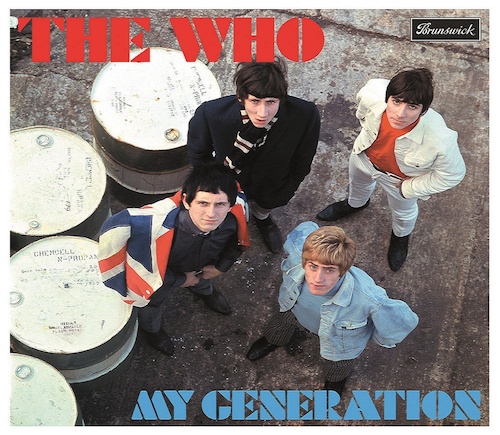
The English edition of the Who’s debut album
As rock and roll traded a portion of its fleet-footed bounce for a weightier lurch that seemed to dent the ground in the pivotal year of 1965, The Who were the band that pressed down harder than any had previously.
This is the period when we start to see an initial flowering of the innovative and louder sounds that will bear copious fruit in the next several years, when it seemed that experimentation—but with intent and focus—became, somehow, a paradoxical standard. If you weren’t growing, you were busy dying, to paraphrase Bob Dylan, and no serious listener would take you seriously.
It’s hard to imagine that this was once the state of affairs in anything, given the lockstep homogeneity—speaking of gaits—and risk aversion of the present century. Melville wrote words to the effect that, “They all think alike,” in his first novel Typee, and people who think alike and not for themselves tend to be people who act and create alike. The Who, most certainly, did not, with their guitarist and principal songwriter Pete Townshend seemingly incapable of conformity if that had been the fervent goal of his life.
December 3, 1965, made for a nice day out at the record store if you were a sharp-eared Briton, for with the opening of the shops that morning came the official release of the Beatles’ “Day Tripper”/“We Can Work It Out” single, as well as the band’s Rubber Soul album; the Rolling Stones’ December’s Children (And Everybody’s); and My Generation, the debut LP of the Who, itself among the all-time game-changers in popular music history and arguably the most influential album to appear on that doozy of a day: musical statement with neither precedent nor warning.
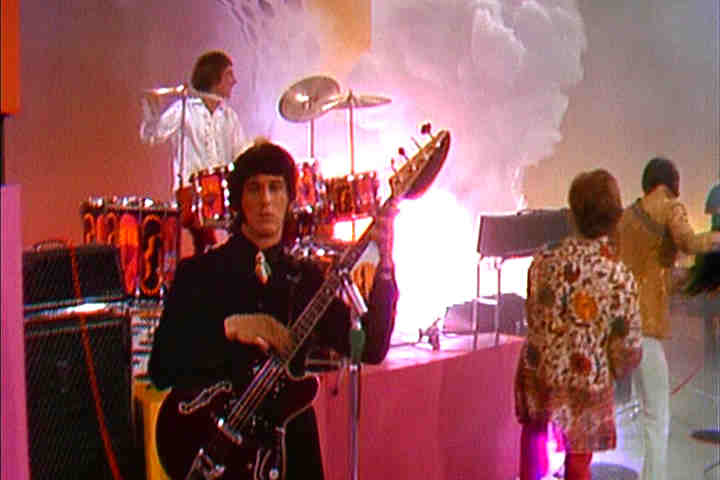
The Who (in 1967) on The Smothers Brothers Comedy Hour
The Who morphed quite a bit in the first five years of their career, but perhaps never more than at the start. They’d be art-rockers with a storytelling bent in 1966, psychedelic conceptualists in 1967, borderline novelty rockers in 1968, before hitting on a little something called Tommy and exploding into new life as a cultural phenomenon.
But nothing that followed for the Who—save their 1970 LP Live at Leeds—would prove as shocking and enthralling as My Generation. Rock was growing in brawn, but here we had the 33 1/3 RPM version of sharks circling in the water, whipping themselves into a feeding frenzy with the incoming chum. The Who of My Generation wasn’t a genial band. They come across as an outfit that will kick down your door, and that’s if you got off easy.
It’s funny, too, to think about My Generation from the viewpoint of a society that demands “comparables”—that which we can say a given work of art or entertainment is like, because heaven forbid anything be unique. My Generation has antecedents, but no precedents, if that makes sense. On display is the latent rhythm and blues power of Bo Diddley, in addition to the in-the-pocket, sweaty groove hustle of James Brown and his Famous Flames. Even the eardrum-bifurcating roar of the Stan Kenton jazz bands and the riff-based physicality of Woody Herman’s Thundering Herds.
But the glue is pure Who, the soul of the endeavor pure Who. This music couldn’t have been made by anyone save these four men in Townshend, vocalist Roger Daltrey, bassist John Entwistle and drummer Keith Moon—whom we must call a drummer but is wholly his own thing.
Produced by Shel Talmy, My Generation consists of two James Brown covers, another from Diddley, an instrumental called “The Ox”—the nickname of Entwistle—credited to the three instrumentalists as well as Nicky Hopkins, who lent support on piano, with the remaining eight numbers authored by Townshend. The tonality is what you could call very analog; enough that some may struggle to listen to the record through headphones. The sound is too granitic, unfiltered. You need some distance, the same as you do from the sun.
As apparently the band’s U.S. label, Decca, believed that Americans did from the non-stop molten rhythm and blues of the British disc. The Who Sing My Generation—a title implying this was no musical gang but rather pop radio friendly choristers—was issued Stateside, with Diddley’s “I’m a Man,” a piece of savagely sincere earnestness, swapped out for the lighter but progressive “Instant Party” as the new closer, rather than “The Ox.”
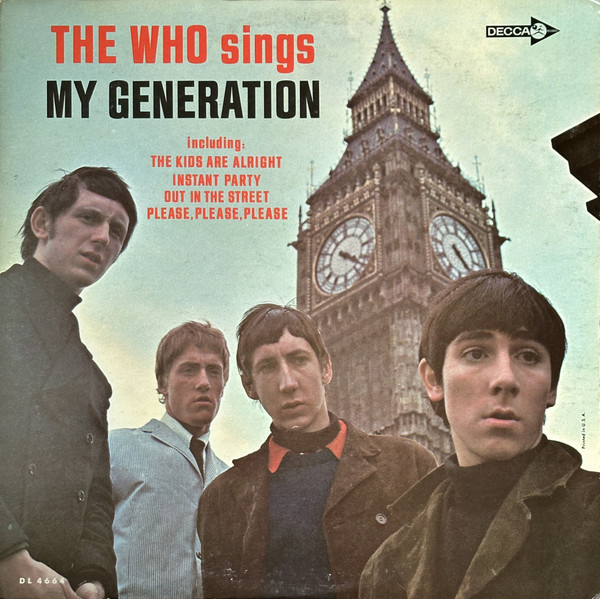
The U.S. album cover.
Daltrey has yet to figure out who he is as a singer at this early date. He tries to sound African-American, such that if you’re a Who neophyte and you listen to Tommy, you may be surprised that this is the same man, but he definitely appears to mean what he says, and his singing has the quality of someone giving vent to their core values.
“The Good’s Gone” numbers among those songs that has a claim for being the first out-and-out instance of heavy metal. It’s a drone, a rhythm and blues raga by way of fried amplifiers begging for mercy. A single hit of it will get you hooked. Instant party? How about instant convert?
The band can sound like the nascent heavy metal version of that piano going down the tall stairs in Laurel and Hardy’s The Music Box, including on the songs that, by comparison with the heaviest fare here, possess finesse, as with “Much Too Much” and “La-La-La-Lies.”
“Out in the Street” is an insane first track for a first album. It possesses the primacy of a field holler, but with the electrical jolt of all the machines of Frankenstein’s laboratory, and a natural echo produced by the sheer volume of the players and Daltrey trying to scream-sing over them. What an opening wallop. And it’s an uptempo shuffle.
Townshend was busy carving out a spot for himself as one of the medium’s eternally most impactful guitarists with a single disc. He doesn’t play lines as much as he builds sonic structures to then knock them down. Think of it as a form of six-string architecture crossed with the nothing-is-meant-to-stand-unchallenged lived-in attitude of the deconstructionist. He’s the only guitarist here, but would he think of himself as playing lead or as someone allocating rhythm? Or maybe we ought to ask: What is lead and what is rhythm? Can a given musical force—especially a force within a force—be both?
Related: 10 great Pete Townshend guitar solos
Entwistle is an entire storm center unto himself, his bass notes suggesting clusters of thunder, but then there is Moon. It’s hard not to ask yourself what possessed him to play as he does. Where did that idea come from? And, having had the idea, what made him say, “Yes, that is definitely how I should do this”? As we listen, we’re cognizant of two certainties: Moon couldn’t have been the drummer for any other band than the Who, and he had to be the Who’s drummer or the Who couldn’t have been themselves.
His drums are akin to our narrator, the guide, the MC. Dante’s Beatrice to take us into the maelstrom. Not just take us in—help us to love what we experience as the detonations jeopardize the safety of our ears.
And yet, despite the you-are-there, seemingly real-time formulation of heavy metal, My Generation is also wise and tender. These were very young men—Moon was a teenager—but you get the sense that they knew about the world. Somehow. Their complexions had yet to clear, but consider the record’s themes—marriage, debt, the law, mid-life crises, the horrible realization that what you have isn’t what you wanted and it could be too late to do anything about it. This isn’t Ray Davies, but these are Davies-esque concerns put over Who-style.
Townshend’s “The Kids Are Alright” could be the London cousin to the Beatles’ “She Loves You”—it’s that mature and, frankly, gracious, and it has a similarly unsurpassable energy. The singer is even okay with other guys dancing with his girl. The Who were dress-up mods rather than real-life mods, and Townshend was closer to the less-than-sure-footed Jimmy of his 1973 mod rock opera, Quadrophenia, than the kids who had no problem stomping skulls on a beach in Brighton.
Still, wisdom is wisdom and “The Kids Are Alright” is a sagacious number. On Tommy, it feels as if Moon’s drums are doing us a kindness, as Thackeray remarked that Dickens had done with A Christmas Carol. The drums make sure we are taken care of on our journey alongside the deaf, dumb, blind boy, and already here on the Who’s first album, they serve a similar function with “The Kids Are Alright.” For the people in your life who want to say John Bonham was the best rock drummer ever to do it, play them this song. Moon’s fills have the buoyancy of the essential spirit of human life. They lift you up as they carry the music forward.
“The Ox,” meanwhile, is an instrumental as chimera: part strafing missile fire, part hulking behemoth fit to accompany Paul Bunyan. A few years later in 1967 the Who would play a version of this song at the Village Theatre in NYC, a tape of which has surfaced. You may not regard it as music as you’ve come to know music, but rather an avant-garde lashing to make strips out of your back as your ears bleed out. It’s awesome.
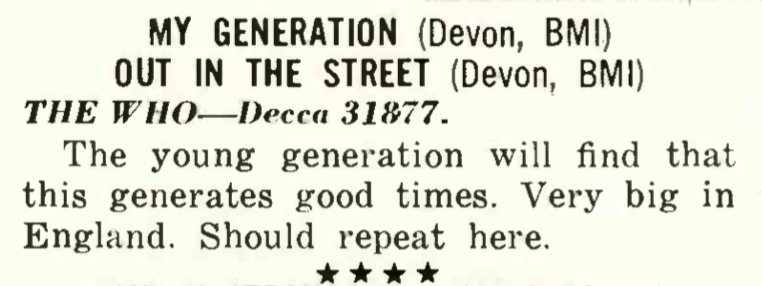
Record World predicted big things for the single.
Obviously, too, there’s the title track. Most of the words expended on “My Generation” extol its anthemic qualities. This is a key rite of passage for Daltrey. He’s in character and was most efficacious when he found a voice to embody with conviction.
Entwistle gives us no less than four bass solos—in a bloody single—but it’s the coda that takes what already felt impermissible for a plethora of reasons and kicks that notion further down the road such that we lose sight of it. Has rock and roll ever come closer to sounding like the Blitz?
The Who weren’t screwing around, nor were they waiting around. They were perfectly willing to be both first and last, if need be, on this debut album of theirs. Had they released nothing else, a rung would have nonetheless belonged solely to them on the evolutionary ladder of popular music. Thankfully, though, they had just started, with My Generation being their initial long-form step. One heavy and powerful enough to send parts of the old road underfoot flying.
Watch The Who perform “My Generation” in 1977
The Who’s recorded legacy is available in the U.S. here and in the U.K. here.
Many of Colin Fleming’s books are available here.



No Comments so far
Jump into a conversationNo Comments Yet!
You can be the one to start a conversation.