
 Telephone calls requested, made and received, missed, misunderstood and unanswered have been the basis for countless hits over the years. “I Just Called To Say I Love You” (Stevie Wonder), “Hello” (Adele), “Operator” (Jim Croce), “Hello It’s Me” (Todd Rundgren), “Memphis, Tennessee” (Chuck Berry, Johnny Rivers), “Telephone Line” (Electric Light Orchestra), “Call Me” (Al Green and Blondie) and “Hanging on the Telephone” (Blondie, again) are just a few that come immediately to mind. Much rarer are the songs that have a phone number for a title. Here are 10 noteworthy examples.
Glenn Miller and His Orchestra—Pennsylvania 6-5000—The charter member of this exclusive subgenre is a big-band hit from 1940 that is essentially an instrumental punctuated by the periodic chant of its title. Written by arranger Jerry Gray, its minimalist lyric by Carl Sigman was based on the phone number of New York City’s Hotel Pennsylvania, where the Miller aggregation frequently played the Cafe Rouge.
The Marvelettes—Beechwood 4-5789—Among the early Motown hits (on its Tamla label) in 1962, recorded by the Detroit company’s first hit group, with lead vocals by Gladys Horton. Written by staff producer Mickey Stevenson, George Gordy and Marvin Gaye, who also plays drums on the track, the song was revived 20 years later by the Carpenters, who had previously scored with their remake of the Marvelettes’ first hit, “Please Mr. Postman.”
Wilson Pickett—634-5789 (Soulsville U.S.A.)—The wicked Mr. Pickett may have misdialed the first digit of the Marvelettes’ hit but he connected with a hit to call his own in 1966 with this one, written by Eddie Floyd and Steve Cropper and produced by Cropper with Stax label head Jim Stewart. The song features an all-star cast in the studio, including the MG’s sans Booker T. but with Isaac Hayes on keyboards, the Memphis Horns with Packy Axton, and Patti LaBelle and the Blue Belles on backing vocals.
Etta James—842-3089 (Call My Name)—As if to answer Wilson Pickett (and in the “midnight hour,” no less), Etta James featured this song on her 1966 album Call My Name, produced by Ralph Bass and Monk Higgins, who wrote it with Maurice Dollison and Billy Foster. Perhaps too raucous and suggestive at the time of its release, it failed to chart as a single.
City Boy—5.7.0.5.—The inability to reach the object of one’s affection by phone inspired this top 10 hit in the U.K. (top 30 in the U.S.) in 1978. An early success for producer Robert John “Mutt” Lange, later renowned for his work with Graham Parker and the Rumour, the Boomtown Rats, AC/DC, Foreigner, Def Leppard, the Cars and Shania Twain. It was written by lead vocalist Lol Mason and percussionist Steve Broughton of the group.
The B-52’s—6060-842—From the band’s 1979 debut album, this was produced by Island Records chief Chris Blackwell and written by band members Fred Schneider, Kate Pearson, Keith Strickland and Ricky Wilson. They may have gotten the exchange wrong but sometimes those numbers written on restroom walls simply go unrequited…
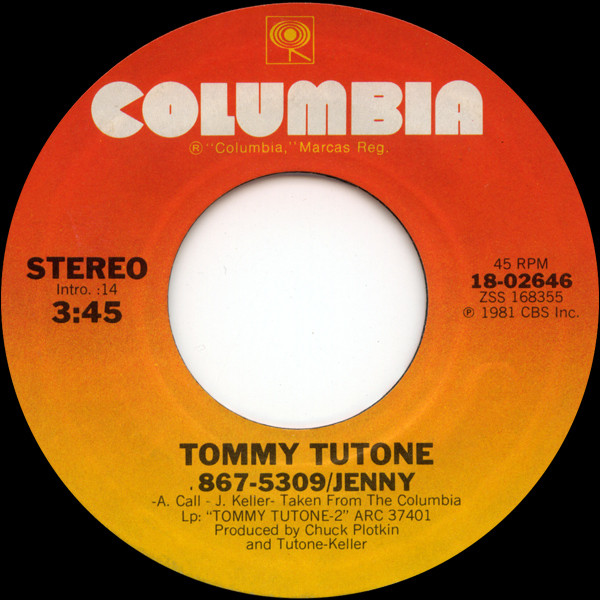
Tommy Tutone—867-5309/Jenny—…and sometimes they don’t, but in this case we’ll never know if Jenny ever calls back. Despite that, this record, written by Alex Call of Clover and the group’s Jim Keller and produced by Chuck Plotkin and Tutone-Keller, became a top 5 pop hit in 1982. The song came from the Bay Area band’s sophomore album Tutone-2.
The Time—777-9311—The telephone call as seductive come-on, this was produced (as the pseudonymous the Starr Company), arranged, composed and played by Prince with the Time’s Morris Day on lead vocals, from the group’s second album What Time Is It? The phone number belonged to Prince guitarist Dez Dickerson, who had to change it when the single became a #2 R&B hit in 1982.
Squeeze—853-5937—The frustration of encountering an unresponsive answering machine is a highlight of the New Wave stalwarts’ second album of their second incarnation, 1987’s Babylon and On. The album’s second single (in the U.S.) was written by band mainstays Chris Difford and Glen Tilbrook and produced by Tilbrook and Eric “ET” Thorngren. Named for Tilbrook’s actual phone number, it became the group’s second-highest-charting single in America, behind only the same album’s “Hourglass.”
Bee Gees—855-7019—A telephone call goes unanswered in this outtake from the Brothers Gibb’s twentieth studio album, Size Isn’t Everything, among the rarest of rarities in their discography, released only as the B-side of the single “How to Fall in Love, Part 1” in 1993. The track was produced by Barry and Robin Gibb and written by Barry, Robin and Maurice Gibb.
Related: Sometimes a telephone call could mean life or death




5 Comments so far
Jump into a conversationIsaac Hayes: Good Love 6-9969 (1971)
As far as songs about telephone calls go, here’s a few more:
Rikki Don’t Lose That Number (Steely Dan)
Sylvia’s Mother (Dr. Hook)
It Must Be Him (Vikki Carr)
I’ve Got to Get a Message to You (Bee Gees)
Don’t Hang Up (The Orlons)
Don’t Hang Up (10cc)
… and these are just the ones that come to my mind …
Ry Cooder 634-5789
We went with the Wilson Pickett original, although Ry is no slouch.
And all these numbers put through by Switchboard Susan from later period The Searchers.