
Before They Were Stars: Rock Greats’ Early Records
by Gene Sculatti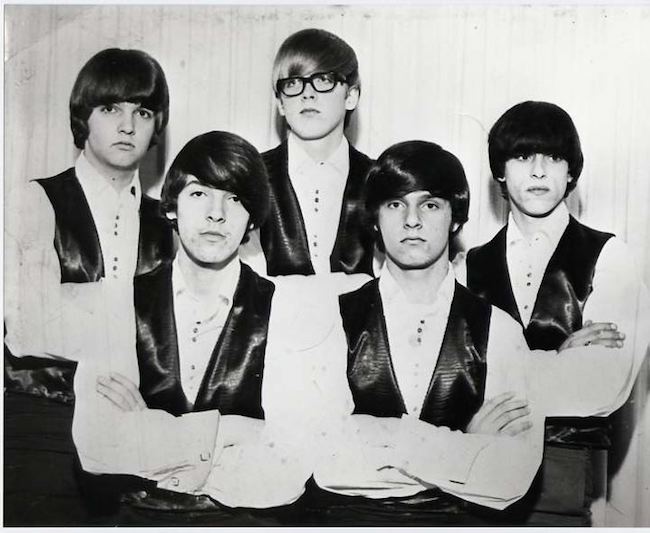
Bruce Springsteen (2nd from left) and the Castiles (scroll down to hear their 1966 track, “Baby I”)
In the first part of our series, we exposed the early, lesser-known records of many rock stars, including Stephen Stills, members of the Eagles, and more. It’s a deep well, which made follow-up installments of the investigation seem like the natural thing to do.
This article was co-written by Ken Barnes.
EARLY ZEPPELIN FLIGHTS
Jimmy Page, “She Just Satisfies,” 1965
It’s common knowledge that Jimmy Page was a prolific session guitarist before joining the Yardbirds and constructing Led Zeppelin from their ashes. But he was also a veteran of a few other bands (Carter-Lewis and the Southerners and Neil Christian’s Crusaders, for two), and cut a solo single. “She Just Satisfies” adds vocals to a rather blatant appropriation of a riff from the Kinks’ “Revenge,” perhaps just recompense for Page’s anonymous rhythm-guitar contributions to several of the Davies gang’s early classics.
Robert Plant: Listen, “You Better Run,” 1966
Before being conscripted into Zeppelin duty, Plant recorded a couple of orchestral-pop singles that only slightly resemble his later efforts. But before those he sang for a group called Listen, whose energetic cover of a Rascals rocker was deemed commercial enough to gain an American release on Columbia.
John Paul Jones, “Baja,” 1964
Jones, like Page part of London’s session-musician elite before Zepping up in the world, naturally was acquainted with Rolling Stones producer Andrew Loog Oldham, who moonlighted with scads of lavishly orchestrated pop singles (the biggest of which was Marianne Faithfull’s “As Tears Go By”). Oldham decided to use a similarly lush approach on a cover of the Astronauts’ Lee Hazlewood-composed surf instrumental “Baja,” released as Jones’ first single. The B-side was titled “A Foggy Day in Vietnam,” one of the first—if abstract, since it was also an instrumental—references on record to that conflict.
PRE-PURPLE HAZE
Episode Six, “Love, Hate, Revenge,” 1967
Deep Purple was what would now be called a supergroup, of sorts, assembled from veterans of several British beat combos. After Jon Lord and Ritchie Blackmore deemed Purple’s first incarnation (the ones who hit with “Hush”) inadequate, they drafted bassist Roger Glover and singer Ian Gillan from the long-lived band Episode Six. The Eps were a versatile pop band, covering hard rock and soul tunes live but dabbling in harmony pop, classical-rock fusion, psychedelia and even hot-rod numbers (a rare British entry in this genre, “Mighty Morris Ten”). “Love, Hate, Revenge,” a thoroughly psychedelicized cover of an obscure tune by former Dion back-up vocalists the Del Satins, is one of Episode Six’s best.
RONNIE JAMES DIO, “Gonna Make It Alone,” 1963
As a kid in Upstate New York in the late ’50s, the young metallurgist wasn’t throwing horns. He was digging the hefty opera chops of Mario Lanza and, soon after, fronting local rock bands Ronnie and the Rumblers, and Ronnie Dio and the Prophets. Whether inspired by the similarity of their names or merely good taste in song selection, Dio did an exceptional job covering “Gonna Make It Alone,” from Dion’s Ruby Baby album.
BACKDOOR MANZAREK
Ray Manzarek, “Geraldine” (with Rick and the Ravens), 1965
While drummer John Densmore and guitarist Robbie Krieger also logged time in local Southern California bands, Ray Manzarek is the only Doors member to have left a literal record (three, to be exact) of his pre-breakthrough musical activity. UCLA film student by day, rocker by night, Manzarek played piano and, along with his brothers Jim and Rick, backed vocalist “Screaming Ray Daniels” in this accomplished bar band. Its future evaporated once Manzarek met Densmore and Krieger at a meditation class and told them about a poet pal of his who wanted to start a new group.
JOE COCKER, “I’ll Cry Instead,” 1964
They weren’t friends yet, but Joe Cocker did get a little help from Lennon and McCartney at the start of his recording career. The team supplied the material for his first single, a rather more rockabilly-ish cover of “I’ll Cry Instead,” produced by Mike Leander, who would go on to contribute string arrangements to the Beatles’ “She’s Leaving Home” and the Stones’ “As Tears Go By.”
BRUCE SPRINGSTEEN: Castiles, “Baby I,” 1966
Springsteen’s previously unreleased initial foray into recording recently hit the mainstream with its release on the career-spanning Chapter and Verse anthology, which accompanied the artist’s autobiography. As 1966 garage-rockers go, it’s no “Psychotic Reaction” or “Talk Talk,” but it’s a tantalizing hint of glory days to come. For those seeking to delve deeper, there’s a bootleg collection of live Castiles performances, many of which can be found online.
CAROLE KING, “Oh! Neil,” 1960
As the subject of one of Neil Sedaka’s first hits (“Oh! Carol,” 1959), it was only fair that Carole King reciprocate—in a clever parody that cast the Brooklyn teenager as a backwoods gal with a crush on the pop star. Her tongue is firmly in her cheek, as evidenced by the couplet “I’d give up a month of chewin’ tobacky/Just to be known as Mrs. Neil Sedaky.”
RANDY NEWMAN, “Golden Gridiron Boy,” 1962
At first reluctant to sing his own songs, Randy Newman initially made a name for himself penning the B-sides of hit singles by soul giant Jerry Butler and pop trio the Fleetwoods. Part of his aversion to performing his own material may have been his failure to push his debut 45 (produced by Pat Boone and featuring Glen Campbell on guitar) over the goal line.
DUBIOUS ORIGINS
Michael McDonald, “God Knows,” 1971
The voice of the Doobie Bros. from 1975 onward, McDonald started his career in St. Louis, playing with local bands including the Guild, who made a record or two after he decamped for Hollywood fame and glory. These goals took a while to achieve, starting with the above RCA single—something of a latter-day favorite among U.K. soul enthusiasts—a couple more on Bell, and a stint singing backgrounds for Steely Dan before his joint pact to take over Doobies lead vocals from co-founder Tom Johnston.
Tom Johnston: The Implicits, “Give Me Justice,” 1964
Johnston had been lead singer for the intriguingly monickered Implicits, the pride of Visalia, in California’s arid Central Valley. They cut the rough-edged “Justice,” and the early garage-rocker was even picked up for national distribution by A&M subsidiary Almo International. Johnston went on to ride the Doobies’ long train from biker bars in the Santa Cruz Mountains to princes of yacht rock, disembarking in 1978.
LOGGINS & MESSINA
Second Helping, “Floating Downstream on an Inflatable Rubber Raft,” 1967
Before sailing off to yacht-rock paradise in the ’70s, Kenny Loggins and Jim Messina served unusually varied musical apprenticeships. Loggins was a touring member of the Electric Prunes and part of a group called Gator Creek (whose single was the first version of “Danny’s Song”). But before that he dived into the psychedelic rapids with this enjoyable single, written by Loggins with a less-than-sure grasp of what works as a radio hit title.
Jesters, “Panther Pounce,” 1964
Messina, meanwhile, was best known for stints in Buffalo Springfield and Poco, but he got his start cranking out surf instrumentals such as this one, which bears an eerie resemblance to the Marketts’ hit version of the theme song from TV series The Twilight Zone.




4 Comments so far
Jump into a conversationThe last song, Panther Pounce, I am sure you meant to reference “The Twilight Zone” rather than “The Outer Limits”. We control the horizontal. We control the vertical.
No, at least per The Marketts’ version, it was the tune they called “Out of Limits.” The OOL four-note motif was a permutation of the Twilight Zone four-note motif, with the last note moved to the beginning. It’s all about where the downbeat happens.
But you may be right that the Marketts theme was not actually used on the “Outer Limits” TV show itself. It is just an alteration of the Twilight Zone theme.
You wrote about Rick and the Ravens that Ray Manzarek ‘played piano and, along with his brothers Jim and Rick, backed vocalist “Screaming Ray Daniels”.’ According to Wikipedia, Ray joined his brothers on vocals and occasional piano. So he wasn’t “backing” the vocalist named Ray; he was the vocalist.