
A Rare 1974 Interview with Freddie Mercury (+ Deluxe ‘Queen II’ Set Arrives)
by Harvey Kubernik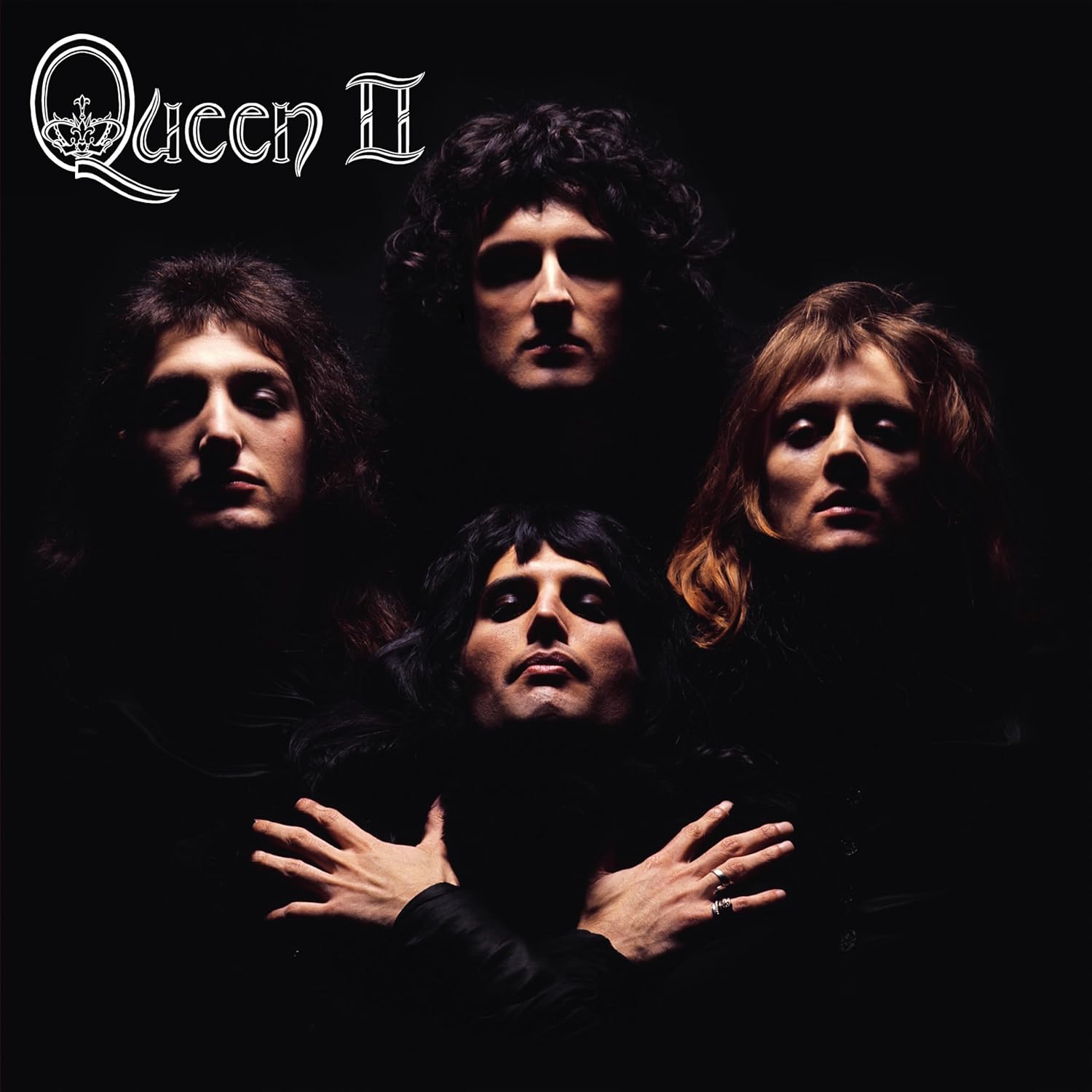 More than half a century after its original 1974 release, Queen’s second album, Queen II, has been remixed, remastered and expanded for a lavish 2026 boxed set.
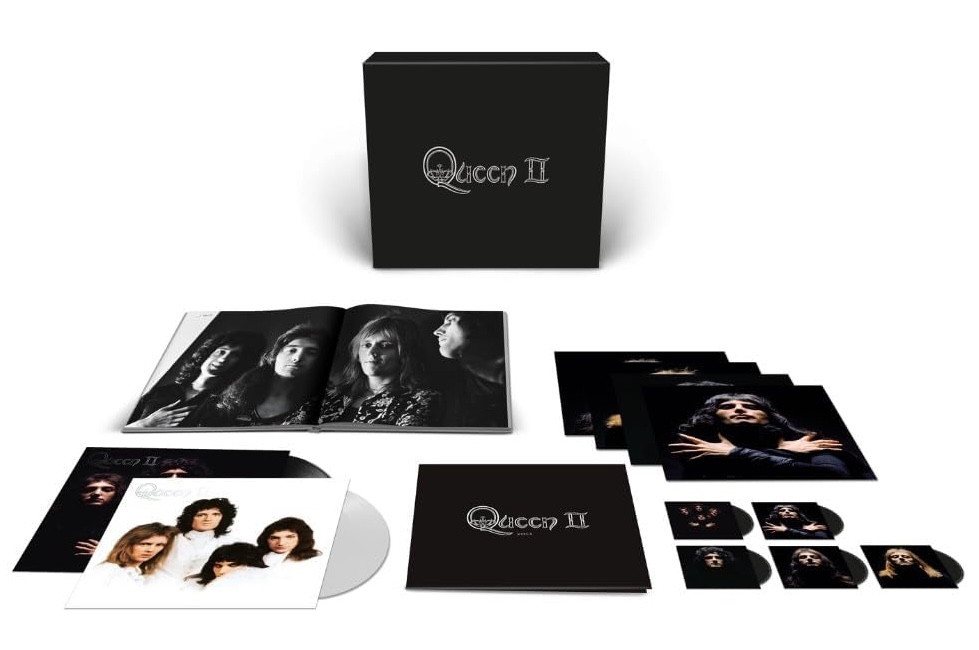
Arguably the heaviest Queen album, Queen II was widely heralded as the band’s first true masterpiece. With band members Brian May and Roger Taylor as executive producers, the 5-CD/2-LP Queen II Collector’s Edition box, released on March 27, features the 2026 mix of the album, plus intimate fly-on-the-wall audio of Queen in the recording studio, previously unheard outtakes and demos, live tracks and radio sessions. See the complete track list below. [It’s available in the U.S. here, in Canada here and in the U.K. here.]
It’s also available as a 2-CD Deluxe Edition, vinyl LP, vinyl picture disc LP, and in 1-CD and cassette formats, all featuring the new mix. Many of the configurations are available in the U.S. here, in Canada here and in the U.K. here.
“Queen II was the single biggest leap we ever made,” says guitarist Brian May. “That’s when we really started making music the way we wanted to, rather than the way we were being pushed into recording it.”
“With Queen II, I couldn’t believe how much work we put into it,” adds Roger Taylor. “I think we felt we were evolving our own sound. We were pioneering the multitracking thing. It gave you a tremendous pallet, massive choral effects with just three of us singing.”
The task of remixing Queen II for this new edition fell to Justin Shirley-Smith, Joshua J. Macrae and Kris Fredriksson, who worked on the reissue of the self-titled debut as well as several other past releases from the band.
“I wanted to give it everything—to be self-indulgent,” said Freddie Mercury at the time of the album’s initial release. “But the whole band doesn’t go in for half-measures and I’m pretty hard with myself. There are no compromises.”
***
I interviewed Freddie Mercury twice: once in Beverly Hills in 1974 for the now defunct U.K. music periodical Melody Maker, and subsequently in the summer of 1975 in his publicist’s office in the UK. The first time, Mercury waltzed into the room, stuck out his hands and greeted fellow journalist Justin Pierce and me with, “Hello, darlings. What do you think of my black fingernail polish?”
I quickly replied to him, “Freddie, I grew up in Hollywood. I know what kind of fingernail polish real queens wear.”
Mercury immediately poured a glass of champagne and requested “to please put the tape machine on.” He thoroughly enjoyed trumpeting Queen and discussing the machinations of their mid-’70s career. But we must have spent the first 10 minutes just talking about Liza Minnelli and Judy Garland.
Mercury had an air of confidence and mega-stardom destiny about him. He had a keen sense of the pop music process and being a star on and off the stage. Mercury reflected on Queen’s latest tour of the States, in support of the band’s third album, Sheer Heart Attack.
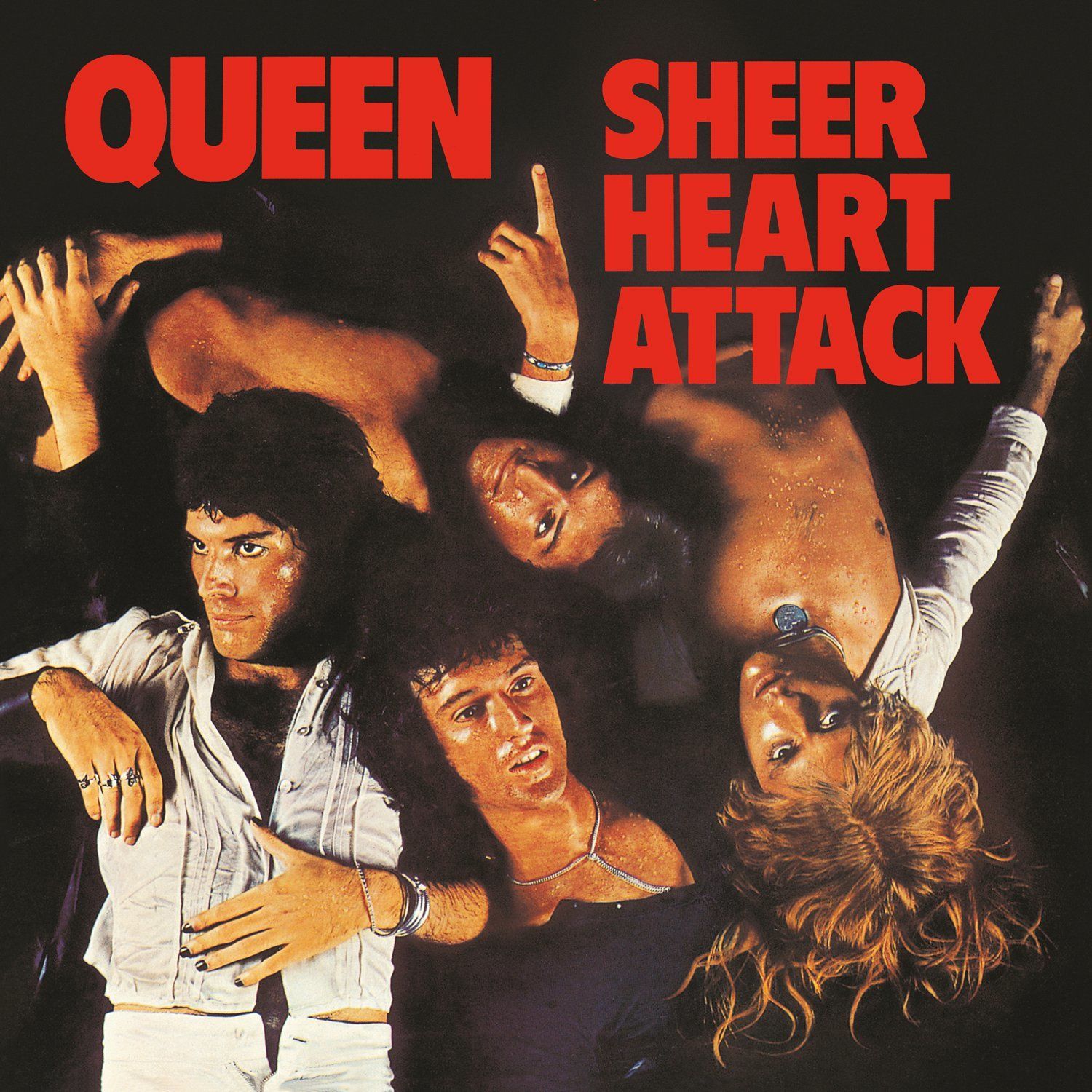
Queen’s 3rd album, 1974’s Sheer Heart Attack
Related: Our Album Rewind of Sheer Heart Attack
“The tour has been going just great,” he said. “The only drawback has been the problems with my voice, which I’ve been overtaxing. But since I’ve been taking care of it and resting more, it’s been fine. The problem is that when you do a tour, you try to schedule the concerts as close as possible. Therefore, it’s like a constant workout. However, at this moment it’s raring to go and at the conclusion of this tour, we’re going to take a rest in Hawaii, which we really deserve. From there it’ll be on to Japan and Australia.”
What did Mercury see as being the key to their phenomenal following? “I can’t pinpoint it, but there’s something about our music that’s different and unlike anybody else’s,” he said. “I believe that’s our major strong point. But there’s other ingredients. Besides the fact that our timing has helped, there is the fact that we take risks. We’re not one of those groups that go through every stage, for we skipped a few hurdles and we’re willing to take the chances that brought us to our level of acceptance.
“This American tour is a perfect example,” he continued. “To undertake this kind of massive tour is not unheard of, but it is a risk. People were constantly telling us about the American economy and how the biggest groups are having trouble filling venues. And for us to come on as strong as we are, headlining after only half a previous tour, shows how confident we are, or what you can put across unless you were a headliner. And now we’ve proved we can do it. Here we are, the first time in L.A. and we’ve sold out two shows, and it’s simply an amazing feeling.”
Queen had only recently broken into the American record charts with “Killer Queen,” a track from Sheer Heart Attack; the single peaked at #12. The gentleness and buoyancy of the tune is in marked contrast to the high level of energy that characterized their first two albums. It was only on the third album that the diversity really became apparent. However, Mercury didn’t look at it as a great change: “The thing I hate is trying to pinpoint everything for everybody,” he said. “People always ask questions like, ‘Why did you write such and such a lyric and what does it mean?’ That’s now what it’s all about. The one thing the British press has been trying to do for years is to categorize. It really annoys us.
“We came out with ‘Keep Yourself Alive’ [1973] as a single, which is raunchy, and then we decided on ‘Killer Queen’ for a latter release. The first thing they do is ask, ‘What are you up to?’ This is our music and it’s up to the individual to interpret it. It’s not up to us to come out with a product and label it. It would be boring if everything was laid out and everybody knew what it was all about all the time. I like people to make up their interpretation.
“They also want to categorize stage image,” he continued. “I remember an interview where I said, ‘I play on the bisexual thing.’ Of course I play on it. It’s simply a matter of wherever my mood takes me. If people want to know and ask me if I’m gay, I tell them it’s up to themselves to find out. I’m just being my flamboyant self and having a good time.”
Even though Mercury preferred not to analyze Queen’s music, he discussed their cumulative work in a logical manner: The first LP, he said, was very raw and full of freshness.
“It was simply a reflection of what we’d been doing for so long and we just wanted to get it out of our system. On the second album we found out that even though we had a formula we didn’t necessarily have to keep it. Therefore, we dabbled at other things. Sheer Heart Attack was something different again. We wanted to make it interesting for ourselves as well as the listener. Hopefully, we succeeded on both counts. When we’re on stage we try to do the same thing. We’re perfectionists. Although all of us write, it doesn’t necessarily mean that every song composed will appear on an album.
“Having all the members write adds to our versatility, and that’s another strong point,” he said. “On the last album we wanted to create a certain feel, and did. However, there were so many ideas and things that we wanted to do and have yet to carry out. You simply can’t do everything on one album. Lots of groups eventually burn themselves out due to lack of new ideas. But at this point, there’s no way we’re going to burn out. In fact, presently we’re stronger than ever.
“We do rock ’n’ roll, and our presentation is just a way of putting across the music. We view albums and concerts as two spheres of work. There’s a different level in the studio as compared to when you’re on stage. But when we’re before an audience, we let loose.”
I asked Mercury how he felt the English music market differed from the American.
“Even though singles may have been more important at one time in Britain, I feel that the stress on the singles and the albums is becoming pretty even,” he said. “If you play too much on singles you can quite easily become a singles group. At that point it’s almost impossible to revert back to albums. I feel we’re in a fortunate position for we’ve only released four singles, including our new one. Therefore, we’ve achieved a balance. I think the same thing is true in America, though we’ve had to rely on response to our albums to carry us through. It wasn’t really till ‘Killer Queen’ that we received mass exposure on a commercial level.
“Back home, you have to be very careful of what you say or do because you’re in a position of immense responsibility. In fact, it can sometimes get ridiculous,” he continued. “We have this black-and-white theme that we carry out in England and it’s very strong. It has even got to the point where the audiences dress and look like me to a t. They’re very faithful and it’s beautiful. On this tour, in Dallas, there was even a fan dressed with black makeup on one side of his face and white on the other, and it was marvelous.”
As for his own musical taste, Mercury said, “I listen to all kinds of music from Hendrix to Liza Minnelli, all the way back to Mae West. I also enjoy Flo and Eddie [of the Turtles and the Mothers] when I hear them on the radio. They’re simply a riot. I also enjoy Joni Mitchell tremendously, and am constantly awed by her vocal phrasing as well as the amazing things she writes. She’s simply beautiful.”
After Justin Pierce and I interviewed Mercury, I mentioned I was planning a summer 1975 trip to London. Mercury quicky suggested, “If you come to London do call my publicist. We must do this again!” And we did, but on my ’75 visit, Freddie was wearing green fingernail polish.
Watch a 1977 live performance of “Killer Queen”
Author Harvey Kubernik’s 21st book, Screen Gems: Pop Music Documentaries & Rock and Roll TV Scenes, published in Feb. 2026 by BearManor Media, dives deep into 24 noteworthy productions. The book is available in the U.S. here, in Canada here and in the U.K. here.
The Queen II Collector’s Edition also comes with a 112-page book featuring previously unseen photographs, handwritten lyrics, diary entries and special memorabilia, as well as memories of writing and recording the album from the band members. It’s available in the U.S. here, in Canada here and in the U.K. here.
QUEEN II: Collector’s Edition 2026 Mix (5-CD+2-LP)
CD1: Queen II – 2026 Mix
1 Procession
2 Father To Son
3 White Queen (As It Began)
4 Some Day One Day
5 The Loser in the End
6 Ogre Battle
7 The Fairy Feller’s Master-Stroke
8 Nevermore
9 The March of the Black Queen
10 Funny How Love Is
11 Seven Seas Of Rhye
CD2: Queen II – Sessions
1 Procession (Stage Intro Tape – April 1973)
2 Father To Son (Takes 4 & 9 – with Guide Vocal)
3 As It Began (Brian’s Studio Demo – October 1969)
4 Some Day One Day (Take 1 – with Guide Vocals)
5 The Loser In The End (Roger’s First Demo)
6 The Loser In The End (Roger’s Second Demo)
7 Ogre Battle (Takes 2 & 6 – with Guide Vocal)
8 The Fairy Feller’s Master-Stroke (Takes 4 & 9)
9 Nevermore (Take 6)
10 The March Of The Black Queen (First Section Takes 3 & 5)
11 The March Of The Black Queen (Second Section Take 1)
12 Funny How Love Is (Take 4)
13 Seven Seas Of Rhye (Takes 4, 5 & 6)
14 I Do Like To Be Beside The Seaside (Take 4)
15 See What A Fool I’ve Been (B-side Version 2026 Mix)
16 Not For Sale (Polar Bear)
CD3: Queen II – Backing Tracks
1 Procession
2 Father To Son
3 White Queen (As It Began)
4 Some Day One Day
5 The Loser in the End
6 Ogre Battle
7 The Fairy Feller’s Master-Stroke
8 Nevermore
9 The March of the Black Queen
10 Funny How Love Is
11 Seven Seas Of Rhye
CD4: Queen II – At The BBC
1 See What a Fool I’ve Been (BBC Session 2, July 1973 – 2011 Mix)
2 Ogre Battle (BBC Session 3, December 1973)
3 Nevermore (BBC Session 4, April 1974)
4 White Queen (As It Began) (BBC Session 4, April 1974)
5 Procession – Intro Tape (Live at Golders Green Hippodrome, 13th September 1973)
6 Father To Son (Live at Golders Green Hippodrome, 13th September 1973)
7 Son And Daughter (Live at Golders Green Hippodrome, 13th September 1973)
8 Guitar Solo (Live at Golders Green Hippodrome, 13th September 1973)
9 Son And Daughter – Reprise (Live at Golders Green Hippodrome, 13th September 1973)
10 Ogre Battle (Live at Golders Green Hippodrome, 13th September 1973)
11 Liar (Live at Golders Green Hippodrome, 13th September 1973)
12 Jailhouse Rock (Live at Golders Green Hippodrome, 13th September 1973)
CD5: Queen II – Live
1 Procession – Intro Tape (Live at the Rainbow, March 1974)
2 Father To Son (Live at the Rainbow, March 1974)
3 Ogre Battle (Live at the Rainbow, March 1974)
4 White Queen (As It Began) (Live at the Hammersmith Odeon, December 1975)
5 The March Of The Black Queen (Live at the Rainbow, March 1974)
6 The Fairy Feller’s Master-Stroke (Live at the Rainbow, March 1974)
7 Seven Seas Of Rhye (Live at the Rainbow, March 1974)
8 See What A Fool I’ve Been (Live at the Rainbow, March 1974)
LP1: Queen II – 2026 Mix (Side White)
1 Procession
2 Father To Son
3 White Queen (As It Began)
4 Some Day One Day
5 The Loser in the End
LP2: Queen II – 2026 Mix (Side Black)
1 Ogre Battle
2 The Fairy Feller’s Master-Stroke
3 Nevermore
4 The March of the Black Queen
5 Funny How Love Is
6 Seven Seas Of Rhye


No Comments so far
Jump into a conversationNo Comments Yet!
You can be the one to start a conversation.