
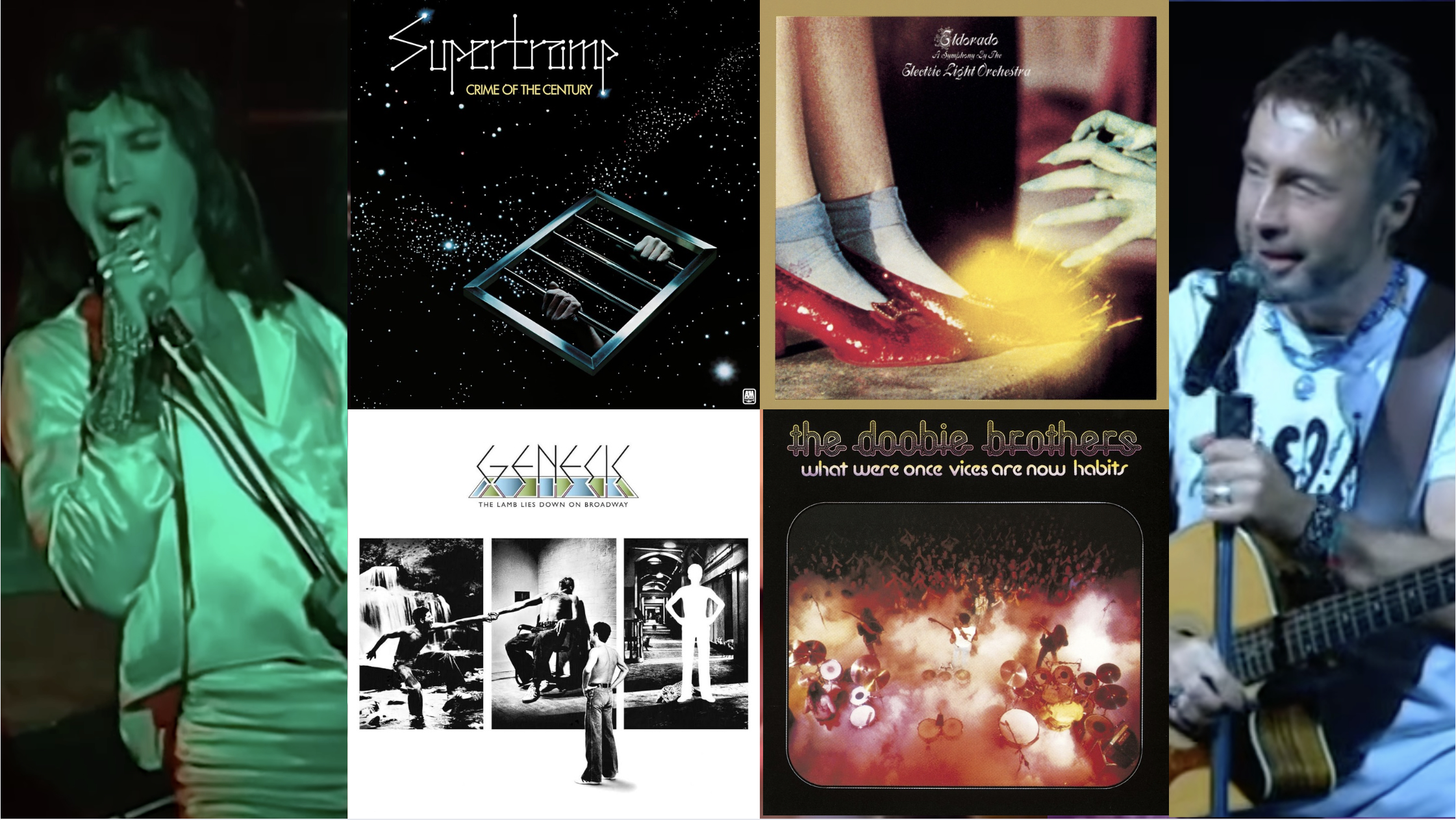
Queen’s Freddie Mercury and Bad Company’s Paul Rodgers flank some of the albums whose songs appear in our feature.
Some of the greatest musical “surprises” are the ones you stumble upon. With so much great music being released during the ’70s, some of the best moments aren‘t instantly apparent; sometimes you just grow into them as deep cuts on an album filled with hits.
Looking back at a year like 1974, it would be easy to focus on the major hits, the singles that charted in the Top 40, the albums that topped the chart, the songs you still hear on the radio—or in the supermarket—more than half a century later. Yet the appeal of a year such as 1974 lies in what is found just slightly off-center. These are the songs that gave depth, surprise and personality to their respective albums, those that kept surprising you upon every rotation. As it was with our 1972 revisited listicle, sometimes they were simply “hiding in plain sight,” alongside the chart-toppers.
“Flick of the Wrist”—Queen
This great song was released as a double A-sided single with “Killer Queen” in October 1974, in advance of the band’s Sheer Heart Attack that November. There is a sharper edge to it, with Freddie Mercury‘s repressed power held back and constrained, serving as the perfect counterpart to the more refined tone of the flip side. The band was becoming tighter, and beginning to come into its own as a significant force.
“Bloody Well Right”—Supertramp
Originally a B-side that first appeared with the “Dreamer” single from Crime of the Century (October 1974), “Bloody Well Right” did eventually find its way onto American radio and reached #35 on the Billboard Hot 100 in the first weeks of 1975. Rick Davies, who co-wrote the song with Roger Hodgson, provides the vocal to a song that only improves with repeated listening. That’s also Davies on the Wurlitzer electronic piano that kicks off the song.
“Seagull”—Bad Company
After a series of swaggering rockers like “Can’t Get Enough” and “Bad Company,” from their debut release (May 1974), the LP closes out with this acoustic number. Stripped to vocals and a guitar, “Seagull” highlights Paul Rodgers’ ability to own the song, and its simple, straightforward structure is what makes it lasting.
“Back in N.Y.C.”—Genesis
Leading off side two of the sprawling two-LP set, The Lamb Lies Down on Broadway, this song punches through the dense narrative of the album with energy. Peter Gabriel sings in a no-nonsense style, and the accompaniment is taut and dynamic, marking one of the most distinctive songs on a high-concept record that features such better known numbers as “In the Cage” and “The Carpet Crawlers.”
“Fallen Angel”—King Crimson
Red arrived in shops in October 1974 and is bookended by the title track and “Starless,” two of the defining reasons for the album‘s reputation as the giant it is. Between those two hulks lies “Fallen Angel,” a track that introduces melody and sadness into the mix without lessening the power. John Wetton‘s vocal here is a revelation and the lyrics about a stabbing death of a younger brother give the album one of its most human moments.
“Day of the Eagle”—Robin Trower
The intro of the lead-off track from Bridge of Sighs sets a tone of contemplation from the very first chord. Trower‘s guitar lines crawl up the scale and linger in the air, creating a mood instead of rushing to a resolution. Given how the title song turned out to be the gateway and trademark of the album as a whole, this opening song might not always come first to mind.
“Motherless Children”—Eric Clapton
461 Ocean Boulevard was EC’s big, blues-heavy comeback following his heroin addiction, and it opens with this soulful interpretation of a classic. Producer Tom Dowd signals the pace from the get-go: loose, funky, warm and grounded in groove. Though “I Shot the Sheriff,” the album‘s surprise #1 pop hit, paved the way for the LP’s commercial success in the U.S., this blistering lead-off track was a great way to re-introduce the star to rock radio audiences.
“Mister Kingdom”—Electric Light Orchestra
Jeff Lynne constructed a whole narrative around Eldorado, which arrived stateside in September 1974. The album’s hit single, “Can‘t Get It Out of My Head,” was their U.S. breakthrough, reaching #9 on the Hot 100. But “Mister Kingdom,” which leads off side two, lives near the LP’s heart. It unfolds grandly, strings and piano gently moving the music like someone speaking to you in a slightly elevated, yet hushed tone. The symphonic piece has often resided with ELO fans who enjoy deep tracks.
“Another Park, Another Sunday”—The Doobie Brothers
The lead single from the band’s fourth album, What Were Once Vices Are Now Habits, peaked at just #32 on the Hot 100, losing much of the momentum that they had gained from a pair of top 15 hits from its predecessor, The Captain and Me. This gorgeous tune with rich stacked vocals is a change of pace from those rockers (“Long Train Runnin'” and “China Grove”). And it turns out their label, Warner Bros., didn’t initially recognize the big hit that was staring right at them: “Black Water,” originally the B-side to “Another Park…,” was eventually released as a single and became the Doobies’ first #1 hit.
“Jazzman”—Carole King
Ask anyone to mention a Carole King song and they’re likely to offer any number of tracks from her 1971 masterpiece, Tapestry. So it’s easy to overlook this gem from her Wrap Around Joy album, despite that it reached #2 on the Billboard Hot 100, making it her second biggest single. King‘s great vocals aside, the song is most famous for its long saxophone solos, played by Tom Scott.
“If You Can‘t Rock Me”—The Rolling Stones
When the It‘s Only Rock ‘n Roll album was released, the title song and “Ain‘t Too Proud to Beg” became the public-facing work as hit singles. But your first sonic hit when you spin the album sets the tone for the rest of the disc. With the rhythm section of Charlie Watts and Bill Wyman locking in a groove, this tune kicks the LP off the right way. Dynamite.
“Sound Chaser”—Yes
By the time Relayer arrived, Yes had recruited keyboardist Patrick Moraz to replace Rick Wakeman and seemed reborn as a result. “Sound Chaser” is that energy at full speed, transforming intricate parts including their newest member’s song intro. A sign of change to come, the song‘s structure constantly drives forward and pulls tighter, and feels like a band fully dialed into their playing.



No Comments so far
Jump into a conversationNo Comments Yet!
You can be the one to start a conversation.