
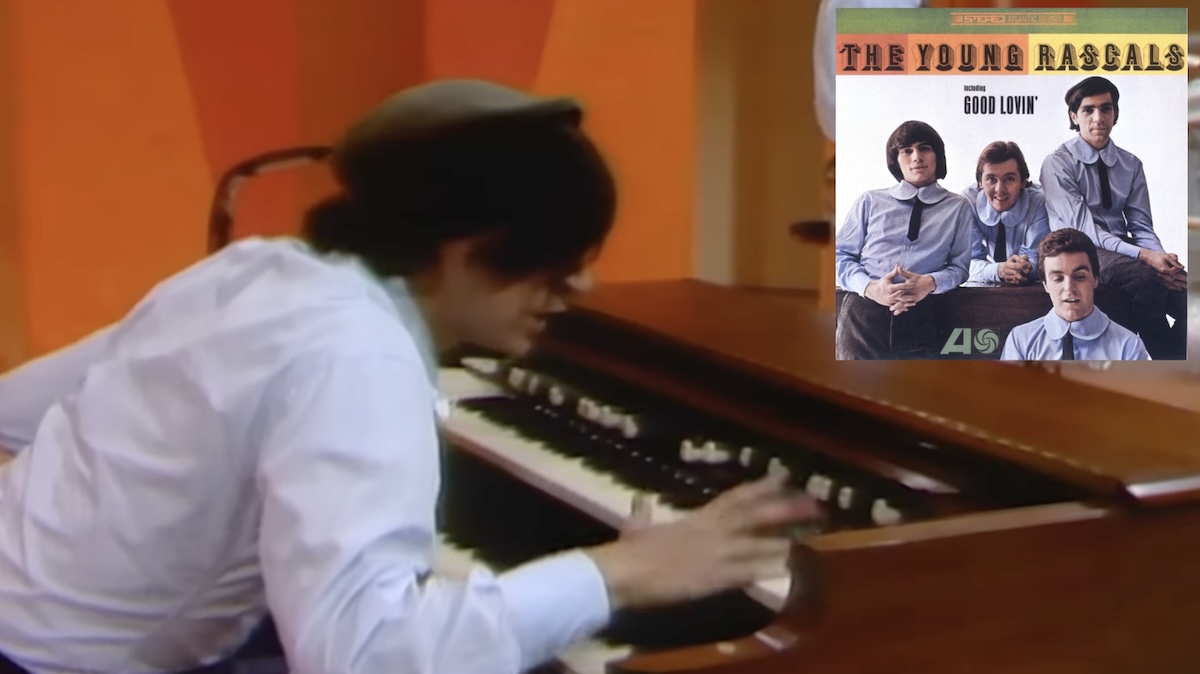
Felix Cavaliere, performing “Good Lovin'” with The Young Rascals, on The Ed Sullivan Show.
Not long after we published the listicle “13 Top Rock Organists (& Their Most Killer Tracks)” in 2016, we’ve been meaning to do a follow-up. Well, it’s finally here, even if it took us a decade to do so! (By the way, that first edition included such legends as Billy Preston, Keith Emerson, Garth Hudson, Ray Manzarek and Booker T. Jones.)
While the guitars still own the marquee, many would argue that when the Hammond B-3 kicks into action, the room stops to hold its breath. Through the latter half of the ’60s and all of the ’70s, the organ was the soul of the rock world. One minute it was a spiritual revelation, the next a raucous, late night jam session. And these 10 artists created excellence in the studio and helped give their bands a sonic identity on stage.
Gregg Rolie (Santana)—“Black Magic Woman”
With Santana making it big after playing the 1969 Woodstock festival, Rolie‘s heavenly Hammond was as awesome as Carlos’ guitar playing. “Black Magic Woman” reached #4 in 1970 and it became the best of both worlds, mixing the blues and Latin flavor. Rolie’s melodic content was underscored by a dense drone, the source of most of the song‘s hazy vibe. He bounced between keys and his own voice, grounding the mayhem of the drums with ecclesiastical harmonies.
Danny Federici (Bruce Springsteen and the E Street Band)—”Born to Run”
His glockenspiel and organ on this 1975 classic lent the song an epic, movie trailer feel and sent Springsteen on his way to stardom. Federici, who died in 2008, had a real sense of atmosphere, and his live performances with the E Street Band would offer flight altitude underneath the Boss’ stories.
Billy Powell (Lynyrd Skynyrd)—“Free Bird”
Though “Free Bird” opens with a piano intro, it‘s Powell‘s organ that elevates this anthem into the stratosphere. Released by Skynyrd in 1973, it quickly became their signature song to close their concerts, Southern rock and roll infused with gospel overtones. Powell’s organ layers, combined with the twin guitar harmonies during the long slow builds in the body of the song, give the groove the body and shimmer that lifts the track from ballad to rocker.
Mark Stein (Vanilla Fudge)—“You Keep Me Hangin’ On”
In 1967, the Fudge turned a Motown classic into solemn, booming majesty when their take on “You Keep Me Hangin’ On” hit #6 on the Hot 100 thanks to Stein‘s epic Hammond organ. With his fiery entrances, sweeping glissandi and grandiloquent freezes, Stein is a bombastic, visually minded keyboardist, helping to pave the way for the progressive rock and heavy rock keyboardists to come.
Richard Wright (Pink Floyd)—“Set the Controls for the Heart of the Sun”
In the days before they became a behemoth, Wright was a master of the band‘s soundscape. On the 1968 album, A Saucerful of Secrets, he wielded his Farfisa keyboard to give this track its cosmic propulsion. Sustained chords rose slowly to the fore over a hypnotic rhythm section, giving the track an immense, otherworldly power. Wright‘s melodic gifts came to the fore on “Remember a Day,” which he wrote for the album, providing lead vocals and sparkling keyboard lines. His skills brought depth and atmosphere to Pink Floyd, creating the sonic tapestry on their journey from underground ravers to prog rock legends.
Goldy McJohn (Steppenwolf)—”Born to Be Wild”
Some might say no song sums up ‘60s rebellion as well as this classic. The 1968 track became the band’s first hit, peaking at #2 on the Hot 100, and became a pop fixture thanks to the counterculture film Easy Rider. McJohn‘s organ churned beneath the haze, forming a very visceral, engine-like rumble. Coupled with John Kay’s gritty vocals and the band‘s driving energy, it made the song an essential track to head out on the highway.
Benmont Tench (Tom Petty and the Heartbreakers)—“American Girl”
Though the 1976 song eventually became one of the most enduring and iconic songs in American rock, it never charted when it was released as a single in 1977. Tench’s organ and piano outlined the melody to support, rather than confront, Petty‘s masterful storytelling. But on the band’s expert live shows, the star generously gave his keyboardist time to shine.
Brian Auger (Brian Auger and the Trinity)—“This Wheel‘s on Fire”
In contrast, Auger combined the polish of jazz with the rough power of rock and roll. In 1968, he teamed up with Julie Driscoll to record a cover of The Band’s “This Wheel‘s on Fire.” The song developed a cult following and became a psychedelic favorite and a top 5 U.K. hit. For Auger, the Hammond was a jazz instrument in a rock setting. That improvisation he originated in his phrasing gave the organ‘s voice new flexibility, bringing groove and taste to the mix and ushering in the progressive revolution.
Lee Michaels—“Do You Know What I Mean”
The Californian brought Hammond out of the background for the 1971 single “Do You Know What I Mean,” which reached #6 thanks to Michaels’ tour de force organ performance. Michaels collaborated with the drummer known as “Frosty,” performing as a duo, while proving that a keyboardist could front a successful band without a “guitar hero” figure.
Felix Cavaliere (The Rascals)—“Good Lovin’”
With a hook to end all hooks and the confident swagger of his B-3, the Rascals’ classic piece of blue-eyed soul had arrived on the AM airwaves in 1966, with their first of three #1 singles. Cavaliere‘s sharp staccato bursts, the loping glissandos and the sharp attack of his organ playing gave rock, roll and pop airwaves a potent, new American voice. [The Rascals: It’s Wonderful: The Complete Atlantic Studio Recordings is available in the U.S. here and in the U.K. here.]
Did you miss Part 1? It’s here.


15 Comments so far
Jump into a conversationDoug Ingle, Iron Butterfly “In-A-Gadda-Da-Vida” (1968)
You forgot about STEVE WINWOOD
Not only that, but you forgot about the iconic organ solo from Procol Harum, Whiter Shade of Pale.
Apparently, Gregg Allman was forgotten as well. But I’m thrilled to see my personal favorite, the late, great Billy Powell included!
Rod Argent’s keyboard in “Hold Your Head Up” at least deserves honorable mention. His work in The Zombies is incredible too.
Readers Randy and Brit… Both Rod Argent and Steve Winwood are in Part 1, linked in this article and again here.
You missed Tony Banks from Genesis. There are so many songs especially from the Peter Gabriel era.
You might want to mention ? and the Mysterians’ “96 Tears”
Fun list but when talking about keyboard greatness you cannot overlook Tony Banks from Genesis (intro to Firth of Fifth as an example) and the master that is Keith Emerson. But these things are truly subjective.
Emerson is in the first part.
How about Jon Lord? Many songs to choose from but I’d go with Lazy from Machine Head.
Jack and Suzy… Both Jon Lord and Gregg Allman are included in Part 1, which is linked in this article, as well as here.
Bill Payne of Little Feat. Take a listen and be rewarded
Both Jon Lord and Keith Emerson in your first list have cited Mark Stein as an inspiration.
ALAN PRICE House of the Rising Sun and he also arranged it