
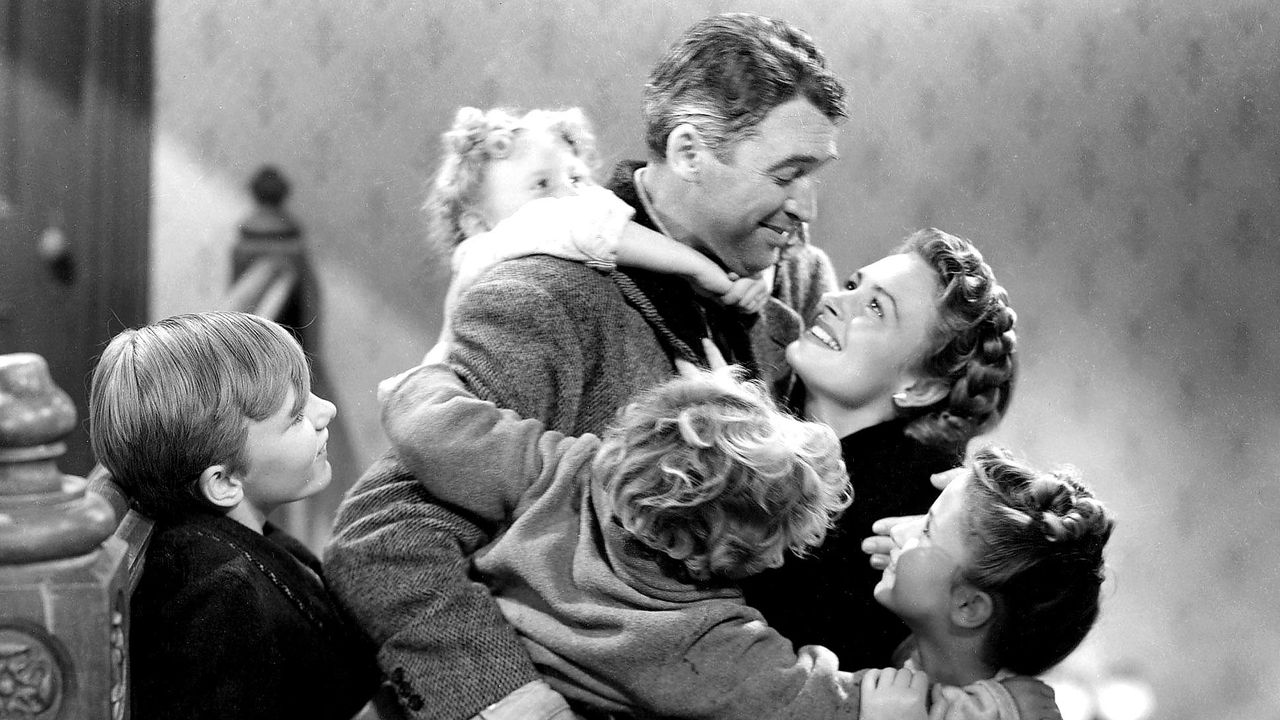
Jimmy Stewart as George Bailey, Donna Reed as Mary Bailey, and their four kids in Frank Capra’s 1946 film, It’s a Wonderful Life.
Frank Capra’s It’s a Wonderful Life isn’t just the most beloved holiday movie of all time. It can also fairly be described as the most quintessentially American movie ever made. Its populist message of an “everyman” hero, patriotism and sentimentality has earned it its treasured spot in annual Christmastime viewing for multiple generations. [Note: In the unlikely event a reader has not seen the film classic, this story contains spoilers.]
The 1946 film stars James Stewart as George Bailey, a banker in the fictional town of Bedford Falls, N.Y., husband to Donna Reed’s Mary Hatch, and father to four children: Pete, Janie, Zuzu and Tommy. Stewart, 38 years old when filming was completed, was already a significant star with an Academy Award nomination for his titular role in 1939’s Mr. Smith Goes to Washington, followed by an Oscar-winning performance for Best Actor in 1940’s The Philadelphia Story. His career then took a significant pause when he became the first major American movie star to enlist in the U.S. Army to fight in World War II. Stewart trained pilots, was ultimately promoted to colonel and was awarded the Distinguished Flying Cross.
Though not the first choice as “Mary,” it’s difficult to imagine anyone else but the then-25-year-old Reed in that role. Capra’s camera often lingers on her girl-next-door looks. And although Jean Arthur, Olivia de Havilland and Ginger Rogers are said to be among the actresses considered for the role, Reed was a perfect choice.
Capra was one of the film industry’s most preeminent directors when he was hired, having dominated the Academy Awards during the ’30s with three wins among five nominations. It’s a Wonderful Life was a reunion for the director and its leading actor, who had previously teamed on 1938’s You Can’t Take It With You and would meet again for the following year’s Mr. Smith Goes to Washington.
It’s a Wonderful Life, from RKO Radio Pictures, earned five Academy Award nominations, including Best Picture, Best Director and Best Director, but it was shut out in all categories. [The studio was awarded a Technical Achievement Award for special effects.] Perhaps because of its subject matter, which includes thoughts of despair and suicide, the film was a significant flop at the box office, with both its budget and ticket revenue just north of $3 million. And though in retrospect it’s considered a classic—its Rotten Tomatoes critics rating is a robust 94% positive—that wasn’t the case upon its release, when it received mixed reviews. The New York Times noted, “The weakness of this picture, from this reviewer’s point of view, is the sentimentality of it—its illusory concept of life. Mr. Capra’s nice people are charming, his small town is a quite beguiling place and his pattern for solving problems is most optimistic and facile. But somehow, they all resemble theatrical attitudes, rather than average realities.”
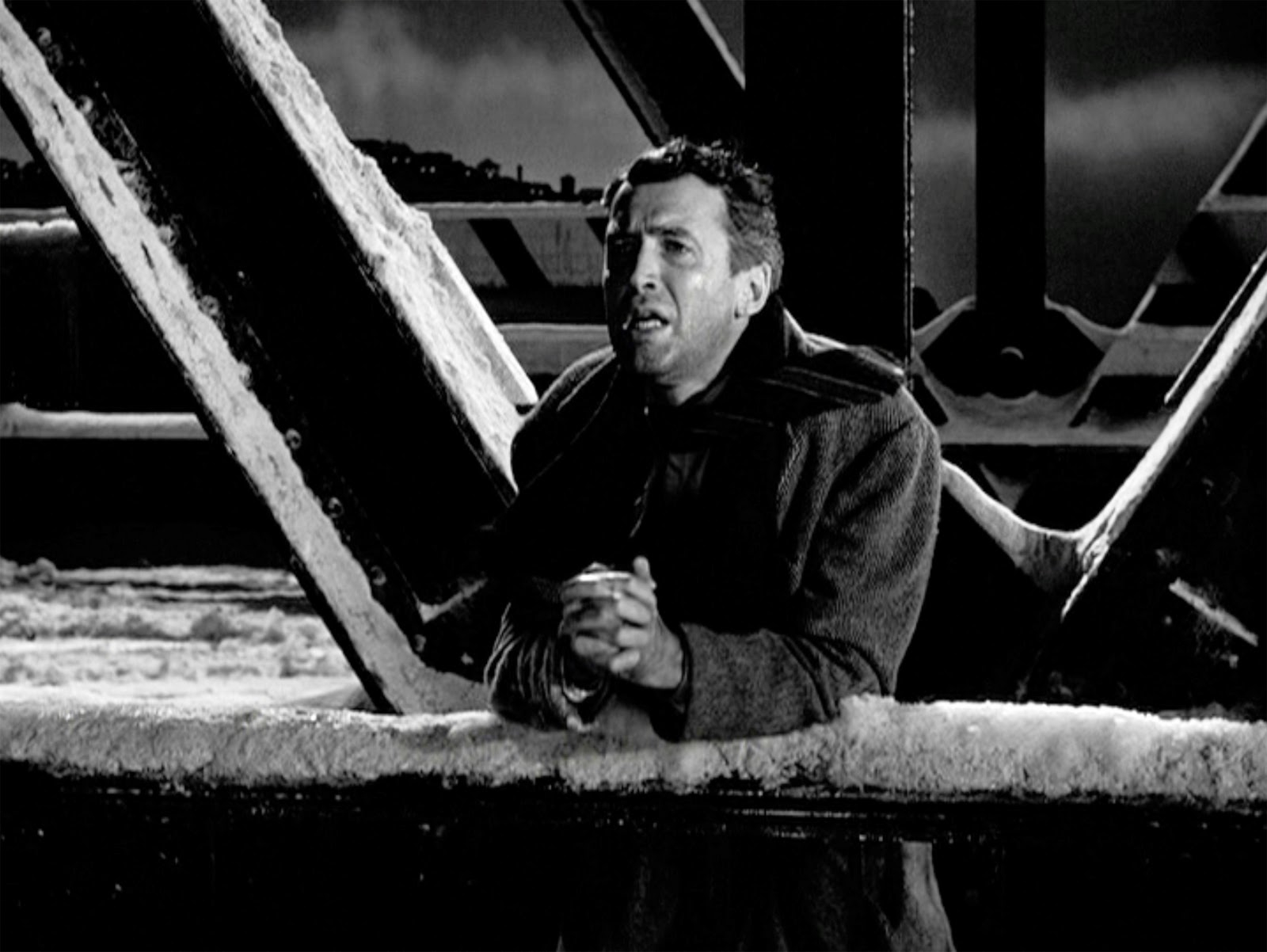
Jimmy Stewart as George Bailey, contemplating suicide.
We witness Stewart’s “everyman” role as George in his warm relationships with his family members, neighbors, other townsfolk and future wife.
George and Mary raise their four children, all the while leading “ordinary” lives doing good for others in their small town. The film’s villain, Mr. Potter, is expertly played by Lionel Barrymore.
On Christmas eve 1945, George faces financial ruin and contemplates suicide when his family-owned bank, Bailey Bros. Building & Loan Association, comes head-on with a run of withdrawals that would force the institution to close. His prayers are heard and a guardian angel second class, Clarence, is assigned to him.
Through a series of flashbacks, George sees that he has done far more in his life to help others than he gives himself credit for.
The film reaches its apex when Clarence offers him “a chance to see what the world would be without you.” And so George sees first-hand what would become of the town—in which he has held a pivotal role as a community leader—if he never existed.
The movie’s final scene is about as heartwarming as it gets.
It’s a Wonderful Life was recognized by the American Film Institute as one of the 100 best American films ever made. It’s available to stream or purchase in the U.S. here, in Canada here and in the U.K. here.
On a personal note, the film was the holiday favorite of my wife, Leigh Anne, and we would watch it during its annual pre-Christmas airing on NBC. Over the years, the screenings evolved to a mother-son viewing with Leigh Anne and her “Danny boy,” first as a teenager, then as a young adult, and beyond. I’d realize the movie had ended when the two of them would come into whatever room I was in with their eyes filled with tears.
Leigh Anne was the embodiment of Donna Reed’s good-hearted Mary, preparing a meal for a neighbor who was in the midst of a tough time, never missing one of our kids’ games and school events, and mentoring scores of people during her highly decorated career. After a long illness, Leigh Anne was taken from us on October 3, 2025. I closed our family’s eulogy at her funeral with the words, “It’s a wonderful life.” I dedicate this feature story in her memory. She is missed by all who knew her.
In order to close with something lighthearted, here’s a sketch called “The Lost Ending” that Saturday Night Live did in 1986, with Dana Carvey as George and Jan Hooks as Mary, with appearances by fellow cast members Dennis Miller, Phil Hartman, Jon Lovitz and more.
And, of course, The Simpsons couldn’t resist taking a poke.

- It’s a Wonderful Life: An Appreciation - 12/27/2025
- Let’s Dance: 12 Disco Songs By Classic Rock Stars - 12/21/2025
- 10 (More) Big Rock Acts Without a Top 10 U.S. Single - 12/19/2025




No Comments so far
Jump into a conversationNo Comments Yet!
You can be the one to start a conversation.