
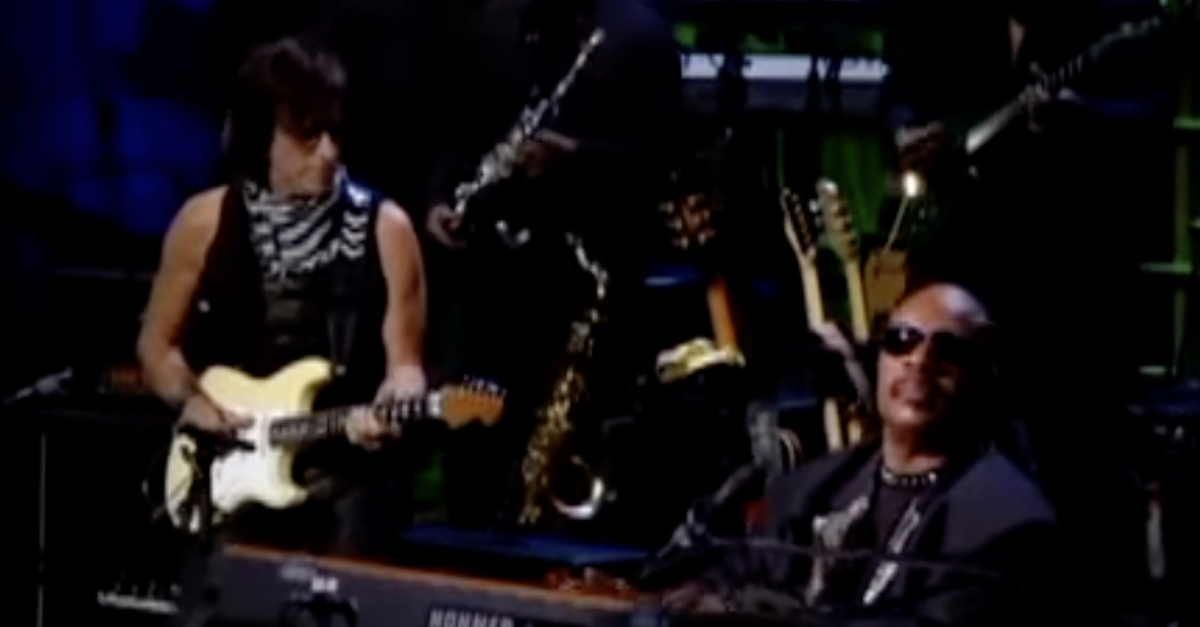
Jeff Beck and Stevie Wonder performing at the Rock & Roll Hall of Fame induction ceremony in 2009.
Sometimes the most memorable moments on classic recordings come from an unexpected collaborator. Eric Clapton‘s guitar solo on the Beatles’ “While My Guitar Gently Weeps” is perhaps the best known, while Eddie Van Halen‘s scorching solo on Michael Jackson’s “Beat It” is one of the most notable cross-genre collaborations of all time.
There are, of course, countless other examples of musicians’ guest appearances that are not as historic. Sometimes a mate popped into the studio, or a producer called up a safe pair of hands, and occasionally a future superstar was still a session player.
Some of these collaborations were planned, others happened almost by accident but each one left its own distinctive imprint on a classic recording.
Cat Stevens—“Morning Has Broken” Guest: Rick Wakeman (piano)
One of the early ’70s’ most famous piano parts was by keyboardist Rick Wakeman, who had done many sessions and was in the process of departing Strawbs. His graceful piano playing on this hit single from 1971’s Teaser and the Firecat turned the ancient hymn into a pop standard and led Wakeman to greater global superstardom as Yes’ keyboard wizard.
[Stevens’ classic albums, including a deluxe 2025 hits collection, are available in the U.S. here, in Canada here and in the U.K. here.]
Paul McCartney—“No More Lonely Nights” Guest: David Gilmour (guitar)
The 1984 track, recorded at Abbey Road Studios, was released on McCartney‘s fifth solo studio album, Give My Regards to Broad Street. The Pink Floyd star’s glorious solos and fills give the song more character than one might find in the average power ballad.
Stevie Wonder—“Lookin’ for Another Pure Love” Guest: Jeff Beck (guitar)
Producers Robert Margouleff and Malcolm Cecil, both of whom were involved in early modular synthesizers, worked alongside the Wonder man and encouraged Stevie to bring in Beck to play guitar on the album Talking Book. The pair had originally workshopped together on “Superstition,” but Wonder ultimately used his own version, which went on to become a significant hit, reaching #1 and winning a Grammy Award. (Beck later recorded it for 1973’s Beck, Bogert & Appice LP.) Beck’s guest spot on “Lookin’ for Another Pure Love” is an excellent snapshot of their fleeting collaboration.
Related: 10 cool classic rock/soul songs
The Rolling Stones—“Sister Morphine” Guest: Ry Cooder (slide guitar)
The chilling slide guitar on this track from 1971’s Sticky Fingers comes courtesy of Ry Cooder, who had already played with the Stones on Let It Bleed at just 22 years old. Cooder also performed on Marianne Faithfull’s original recording of the song, which she had written with Mick Jagger and Keith Richards. His ambient slide guitar is also what makes the Stones’ version so unsettling.
The Beatles—“Revolution” Guest: Nicky Hopkins (electric piano)
The session keyboard ace unleashes a driving electric piano assault on the 1968, high-powered distortion-heavy take of the classic, which was very different than the more gentle take that was used on The Beatles (aka The White Album). This version is one of the group‘s loudest numbers.
Badfinger—“Day After Day” Guest: George Harrison (guitar)
Harrison produced the song for Badfinger‘s 1971 album Straight Up for the Beatles’ Apple label and also played slide guitar on the track. His playing meshed well with the band’s vocal arrangements and helped make the tune a worldwide hit.
Lou Reed—“Satellite of Love” Guest: David Bowie (backing vocals)
The song comes from Reed‘s 1972 classic LP Transformer, which Bowie produced with Mick Ronson. “Ziggy” sang harmony on this track, and as his voice comes into the epic chorus, and with the backing vocals, a little of that stage-y drama creeps in.
Donovan—“Sunshine Superman” Guests: Jimmy Page (guitar) and John Paul Jones (bass)
Before Led Zeppelin came together, Page and Jones were some of the most sought-after session musicians in London. Jones, who would be an arranger on several Donovan sessions produced by Mickie Most, is on electric bass. Page used his volume knob as part of a loop-based idea for the guitar riff in the verses. (Recorded on Dec. 19, 1965, The Guardian newspaper says the song “has a claim to be the first psychedelic rock record ever recorded.”)
Christopher Cross—”Ride Like the Wind” Guest: Michael McDonald (backing vocals)
The Doobie Brothers’ singer, songwriter and keyboardist was white hot when he was enlisted by the band’s label, Warner Bros., to add his signature vocal on the chorus of the company’s newest artist’s 1979 self-titled debut. His distinctive, soulful harmonies added an extra oomph to the track, the album’s debut single, which reached #2 on the Hot 100. It led to Cross earning Best New Artist at the Grammy Awards as well as a surprising win for Album of the Year. [An expanded edition is available here.]
Warren Zevon—“Excitable Boy” Guest: Linda Ronstadt (backing vocals)
The Lovely Linda adds some timely backing vocals on the title song from the 1978 album with her high-pitched harmonies offsetting Zevon‘s dark humor. At the time, she was one of the most successful recording artists and it happened at roughly the same time that she recorded his “Poor Poor Pitiful Me” for her own album release.
Chicago—“Wishing You Were Here” Guests: Carl Wilson, Dennis Wilson and Al Jardine (backing vocals)
The Beach Boys’ trio provided their signature harmonies and California sound to this breezy song from 1974’s Chicago VII, recorded at the famed Caribou Ranch recording studio in Colorado. The two All-American music groups continued their relationship into 1975, when they teamed up for the “Beachago” tour, with the two bands sharing the stage to performe “Wishing You Were Here” and “Feelin’ Stronger Every Day” together.
Tom Petty—“Walls (Circus)” Guest: Lindsey Buckingham (backing vocals)
This one, from the 1996 soundtrack album, Songs and Music from She‘s the One, benefited from Buckingham‘s gorgeous layers of harmony. An overlooked, but stunning piece of work.

6 Comments so far
Jump into a conversationLeon Russell played the piano on Badfinger’s Day After Day and other instruments elsewhere on the Straight Up Lp
Much of Al Stewart’s music has great performances from guest musicians, Wakeman, Page, Roger Taylor to name just a few. One the best songwriters. I encourage everyone to check out his music
How could you leave out Carly Simon’s You’re So Vain, with Mick Jagger’s great assist on the hook?
G.D. Praetorius
Many readers are asking about Carly and Mick on “You’re So Vain.” We felt that it fell into the Clapton on “While My Guitar…” category.
Having noted that, a Part 2 of this story feels necessary.
Money For Nothing, Dire Straits….Sting
On the 1982 Elton John album “Jump Up!”, listen to the song “Ball and Chain.” It features Pete Townshend on acoustic guitar. You can tell it’s him and it jumps off the track (no pun intended).
Thanks for the article